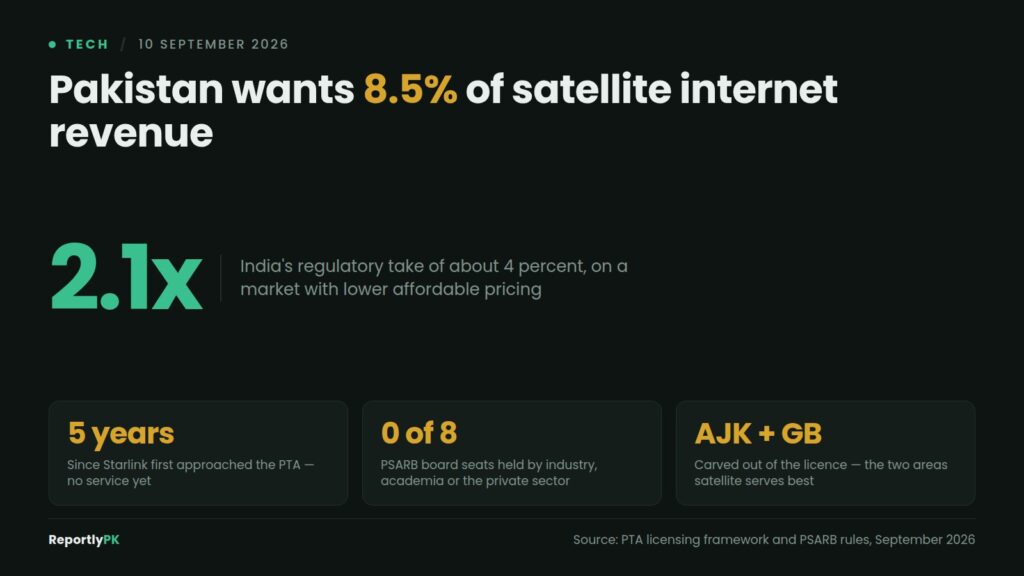
Pakistan satellite internet licensing now carries a regulatory take of roughly 8.5 percent of gross revenue. India takes about 4 percent. Bangladesh takes between 3 and 5.5 percent. At least four operators — Starlink, Amazon’s Kuiper, China’s Qianfan and one other — are waiting on licences, and none of them is selling a connection in Pakistan yet.
Starlink first approached the Pakistan Telecommunication Authority in December 2021. Nearly five years later the licensing category exists, the rules exist, and the service does not.
What the licence actually costs
The PTA finalised its licensing framework in April 2026, creating satellite broadband as a distinct category. The financial obligations attached to it stack in three layers:
- $500,000 one-time licence fee
- 2.5 percent of gross revenue in annual recurring charges
- 6 percent levy for the Strategic Plans Division research fund
The one-time fee is not the issue. Half a million dollars is a rounding error against a satellite constellation’s capital cost. The recurring 8.5 percent is the number that decides whether the business works, because it is levied on revenue rather than profit — it is charged in full during the years when an operator is still building out and losing money.
The comparison operators will actually run
A global constellation operator allocates capacity market by market. It compares the revenue per subscriber it can charge against the cost of serving that market, and regulatory take sits on the cost side.
Pakistan’s 8.5 percent is roughly 2.1 times India’s rate, in a market with lower average incomes and therefore lower affordable pricing. That combination — a higher levy on a thinner revenue base — is the argument against Pakistan in any capacity allocation meeting, and it is an argument the operators will make quietly rather than publicly.
There is a defence of the levy. The 6 percent research contribution funds domestic space capability rather than disappearing into general revenue, and a country that has spent decades importing every layer of its connectivity stack has a reasonable interest in building some of it. Whether a tax on foreign satellite subscriptions is the efficient way to fund that is a separate question, and it has not been argued in public.
What operators must build before selling anything
The non-financial conditions are substantial and, for the most part, not unusual. Licensees must incorporate locally, build a gateway earth station on Pakistani soil within 18 months, route all domestic traffic through it, keep user data in-country, and have live lawful interception capability operating before launch.
Industry sources indicate broad willingness to meet these. Gateways, data localisation and interception are conditions operators already accept in many jurisdictions. The friction is elsewhere.
The carve-out that undoes the use case
The licence permits broadband, backhaul, bandwidth provision and corporate intranet services. It explicitly excludes direct-to-device service, mobile satellite service, earth stations in motion and broadcasting.
More significantly, Azad Jammu and Kashmir and Gilgit-Baltistan are carved out of the licensed service areas altogether.
Those two territories are the clearest commercial case for satellite broadband anywhere in the country. They are mountainous, sparsely populated, expensive to reach with fibre and repeatedly cut off by terrain and weather — exactly the conditions under which a satellite terminal beats a trench. Excluding them, along with direct-to-device service, removes both the connectivity-of-last-resort use case and the emergency use case at once. What remains is a premium broadband product competing against terrestrial fibre in places that already have terrestrial fibre.
Who decides, and who competes
The Pakistan Space Activities Regulatory Board was constituted under rules framed in February 2024, following the National Space Policy of December 2023. Its board has eight seats. Five sit with the security and space establishment, including three Suparco officials and one co-opted intelligence representative. Two go to civilian ministries. None is held by the private sector, academia or the telecom industry.
Suparco also runs PSARB’s secretariat, operates PAKSAT, and holds first right of refusal on government connectivity requirements. It is therefore administering the body that licenses its own commercial competitors.
That is a structural conflict rather than an allegation about conduct, and structural conflicts are usually managed by disclosure and recusal rules. Whether PSARB has any is not on the public record.
The document nobody will sign
The remaining obstacle is the detailed regulatory framework itself. A set of recommendations prepared by the London consultancy Access Partnership has, by industry accounts, stalled without a decision.
This is the recurring shape of Pakistani technology policy: the licence category is created, the fee schedule is published, the security requirements are specified, and then the operational document that would let anyone actually switch a service on sits unsigned. Five years after the first approach, four operators are still waiting, and the country’s least connected districts have been written out of the licence in the meantime.
Related: Pakistan’s Telecom Bill Died on a 90-Day Clock. The Fix Restores the Rule It Was Meant to Replace.