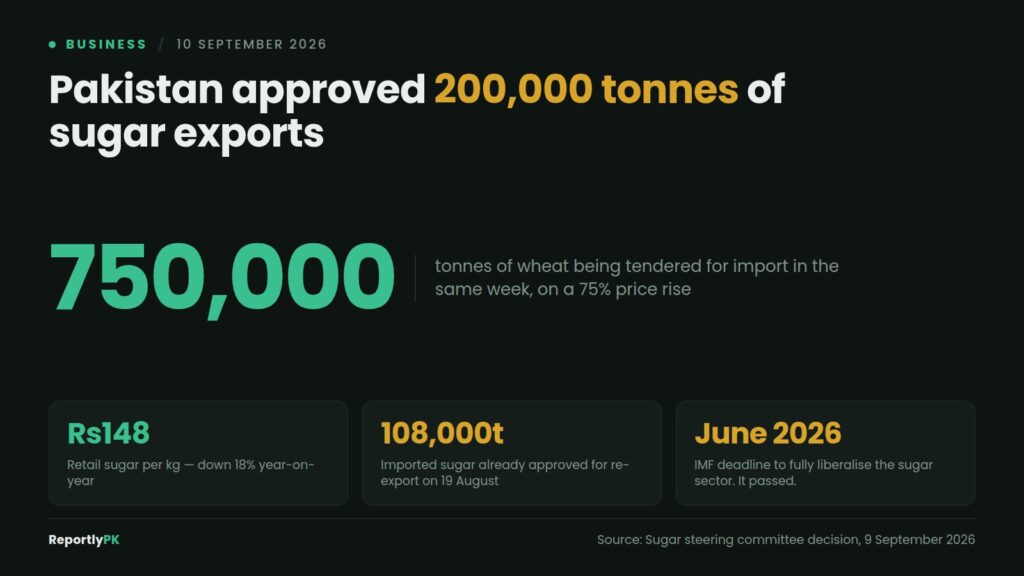
A sugar export approval covering 200,000 tonnes was cleared on 9 September by the sugar steering committee chaired by Deputy Prime Minister Ishaq Dar, subject to a summary going to the Economic Coordination Committee. It is the second export authorisation in three weeks. In the same week, the government floated a tender to import 750,000 tonnes of wheat.
Two staples, opposite directions, one week. The sugar decision is better supported by the current data than the last one was. The wheat decision is the more revealing of the two.
What has now been approved
The running total is 308,000 tonnes across two tranches:
- 19 August — ECC approved the export of 108,000 tonnes of imported sugar, stock the country had bought from abroad and then sent back out
- 9 September — the steering committee approved a further 200,000 tonnes, pending ECC sign-off
Officials put the surplus at over 600,000 tonnes after meeting domestic requirements through the next crushing season. On that basis the approved volume is a little over half the available surplus — a deliberately partial release rather than an open tap, which is the more defensible way to run this.
The surplus number moved
Two days before the approval, the Pakistan Sugar Mills Association was putting the surplus at roughly 1 million tonnes. The government’s working figure is over 600,000 tonnes.
The gap is around 400,000 tonnes — not a rounding difference, and larger than the entire volume being approved. Neither side has published the consumption assumption that produces its number. The government’s figure being the lower of the two, and the approved export being sized against the lower figure, is the conservative outcome. But an industry estimate and an official estimate that differ by 40 percent on the same commodity in the same week is not a settled fact base.
The price backdrop is genuinely different
The obvious objection to any sugar export approval in Pakistan is the 2024-25 cycle, when roughly 765,000 tonnes went out, retail moved from about Rs140 to a record Rs190 per kilogramme, and the government ended up authorising 750,000 tonnes of imports to refill the shelves.
The current numbers do not support that analogy as cleanly. Sugar is retailing at an average of Rs148 per kilogramme, 18 percent below where it stood a year ago. Prices are falling into this decision, not rising out of it. A market that has already given back most of the 2025 spike has more room to absorb an export tranche than one trading at a record.
That is the strongest argument for the approval, and it deserves stating plainly rather than being buried under the precedent.
Wheat is moving the other way
The wheat tender is the harder number. Pakistan is buying 750,000 tonnes from abroad because domestic prices have risen by more than 75 percent.
Wheat and sugarcane compete for the same irrigated acreage in Punjab and Sindh. When the sugar sector is supported through export permissions, guaranteed cane procurement prices and mill-level liquidity interventions while the wheat market is left to a price signal that has run up 75 percent, growers respond to that. The relative returns are the policy, whatever the stated intent.
A country importing three-quarters of a million tonnes of its staple grain while exporting a discretionary sweetener is not necessarily making an error — comparative advantage does not respect national sentiment. But it is a result of the incentive structure, and nobody appears to be treating the two decisions as connected.
The IMF wants this committee gone
The sharpest point in the file is one the announcement does not address. Under its programme conditions, Pakistan was to have achieved full liberalisation of the sugar sector by June 2026. That deadline has passed. The commitment is due for review during the IMF’s visit this month.
Liberalisation means the market decides how much sugar leaves the country, at what price, without a summary going to the ECC. What actually happened in August and September is a steering committee releasing export volumes tranche by tranche under ministerial chairmanship. That is not a partially liberalised sugar sector. It is the administered model, operating normally, three months past the date it was supposed to have been dismantled.
The mechanism nobody has described
The steering committee also decided to develop a mechanism ensuring domestic prices do not rise despite the export. No mechanism was specified.
A workable one is not hard to write down: a retail trigger price at which shipments halt automatically, a minimum strategic stock the exporter must leave behind, and published weekly stock and price data so the trigger can be seen approaching. An equivalent undertaking was given in 2025 and retail still reached Rs190.
The falling price means there is time to build one properly this time. Whether that gets done before the ECC signs the summary is the thing worth watching.
Related: Sugar Mills Want to Export 1 Million Tonnes. Last Time Pakistan Did That, It Imported 750,000 Back.