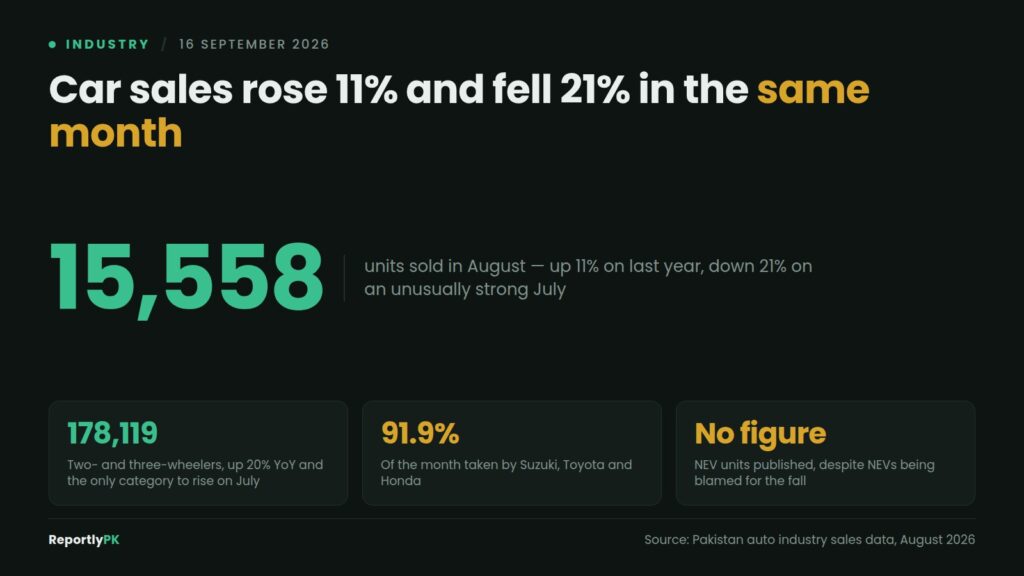
Pakistan car sales reached 15,558 units in August — up 11 percent on August last year and down 21 percent on July. Both numbers are true, they are being reported as though only one of them is, and the industry’s explanation for the second is the more interesting half of the release.
Which number is the trend
A 21 percent monthly fall implies July ran at roughly 19,700 units, which was an unusually strong month. Pakistani auto sales swing hard on delivery timing, model launches and buyers pulling purchases forward ahead of expected price changes — and there were expected price changes, because the sales tax on hybrids moved twice this quarter.
The year-on-year comparison is the one that carries information. Up 11 percent against the same month last year, with two- and three-wheelers up 20 percent and trucks and buses up 31 percent, describes a market that is growing. August was a soft month inside a recovering year, not the start of a decline.
Who sold what
- Pak Suzuki — 7,633 units, up 7 percent year-on-year, down 25 percent on July
- Indus Motor (Toyota) — 4,029 units, up 19 percent year-on-year, down 21 percent on July
- Honda Atlas — 2,633 units, up year-on-year, flat on July
Those three account for 91.9 percent of the month, with Suzuki alone at 49.1 percent. Toyota’s Corolla, Yaris and Cross together rose 21 percent year-on-year to 3,079 units, and Fortuner and IMV sales were up 12 percent. Sazgar Engineering’s figures were unavailable, so the totals understate the market slightly.
Honda being flat month-on-month while its two larger competitors fell 21 and 25 percent is the anomaly in the table. No explanation was offered and it is worth watching, because a firm that does not participate in a sector-wide monthly drop is either running a different order book or clearing different inventory.
The industry names its own problem
The association attributed August to three things: uncertainty surrounding the new auto policy, an uncertain regional atmosphere affecting the supply chain, and competition from new energy vehicles.
The first of those is worth quoting back. Sales tax on locally manufactured hybrids up to 2000cc sat in the region of 8 to 13 percent until 30 June, jumped to 25 percent on 1 July, and was cut to 18 percent on 13 September. Three rates in seventy-five days.
A buyer who believes the price of a car may fall next month does not buy it this month. That is not a demand problem and it is not a supply problem. It is a policy that moved twice inside a quarter, and the August number is partly the cost of it.
NEVs without a denominator
The NEV explanation deserves more scrutiny than it will get, for two reasons.
The first is that no NEV unit figures appear anywhere in the release. The association reports its members’ sales, and a significant part of the NEV segment sits outside that membership. So the claim that new energy vehicles took share in August is made without the number that would let anyone test it. It may well be true. It is currently unfalsifiable.
The second is that if NEVs are winning share, the tax code is the reason. New energy vehicles carry a flat 1 percent sales tax. A locally manufactured hybrid pays 18 percent — eighteen times as much — and a conventional car pays the full rate. A buyer comparing sticker prices across those three categories is reading a policy preference, not a technology preference.
Describing that as competition is accurate but incomplete. The state decided this outcome and wrote it into the schedule. The assemblers are reporting the result as a market development.
The segment that did not fall
Two- and three-wheelers sold 178,119 units in August, up 20 percent year-on-year and up 3 percent on July. They were the only major category to rise month-on-month.
That is 11.4 motorcycles and rickshaws for every car sold in the country, and it is a better description of Pakistani mobility than any car number. Those buyers are also precisely the group the Rs75 billion fuel relief scheme targets, at Rs100 a litre on a 20-litre monthly quota — about Rs2,000 a month, arriving now.
Trucks and buses at 875 units, up 31 percent year-on-year, point the same way on industrial freight demand. The base is small enough that the percentage flatters it — the increase is roughly 207 vehicles — but the direction is right.
What to watch
September will be the cleaner read, because the hybrid rate settled on the 13th and buyers who deferred in August now know what they are paying. If September recovers most of the monthly drop, August was deferral. If it does not, the NEV argument gets stronger.
The more useful reform costs nothing. Publish NEV registrations alongside member sales in the same release. Until somebody does, the industry can attribute any weak month to a competitor nobody is required to count.
Related: Pakistan’s Hybrid Car Tax Has Had Three Rates in 75 Days. Nobody Builds a Plant on That.