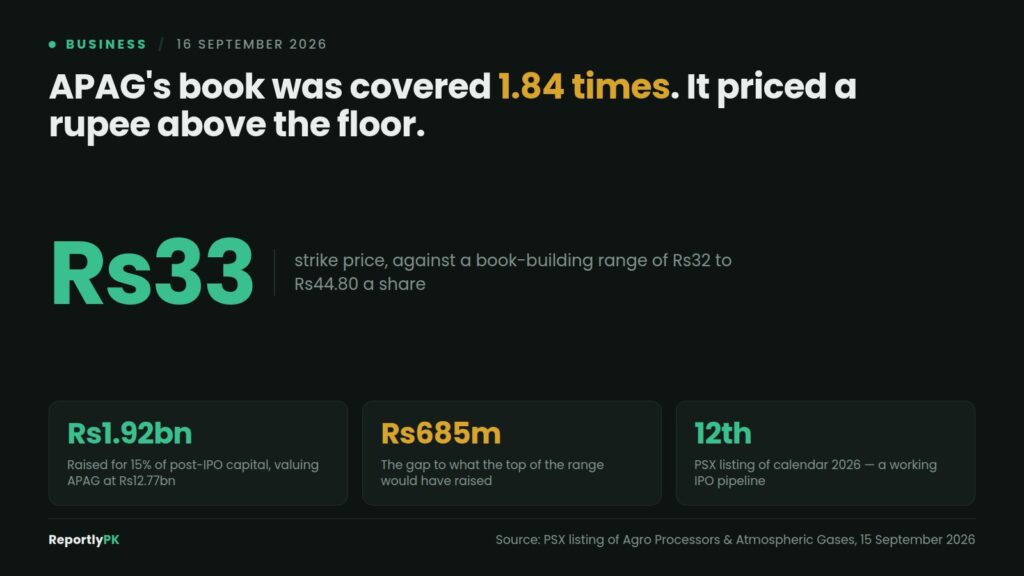
The APAG PSX listing on 15 September raised about Rs1.92 billion for Agro Processors & Atmospheric Gases Limited, the maker of Soya Supreme. The book was covered 1.84 times. The strike price came in at Rs33 — one rupee above the floor of a Rs32 to Rs44.80 range.
Those two facts are usually reported as though they point the same way. They do not.
What was sold
APAG offered 58.049 million ordinary shares, 15 percent of its post-IPO capital. Of those, 43.537 million went through the book-building process and the remainder to retail investors. Book-building was oversubscribed 1.84 times and the retail portion 1.83 times.
Work backwards from the float and the company is valued at Rs12.77 billion — 58.049 million shares at 15 percent implies roughly 387 million shares outstanding, priced at Rs33.
The business is a 45-year-old edible oils and foods portfolio: Soya Supreme cooking oil and olive oil, Taqat margarine, Supremo, Malta and Smart Sauces. This was the twelfth PSX listing of calendar 2026 and the fourth of the current fiscal year.
Oversubscription is a volume number, not a price
A book covered 1.84 times means bids arrived for 1.84 times the shares available. It says nothing about what those bids were willing to pay.
In a Dutch auction the strike settles where enough demand clears the book. Settling at Rs33 against a ceiling of Rs44.80 means the bids clustered at the bottom. Institutions turned up, looked at the valuation, and put their money in at close to the lowest price the company said it would accept.
Read together, the two numbers describe a deal with plenty of interest and very little conviction on value. Coverage was never the constraint. Price was.
Rs685 million left unraised
The top of the range was Rs44.80. At that price the same 58.049 million shares would have raised about Rs2.60 billion.
The difference is roughly Rs685 million — 26 percent of the maximum the offer was structured to achieve. That gap is not a loss in any accounting sense; nobody was entitled to the ceiling. It is a measure of the distance between what the company hoped the market would pay and what it actually paid.
There is a real argument on the other side, and it is the one bankers make. A deal priced at the top of its range frequently breaks issue in the first week, which damages the shareholder register, sours retail investors and makes the next raise harder. Pricing conservatively leaves room for the stock to perform and buys goodwill with the people who will be asked to fund the follow-on. On that reading Rs33 is discipline rather than weakness.
Which reading is correct will be settled by the share price over the coming months, not by the press release.
A 15 percent float is thin
Fifteen percent is a small free float, and small floats have consequences that outlast the listing day.
Thin floats trade thinly. Modest buying or selling moves the price disproportionately, index inclusion becomes harder, and institutional investors who need to be able to exit a position size it down accordingly. It also means 85 percent of the company stays with the existing owners, so the listing is less a change of control than a partial monetisation and a public valuation benchmark.
None of that is unusual on the PSX, where family-controlled groups list minority stakes routinely. It is worth saying plainly because a low float is part of why Pakistani listings price cautiously in the first place.
The market it listed into
Timing deserves weight here. APAG came to market in a week when the KSE-100 was swinging by four-figure margins on Middle East tensions and a crude price above $100, with the State Bank holding rates at 11.5 percent and flagging oil as the main upside risk to inflation.
That backdrop punishes valuation, particularly for a consumer business whose principal raw material is imported and therefore priced in dollars. Getting a book covered at all in that tape is a result. The floor pricing may say more about the week than about APAG.
What to watch
Twelve listings in a calendar year is a genuinely healthier primary market than Pakistan has had for most of the past decade, and that is the story underneath this one. A functioning IPO pipeline is how companies fund expansion without bank debt at an 11.5 percent policy rate.
The tests for APAG specifically are whether the stock holds above Rs33, whether daily volumes justify the float, and what the company does with Rs1.92 billion. A raise that funds capacity or brand expansion into new markets is worth the discount it was priced at. A raise that refinances existing debt is a more expensive way to do what a bank would have done.
Related: Stocks Fell 1,690 Points. The Banks Led It, and That Is the Signal.