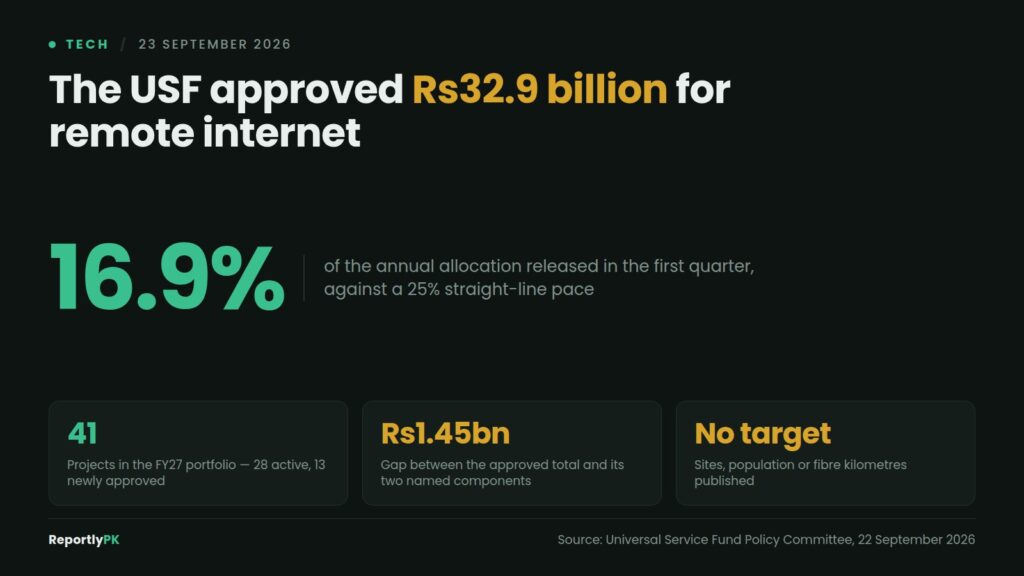
USF remote internet funding for FY2026-27 has been set at Rs32.90 billion. The Universal Service Fund Policy Committee, chaired by IT Minister Shaza Fatima Khawaja, approved the allocation and released Rs5.57 billion as the first-quarter tranche.
This is the correct answer to the problem the regulator documented two days ago. It is also a budget line, and Pakistan’s record on this particular budget line is the reason to read the disbursement figure rather than the approval figure.
What was approved
- Rs24.89 billion for ongoing projects
- Rs6.56 billion for new initiatives
- 28 projects currently active — 17 Next Generation Broadband Service Delivery, 11 Next Generation Optical Fiber Network Services
- 13 new projects approved — nine mobile broadband, four optical fibre
That makes 41 projects in the portfolio for the year, or roughly Rs802 million each if the money were spread evenly, which it will not be. USF chief executive Mudassar Naveed briefed the committee on priorities.
The Rs1.45 billion nobody accounted for
Add the two published components. Rs24.89 billion plus Rs6.56 billion is Rs31.45 billion. The approved total is Rs32.90 billion.
The Rs1.45 billion difference is not explained anywhere in the announcement. It is plausibly administration, monitoring and evaluation, or a contingency reserve, and any of those would be legitimate. At 4.4 percent of the total it is not a rounding error, and a fund that exists to close an information gap should not be creating one in its own press release.
Released is not the same as approved
The Rs5.57 billion first-quarter release is 16.9 percent of the annual allocation. A straight-line quarter would be 25 percent.
There is an innocent reading. Telecom infrastructure spending is lumpy — contracts get awarded, equipment gets ordered, and money moves in blocks rather than smoothly. A light first quarter followed by heavy disbursement later is normal in this sector.
The less innocent reading is that the Universal Service Fund’s recurring criticism has never been that it is allocated too little. It is that approved money sits undisbursed while the areas it was collected for stay unserved. The fund is financed by contributions from telecom licensees rather than from general revenue, which means an accumulating unspent balance is money taken out of the industry that has not become a tower or a strand of fibre.
Sixteen point nine percent in the first quarter does not prove that is happening again. It is the number to watch in January.
Fibre is the ratio that matters
Of 28 active projects, 11 are optical fibre and 17 are mobile broadband. Of the 13 new ones, four are fibre and nine are mobile.
Mobile broadband delivers a visible result faster — a tower goes up and people get signal. But a tower without fibre backhaul is a bottleneck with an antenna on top, and the latency and speed failures the PTA measured in Astore this week are precisely what insufficient backhaul looks like from a handset.
Fibre is the durable asset. It carries every generation of mobile technology that comes after the one being installed, and it is the part that does not need replacing when 5G arrives in a valley. Weighting new approvals nine to four toward mobile is a decision to buy coverage now rather than capacity later, which is defensible politically and expensive technically.
This is the right answer to Astore
Two days ago the PTA published a quality of service survey finding 1,788 milliseconds of latency and a 13.4-second webpage load for one operator in Astore. The commercial logic behind that is straightforward: a site serving a few hundred subscribers in difficult terrain does not repay its capital at Pakistani revenue per user.
A universal service fund exists to break exactly that calculation, and Rs32.90 billion aimed at it is the correct instrument. Credit where it is due.
What sits awkwardly beside it is the other half of the connectivity file. Pakistan’s satellite broadband licence, finalised in April, excludes Azad Jammu and Kashmir and Gilgit-Baltistan from the licensed service area. Satellite has no per-site economics to break — that is the entire point of it. So the state is committing Rs32.9 billion of operator levy money to build towers in places it has simultaneously barred the one technology that needs no towers.
Both policies can be defended individually. Together they mean the taxpayer, or more precisely the telecom subscriber, is paying for the more expensive of two available solutions.
What was not published
No coverage target accompanied the allocation. Not the number of sites, not the population to be covered, not the kilometres of fibre to be laid, not the districts named, not a completion date for any of the 41 projects.
Without those, Rs32.90 billion cannot be assessed as value for money by anyone outside the committee that approved it. A fund whose purpose is to reduce a measurable gap should publish the measurement it intends to move, and then publish it again a year later.