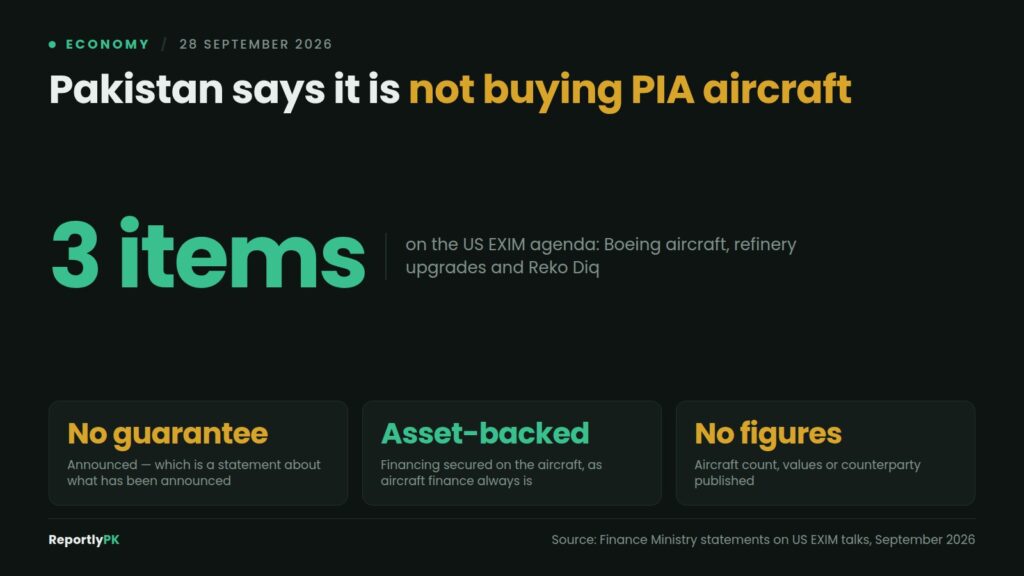
The PIA Boeing financing question surfaced in Washington this week and was denied before it was announced. Finance Minister Muhammad Aurangzeb‘s talks with the US Export-Import Bank covered Boeing aircraft for a privatised PIA, refinery upgrades and the Reko Diq copper and gold project.
Within a day his adviser Khurram Schehzad was clarifying on social media that the government is helping PIA access financing and suppliers but is not buying aircraft, and that no sovereign guarantee or taxpayer-funded loan has been announced.
What was actually said
The structure described is that US EXIM could secure financing against the aircraft themselves and assess the creditworthiness of the airline or lessee, rather than rely on a government guarantee.
Read plainly, that is how commercial aircraft finance works everywhere in the world. An aeroplane is close to ideal collateral: it is mobile, it has a deep and liquid secondary market, its value is quoted by independent appraisers, and international conventions make repossession across borders more workable than for almost any other asset. Export credit agencies lend against aircraft precisely because they can take them back.
So the absence of a sovereign guarantee is not the concession the clarification implies. It is the normal arrangement.
The word doing the work is “creditworthiness”
Which moves the question to the part nobody has addressed. Asset-backed financing still requires a lessee capable of making the payments, and an export credit agency assessing a newly privatised PIA has a short file to read.
A buyer of the airline will have a balance sheet, and if that buyer stands behind the lease obligations the structure works on ordinary commercial terms. If it does not, the financing needs support from somewhere — and the candidates are a residual value guarantee, a maintenance reserve arrangement, or a government undertaking of some description.
Nothing in the public record says which of those is contemplated. “No sovereign guarantee announced” is a statement about what has been announced.
Why the denial came so fast
The speed of the clarification is itself the most informative element here.
PIA has absorbed public money for decades and its privatisation has failed once already for want of credible bidders. A government that has spent this month explaining that a Rs390 billion cap on unpaid tax refunds is an IMF commitment, and that the petroleum levy is not the centrepiece of its programme, does not want a headline about buying aircraft while an IMF mission is in the building assessing the fourth review of a $7 billion facility.
The clarification is aimed at that room as much as at the domestic audience, and it is the correct instinct. It would be more persuasive accompanied by the structure rather than the reassurance.
The other two items on the agenda
Aircraft got the attention, but the same meeting covered refinery upgrades and Reko Diq — and those are the larger numbers.
Refinery upgrading is what determines whether Pakistan keeps importing refined product at Platts-benchmarked prices or processes more crude domestically, which feeds directly into the pump prices that have moved almost daily since 17 July. Reko Diq is a copper and gold development whose export earnings, if delivered, would change the composition of a trade account currently leaning on remittances and a $3 billion Eurobond.
Export credit agency involvement in either would be more consequential than a fleet order, and neither generated a clarification because neither generated a headline.
The sequencing problem
There is a genuine difficulty underneath all of this that the government cannot easily talk its way around.
An airline with an ageing fleet is worth less to a buyer, because the buyer inherits the capital expenditure. Arranging fleet financing before the sale makes the asset more saleable. But arranging it before a buyer exists means the state is shaping commitments on behalf of an owner who has not been identified, for an airline it is trying to stop owning.
Doing it the other way round — sell first, let the new owner arrange its own aircraft — is cleaner but produces a lower price and a longer wait for new capacity.
What would settle it
Three disclosures. The number and type of aircraft under discussion, because a handful of narrowbodies and a widebody order are different propositions entirely. The counterparty — whether financing is contemplated for PIA as currently constituted or for a post-privatisation entity. And whether any contingent liability, of any form, attaches to the federal government.
That last one is the only question that actually matters to a taxpayer, and it is the one a denial phrased around what has been “announced” leaves open.
Related: The IMF Is Back for $1.2 Billion. Here Is What It Will Be Checking.