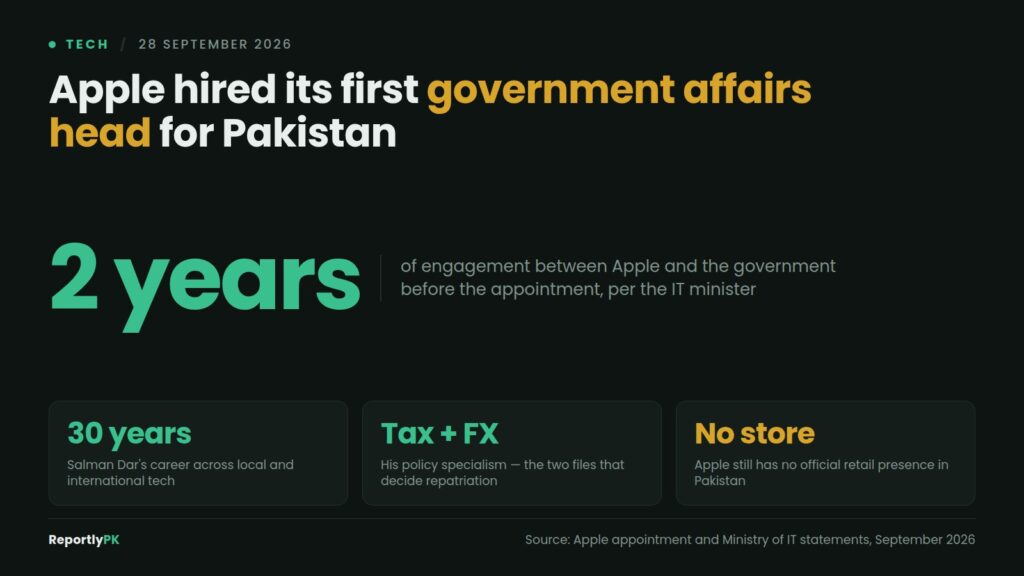
Apple has appointed Salman Dar as its first head of Apple Pakistan government affairs. It is the company’s first dedicated government relations post in the country, and it arrives before Apple has an official retail presence, an official distributor relationship of the kind it runs elsewhere, or a published launch plan.
That ordering is the story. Companies do not hire policy people to manage a market they are already operating in comfortably.
Who was hired
- Roughly 30 years across local and international technology markets
- Co-founder and chief executive of Itroos, an IT company established in 2014
- Member of the Central Executive Committee of the Pakistan Software Houses Association
- Worked specifically on taxation and foreign-currency retention policy for the sector
Federal IT Minister Shaza Fatima Khawaja has said government engagement with Apple had been running for about two years before the appointment.
The two files on his CV are the two that matter
Taxation and foreign-currency retention are not a generic policy background. They are the two questions that determine whether a multinational can operate profitably in Pakistan and take its earnings out again.
Pakistan has periodically restricted profit repatriation when reserves came under pressure, and several multinationals have had dividends stuck in rupees for extended periods. No company commits to a formal market presence without certainty on that point, and no amount of consumer demand substitutes for it.
Hiring somebody whose professional expertise is precisely those two files tells you what the conversation with Islamabad is about. It is not about marketing.
Services first, hardware later
What Apple has actually done in Pakistan recently is instructive. Shortly after the appointment, Apple TV and Apple Arcade were rolled out at no extra cost to iCloud+ subscribers in the country. Separately, Y Mobile opened an Apple Authorized Reseller flagship at Ocean Mall in Karachi alongside a new Bahadurabad location.
Services are the low-risk first move. They need no import regime, no customs valuation, no warranty and service network, and no physical inventory sitting in a bonded warehouse. What they need is a payments rail that works and a settled tax position on digital supply — and the second of those has just become a live subject, with the FBR notifying a procedure for taxing platform-derived income five days ago.
Authorised resellers are the next rung. They put Apple branding and a service counter in a Pakistani mall without Apple itself taking on the importer’s tax and customs exposure.
What formalising would change
A meaningful share of iPhones in Pakistan arrive through unofficial channels and personal imports, registered afterwards through the PTA’s device identification system. Those units generate duty at the point of registration and very little else — no local warranty obligation, no domestic service employment, no channel margin taxed in Pakistan.
An official presence moves that volume into the formal economy, which is presumably a large part of why the government has spent two years on the conversation. It is the same logic running through the FBR’s move on creator income and the State Bank’s push to pull remittances and freelance earnings into banking channels: the state’s priority is not creating the activity, it is seeing it.
The counterweight is price. Formal import with full duty, taxes and an official warranty structure is not obviously cheaper for the consumer than the grey channel it replaces, and Pakistani buyers of premium devices are price-sensitive in ways Apple’s usual markets are not.
The environment he is walking into
September alone produced four significant regulatory events in Pakistani technology. The FBR notified a taxation procedure for social media creators. The satellite broadband licensing framework was confirmed at a regulatory take of roughly 8.5 percent of gross revenue, with Azad Jammu and Kashmir and Gilgit-Baltistan excluded. The PTA ordered PTML to shut down ONIC over MVNO non-compliance. And the telecom amendment bill, withdrawn from the Senate in August on a ninety-day clock, went back to redrafting.
None of those directly concerns Apple. Collectively they describe a regulatory environment that is active, unsettled and willing to reopen decisions — which is exactly the environment in which a company wants a senior local person whose job is to see things coming.
What has not been said
No revenue figure for Apple’s Pakistan business. No market size estimate. No product launch timeline. No statement on whether an Apple Store, an official distributor, or local assembly is contemplated. No indication of what, if anything, Apple has asked the government for.
A government affairs appointment is a signal rather than a commitment, and it can precede an entry by years or precede nothing at all. What can be said is that a company which had no policy presence in Pakistan now has one, held by somebody who has spent a decade arguing with the same ministries about tax and currency. The next visible move will say whether that was preparation or insurance.
Related: Pakistan Will Tax YouTubers on Rs195 per 1,000 Views. Even If They Earned Less.