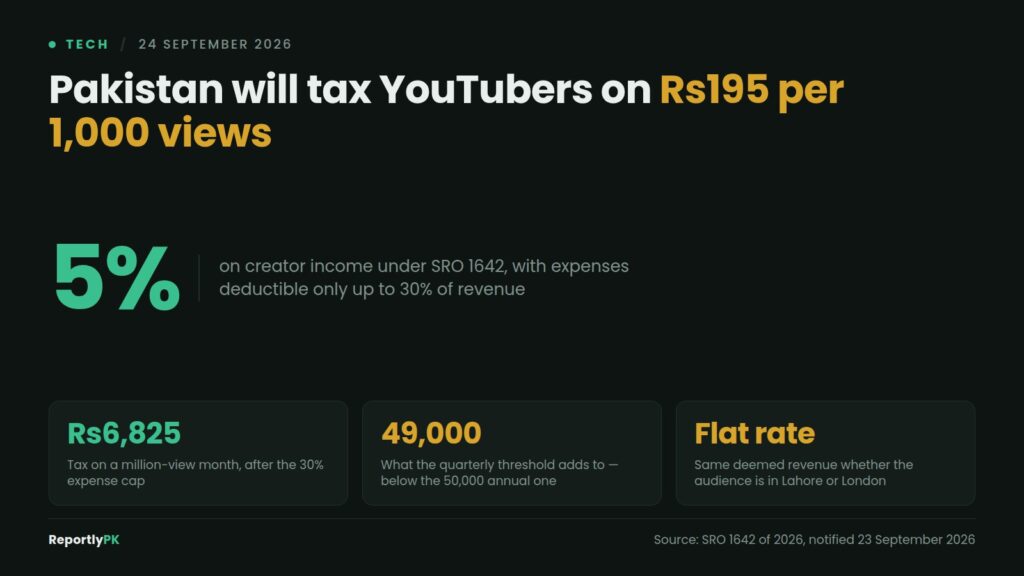
The Pakistan social media tax now has a procedure. Under SRO 1642 of 2026, notified on 23 September, creators earning from YouTube, Facebook, TikTok and Instagram pay 5 percent on income — and where actual earnings cannot be established, the FBR will deem them at Rs195 per 1,000 YouTube views.
That deeming provision is the whole design. It is also the part that will produce the unfair outcomes.
How it works
- Applies above 50,000 users annually or 12,250 users in a quarter
- Taxable income is earnings less expenses, with expenses capped at 30 percent of revenue
- Remuneration is the higher of actual earnings or the deemed Rs195 per 1,000 views
- Advance tax paid quarterly, declared in a dedicated section of the annual return
- Applies to payment in cash or in kind
- Commissioners may rectify under-declarations
Non-resident Pakistanis are covered where the income arises from user interactions inside Pakistan, which extends the rules well beyond people the FBR can knock on the door of.
Why the deemed rate is clever
Every attempt to tax platform income anywhere in the world runs into the same wall: the tax authority cannot see what the platform paid. Payments cross borders through channels the state has no visibility into, and platforms have no obligation to hand over per-creator earnings to a Pakistani commissioner.
A view count solves that. It is published on the video, by the platform, to the whole world, for free. The FBR needs no data-sharing agreement, no treaty, and no cooperation from anybody in California. It needs a browser.
Making the deemed figure a floor rather than a fixed rate is the second half of that design. A creator who genuinely earned more cannot hide behind the formula, and one who earned less has to prove it. For an authority with almost no enforcement reach over this sector, it is a genuinely well-constructed instrument.
Why Rs195 is the wrong number for most of them
Revenue per thousand views is not a constant. It is determined almost entirely by where the audience sits and what the content is about.
A creator whose viewers are in the United States or the Gulf earns multiples of what a creator with a domestic Pakistani audience earns from the same view count, because advertisers pay for the buying power behind the eyeballs. Finance and technology content earns more than entertainment. A Pashto-language channel watched in Khyber Pakhtunkhwa and a diaspora channel watched in Birmingham sit at opposite ends of that range, and this rule assigns them the same revenue.
The consequence is systematic. Creators serving domestic Pakistani audiences — the ones earning least — are the ones most likely to be deemed to have earned more than they did. The rule taxes the local-language creator hardest and the diaspora-facing creator most leniently, which is the opposite of what a progressive levy should do.
The notification says the rate is subject to revision. It should be revised by audience geography, and the data to do that sits in every creator’s own analytics dashboard.
What it actually costs
Work a case. A channel doing one million views in a month is deemed to have earned Rs195,000 from them. After the 30 percent expense cap, Rs136,500 is taxable. At 5 percent the bill is Rs6,825.
That is not punitive, and it is worth saying so plainly against the noise this will generate. Five percent on a capped base is a light touch by the standards of Pakistani taxation, and the creator economy has operated entirely outside the net until now.
The 30 percent expense cap is the harsher provision. Video production carries equipment, editing, travel, location and increasingly staff costs, and a working channel can spend well above 30 percent of revenue producing what it publishes. Capping deductions at a flat third taxes gross revenue for anyone running a real operation rather than filming on a phone.
A threshold that does not add up
The two entry tests do not agree with each other. 12,250 users in a quarter, taken four times, is 49,000 — a thousand below the 50,000 annual threshold.
So a creator whose audience never reaches the annual figure can still be pulled in by the quarterly one. Whether that is deliberate or an artefact of rounding, it means the quarterly test is the operative threshold and the annual one is decoration. Small creators near the line should read the quarterly number, not the headline.
The same people as last week
This site reported last week that Pakistani freelancers earned $352 million in July and August, and that dividing it by the three million freelancers the industry association claims produces under $59 a month each — a figure that only makes sense if a large share of digital income never reaches a Pakistani bank and therefore never appears in official data.
Content creators are the same population and the same problem. SRO 1642 is the state’s answer to it: if you cannot see the money, tax the thing you can see.
What has not been published is any estimate of what this raises. A revenue projection would tell everyone whether the FBR believes this sector is worth billions or millions, and therefore how hard it intends to enforce a rule it has written for people it cannot easily find.
Related: Pakistani Freelancers Earned $352 Million in Two Months. The $2.5 Billion Target Needs 22% More.