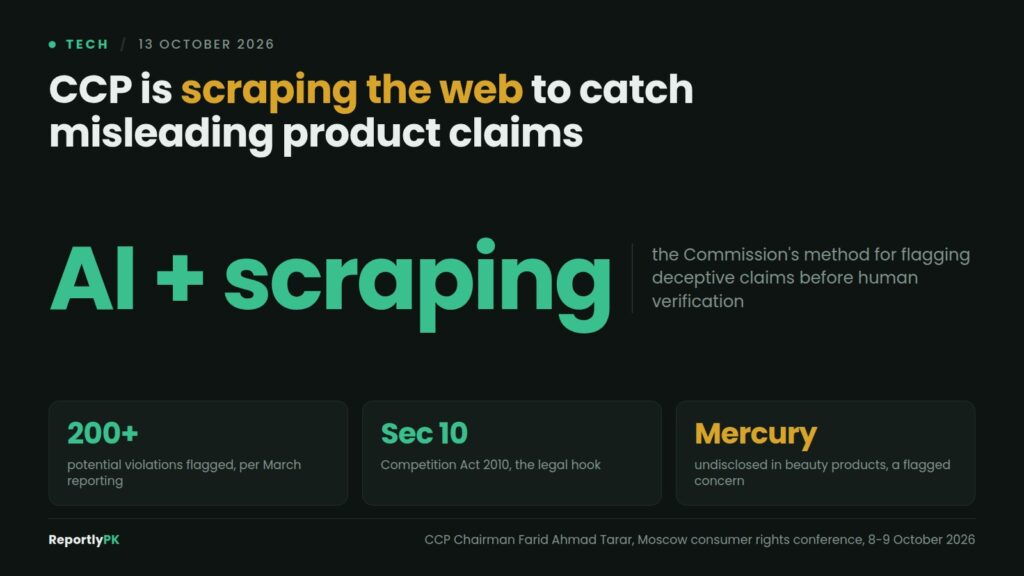
Pakistan’s competition regulator is scraping the web to find out what companies are telling consumers. The CCP AI tools now in use combine machine-assisted analysis with automated collection of online advertisements, product descriptions and consumer-facing claims — a surveillance capability that did not exist in the enforcement toolkit a few years ago.
Farid Ahmad Tarar, chairman of the Competition Commission of Pakistan, set out the approach at the First International Conference on Consumer Rights Protection in the Digital Era, held in Moscow on 8 and 9 October.
What the Commission is actually running
- AI-assisted analysis of product claims
- Web scraping of online listings and advertising copy
- Monitoring through the Meta Ad Library
- Social media monitoring for consumer-facing claims
- Evidence capture and verification before any enforcement referral
The last item in that list is the one that keeps the system defensible. Automated flagging produces candidates, not cases; a human verification step sits between the scraper and any proceeding, which is the difference between a screening tool and an algorithm issuing penalties.
The legal hook is Section 10 of the Competition Act, 2010, which requires product claims to be truthful, verifiable and transparent. The statute predates the technology by a decade and a half; what has changed is the Commission’s ability to see at scale what is being claimed.
What it has flagged
Three categories of concern were named. Undisclosed mercury in beauty products is the most serious — a safety issue rather than a pricing one, and the kind of hazard that is near-impossible for a consumer to detect unaided. The others are misleading claims of regulatory approval and questionable health representations.
Enforcement cases cited by the chairman span well-known brands: Strepsils, Dettol and Lifebuoy, alongside the marketing of a frozen dessert as dairy ice cream. That last example is instructive about what deceptive marketing law actually polices — not whether a product is bad, but whether what it is called matches what it contains.
Reporting from March this year said the Commission had detected more than 200 potential competition violations using AI tools. The Commission has not published an updated count alongside these remarks, nor the proportion of flagged items that survived verification — which is the figure that would show whether the tooling is precise or merely productive.
Related: CCP clears Fatima Fertilizer Agritech stake two years on
The problems a scraper does not solve
Tarar named five features of digital markets that make enforcement harder: seller anonymity, counterfeit and non-compliant online listings, information asymmetry, cross-border transactions and the speed at which misleading advertising spreads.
Scraping addresses the fifth and partly the second. It does nothing about the first and third. A regulator can detect an anonymous seller’s listing perfectly well and still have no one to serve notice on, and cross-border transactions take the seller outside the Commission’s jurisdiction entirely.
That gap is why the international engagement matters more than it might appear. Tarar held a bilateral meeting with Maxim Shaskolsky, head of Russia’s Federal Antimonopoly Service, on the memorandum of understanding the two authorities signed on 27 November 2025. Cooperation agreements are the only mechanism a national regulator has against a seller operating from another jurisdiction.
Two regulators now watching the same screens
The Commission is not alone in monitoring what Pakistanis see online. The Pakistan Telecommunication Authority supervises the networks; the National Cyber Crime Investigation Agency handles criminal complaints; and consumer-protection law in several provinces covers overlapping ground.
Deceptive marketing sits squarely with the CCP, so this is not a jurisdictional clash. But it does mean a company’s advertising is now visible to more than one authority running automated collection, and no public framework governs what any of them retain, for how long, or how an advertiser contests a scraped record used against it.
Those are ordinary administrative-law questions that would arise with any evidence-gathering method. They are sharper here only because the volume is larger and the collection is continuous rather than triggered by a complaint.
Why beauty products keep surfacing
Of the categories flagged, undisclosed mercury in cosmetics is the one with a documented history in Pakistan. Skin-lightening creams have repeatedly been found to contain mercury compounds, which suppress melanin production effectively and cause kidney damage, neurological harm and, with prolonged use, permanent skin injury.
The market conditions that sustain it are specific. These products sell online through small sellers rather than through retailers with compliance departments, the active ingredient is invisible to the buyer, and the effect the buyer wants is precisely the one the banned compound delivers — so a safe reformulation performs worse and loses the sale.
That combination is why a web-scraping approach fits this category better than most. The claims are made publicly in advertising copy, and the sellers are too numerous and too transient for complaint-driven enforcement to reach. What automation cannot do is test the product, and a listing that makes no claim at all is invisible to a tool that reads claims.
Why a mid-sized regulator reached for this first
Competition authorities in larger economies have been slower to adopt automated market screening, and the reason Pakistan’s has moved early is probably resource constraint rather than technological ambition. A commission that cannot staff a large market-surveillance unit has a stronger incentive to automate the first pass than one that can.
That is a reasonable trade, provided the verification step is genuinely resourced. The failure mode for this kind of system is not that it misses things — it is that it generates more flags than the human review capacity behind it can properly assess, at which point either the queue grows or the standard of review falls.
The Commission has not disclosed how many staff sit on the verification side, and that number would say more about the system’s reliability than the description of the tooling does.