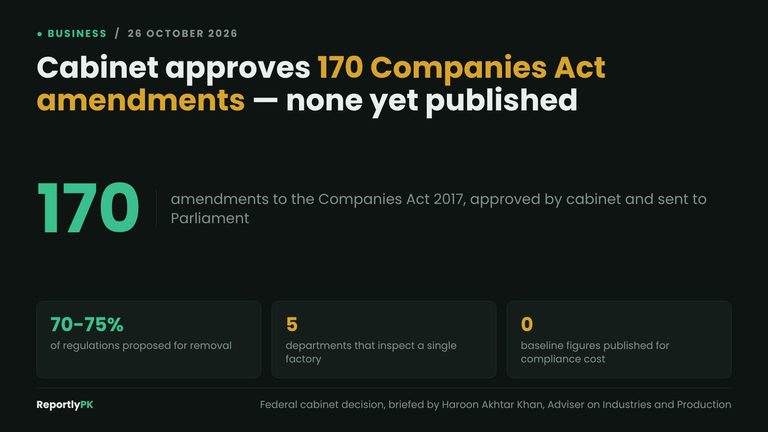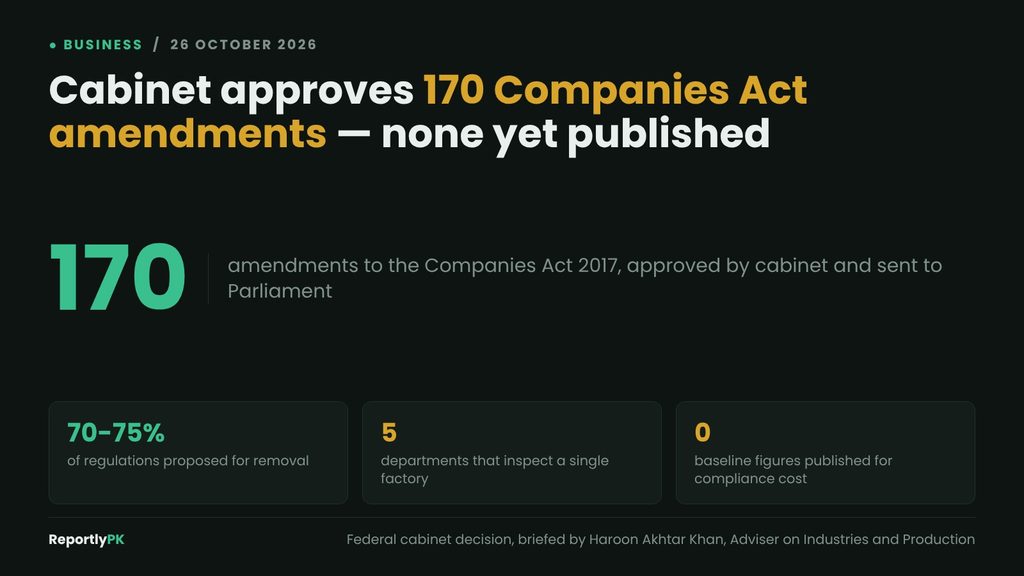
The federal cabinet has approved 170 amendments to the Companies Act, 2017 and sent the bill to Parliament, as part of a deregulation drive in which reform proposals recommend removing on average 70 to 75 percent of rules judged unnecessary or duplicative.
Haroon Akhtar Khan, Adviser to the Prime Minister on Industries and Production, said the complexity of the regulatory framework had discouraged foreign investment, and that “unnecessary complexities and overlapping requirements have accumulated” over time. The stated aim is to make “investment easier, reduce the cost of doing business and restore the confidence of both domestic and foreign investors.”
What has been announced
- 170 amendments to the Companies Act, 2017, approved by cabinet and sent to Parliament
- Reform proposals recommend removing 70 to 75 percent of unnecessary or duplicative regulations
- Overall reform programme described as 60 to 70 percent complete
- Sectors under review: dairy, maritime, beverages, oil refineries, pharmaceuticals, restaurants
- A single-window digital portal and a proposed AsaanKarobar Act are planned
- Benchmarks studied: Delaware, the United Kingdom and Canada
The individual amendments have not been published, which is the central limitation on assessing any of this. One hundred and seventy changes to the statute that governs every registered company in Pakistan could be housekeeping or could be substantial, and the announcement does not say which.
The inspection problem is the real one
Buried in the detail is the clearest description of what actually burdens a Pakistani business: overlapping inspections from labour, environmental protection, fire safety, buildings and boilers departments, each operating under its own authority and schedule.
That is a different problem from the Companies Act, and it is mostly not a federal one. Labour, environment, building control and factory inspection are provincial subjects. A federal statute can be amended 170 times without touching the inspector who arrives at a factory in Faisalabad, which is why the announcement notes that reforms will be coordinated with the provinces, Gilgit-Baltistan and Azad Jammu and Kashmir.
Coordination is the word doing the work. Four provinces with their own legislatures and revenue interests have to agree to surrender inspection powers or fold them into a single process, and nothing in the announcement describes a mechanism for securing that.
Related: SECP opens SE Fruits IPO probe and confirms investors have been refunded
Removing rules and enforcing them are different budgets
This lands in a month when the Securities and Exchange Commission has publicly argued the opposite case in its own domain. Reviewing the SE Fruits IPO — where material discrepancies in a prospectus passed five review checkpoints before Rs1.2 billion was raised and refunded — the Commission said Pakistan’s framework needs to be aligned with international practice and the Audit Oversight Board given effective inspection and enforcement powers, technical staff and stable funding.
These positions are not contradictory, and it would be lazy to present them as such. A regulator can need fewer rules and stronger capacity to enforce the ones that remain; that is in fact the standard prescription, and Delaware — one of the benchmarks named — pairs a permissive corporate statute with a specialised court that enforces it rigorously.
The risk is doing the first half. Removing 70 percent of regulations is achievable by administrative decision. Building audit oversight with inspection powers and stable funding requires money and years, and nothing announced this week commits to it.
Who was consulted
The reform work was benchmarked against Delaware, the United Kingdom and Canada, with a senior international consultant engaged who has worked across 135 countries. The Prime Minister is said to be overseeing the programme personally, with review meetings every two weeks.
What the announcement does not mention is the Securities and Exchange Commission of Pakistan, which administers the Companies Act, maintains the company register and would implement whatever Parliament passes. Its absence from the account may simply reflect an incomplete press summary rather than an incomplete process.
It is worth noting because the comparison to Delaware cuts both ways. Delaware’s attraction is not that its rules are few but that they are predictable and interpreted by an institution companies trust. That is an institutional achievement, not a deregulatory one.
The sectors chosen say something
Six sectors are named as under review: dairy, maritime, beverages, oil refineries, pharmaceuticals and restaurants. It is an odd list until you notice what unites it.
Each is heavily regulated for reasons that are not primarily commercial. Dairy, beverages, pharmaceuticals and restaurants are food and medicine safety matters. Maritime and oil refineries carry environmental and physical safety exposure. These are not sectors burdened by arbitrary paperwork so much as sectors where the paperwork exists because the product can harm people.
That does not make the rules well designed. Overlapping inspections from five departments protect nobody better than one competent inspection would, and duplication is a real cost. But a deregulation exercise that starts with pharmaceuticals in the same month the drug regulator is implementing serialisation to combat counterfeit medicines needs to be specific about which requirements are duplicative and which are the point.
The measure that would settle it
No figures have been given for what compliance currently costs a Pakistani company, how long registration or licensing takes, or how many inspections a typical manufacturer faces in a year. Without a baseline there is nothing against which to measure a 70 percent reduction.
Nor is there a target: no stated date for passage, for the single-window portal, or for the AsaanKarobar Act. The bill is now with Parliament, where the 170 amendments will become public in a form that can finally be read.
That publication is the point at which this becomes assessable. Until then, the announcement describes an intention supported by percentages whose denominators have not been disclosed.