Karachi Industrial Park has been approved as a federal special economic zone by the Board of Approvals at its 11th meeting, chaired by Finance Minister Muhammad Aurangzeb. The stated objectives are export-oriented industrial investment, technology transfer, value addition and employment.
In the same week, the Auditor General of Pakistan reported irregularities and losses of Rs18.46 billion at the company that runs Khyber Pakhtunkhwa’s economic zones. The two items belong together, because the second describes what happens to the first when governance is absent.
What the Board approved
- Karachi Industrial Park confirmed as a federal SEZ
- General eligibility criteria approved for government-funded utilities up to the zero point of privately established SEZs, under the SEZ Act 2012, assessed case by case
- A land lease policy approved for public sector SEZs and industrial estates in Punjab, offering long-term leases to cut upfront land costs
The utilities decision is the substantive one. Providing publicly funded power, gas and water connections up to the boundary of a privately developed zone removes the single largest obstacle to private SEZ development in Pakistan, where the cost of bringing a grid connection to a greenfield site has stalled projects for years.
No acreage, investment figure, job estimate, developer name or timeline has been published for Karachi Industrial Park. Those are the details that would make the approval assessable, and the announcement contains none of them.
The Rs18.46 billion is not what the headline suggests
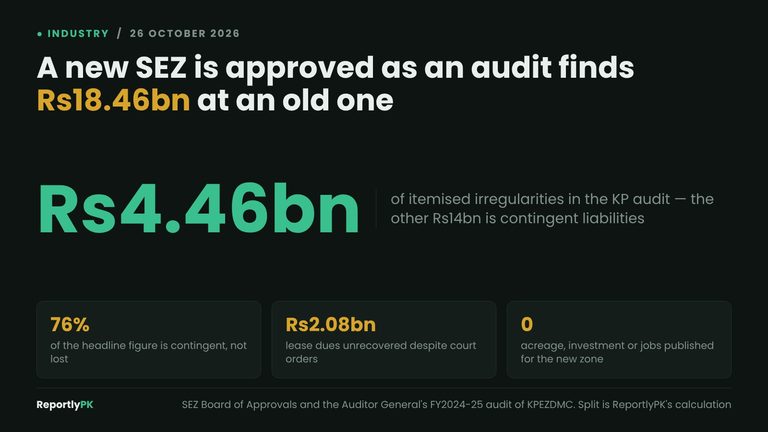
The audit of the Khyber Pakhtunkhwa Economic Zones Development and Management Company for FY2024-25 is being reported as Rs18.46 billion in irregularities. The composition matters.
- Rs2.08 billion in lease payments unrecovered from industrial landholders, despite court orders
- Rs1.08 billion lost on land not vacated in Buner, Mohmand and Jalozai
- Rs629.8 million lost through expired commercial land agreements not renewed
- Rs497.8 million on four Haripur plots totalling 10 acres, allotted without payment being collected
- Rs174.1 million from commercial land illegally allotted for industrial use
- Rs14 billion in contingent liabilities, which the report says threaten the company’s continuity
The itemised irregularities come to Rs4.46 billion. Add the Rs14 billion of contingent liabilities and the total is exactly Rs18.46 billion — so roughly 76 percent of the headline figure is potential obligations rather than established losses.
That distinction is worth insisting on in both directions. Reporting Rs18.46 billion as money lost overstates what the audit found. But Rs14 billion of contingent liabilities at a company the Auditor General says may not be able to continue is a serious finding in its own right, not a technicality — it is the difference between a company that has lost money and one that may be unable to meet what it owes.
Related: Punjab approves a Rs1.995 trillion industrial plan
Every item is about land
Read the itemised findings together and a pattern emerges: lease payments not collected, agreements allowed to expire, land not vacated, plots allotted without payment, commercial land diverted to industrial use. Every one concerns the allocation and administration of land.
That is the core function of an economic zones company. Its business is to acquire land, allot it to investors on terms, collect what is due and enforce the conditions. An audit finding failures across all five of those activities is not describing peripheral mismanagement.
The Rs2.08 billion unrecovered despite existing court orders is the most pointed item, because it rules out the usual defence. The company did not lack the legal basis to collect; it had judgments and did not act on them. The report also raises allegations that steps were taken to benefit favoured individuals.
What the response has been
Khyber Pakhtunkhwa’s Adviser on Information and Public Relations, Samar Haroon Bilour, expressed serious concern and called for immediate notice and a thorough, transparent and impartial inquiry to establish the facts and identify those responsible.
KPEZDMC has not publicly responded to the findings. No inquiry has been constituted, no official has been named, and no recovery action has been announced. These are allegations in an audit report at this stage, and the company is entitled to answer them.
Rashakai is the name in the file
KPEZDMC manages Khyber Pakhtunkhwa’s economic zones, Rashakai among them. Rashakai is not a minor site: it was among the priority zones under the China-Pakistan Economic Corridor and has been presented to investors for years as evidence that Pakistan can deliver industrial infrastructure at scale.
The audit does not attribute the Rs18.46 billion to Rashakai specifically, and the itemised losses name Buner, Mohmand, Jalozai and Haripur rather than Nowshera. It would be wrong to read the findings as a verdict on that zone.
What it is fair to say is that the institution holding the province’s flagship industrial asset is the one the Auditor General has questioned on governance, land allotment and recovery of dues, and whose contingent liabilities he regards as a threat to its continuity. Investors assessing a zone assess the body administering it, and that assessment has just become harder to make favourably.
The connection worth drawing
Pakistan is expanding its SEZ programme. A new federal zone was approved this week, Punjab has a land lease policy for public sector zones, and the provinces are building industrial estates within much larger programmes.
The KPEZDMC audit describes what the operating phase of that programme looks like without recovery discipline: land allotted, payments not collected, court orders unenforced, and a balance sheet carrying obligations it may not meet. The incentives that make zones attractive — subsidised land, publicly funded utilities, long leases — are precisely the assets that go missing when administration fails.
Approving a zone is a decision taken in a single meeting. Running one is a twenty-year administrative task, and the published record on how Pakistan does the second part is this week’s audit.