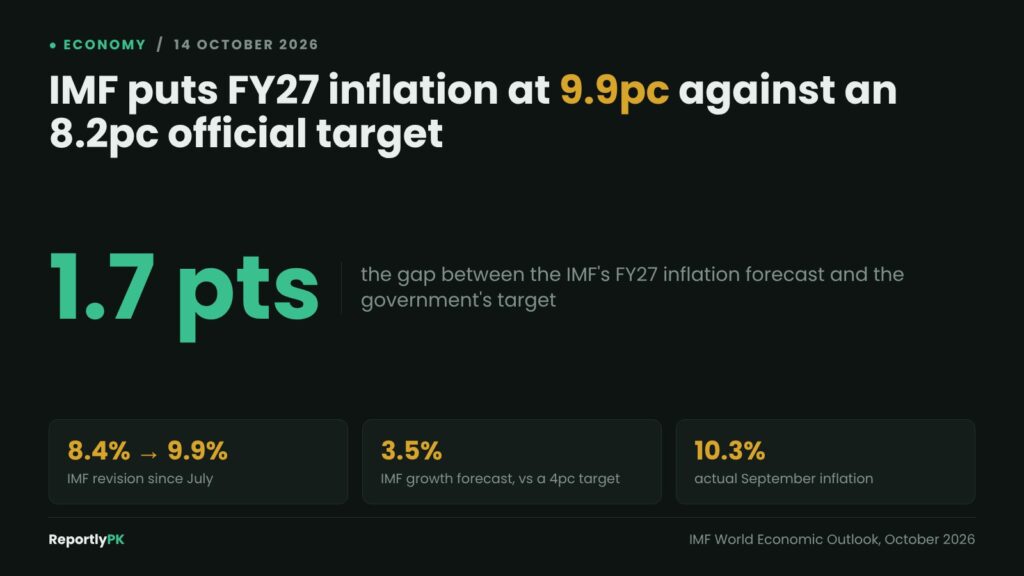
Six days after signing off on Pakistan’s programme review, the International Monetary Fund published a number the government does not accept. The IMF inflation forecast for FY27 now stands at 9.9 percent, against an official target of 8.2 percent.
The gap is 1.7 percentage points, and the direction of travel is the more striking part. The Fund’s July projection was 8.4 percent. It has been revised up by 1.5 points in three months.
Where the two sets of numbers diverge
- Inflation FY27: IMF 9.9 percent, government target 8.2 percent
- IMF’s previous inflation projection, July: 8.4 percent
- GDP growth: IMF 3.5 percent, government target 4 percent
- Current account deficit: 1 percent of GDP, about $4.4 billion
- Revision to the current account forecast: about $450 million wider
The government and the State Bank told the Fund’s mission during staff-level talks that 8.2 percent remains achievable. Finance Minister Muhammad Aurangzeb has separately said he is confident growth will exceed 4 percent, against the Fund’s unchanged 3.5 percent.
September has already made the target harder
Headline inflation came in at 10.3 percent in September. That is a single month rather than a fiscal-year average, but it is above both the Fund’s revised projection and the government’s target, and it is the most recent reading available.
An annual average works as arithmetic: every month that prints above the target obliges the remaining months to run below it by a corresponding amount. With a quarter of FY27 gone and prices running in double digits, the 8.2 percent figure depends on a disinflation that has not yet shown up in the data.
The Fund has not published Pakistan-specific reasoning for its upward revision, which is a gap in the disclosure rather than in the forecast. Without it, the difference between 9.9 and 8.2 cannot be attributed to a particular assumption about energy prices, the exchange rate or administered tariffs.
Related: IMF staff-level agreement unlocks $1.2bn for Pakistan
Approving the review and doubting the targets are not contradictory
It would be easy to read a staff-level agreement on 8 October and a contradictory forecast on 13 October as institutional inconsistency. They are different exercises.
A programme review assesses whether a country has done what it undertook to do — met fiscal targets, passed measures, held to policy commitments. The World Economic Outlook forecasts what will happen to the economy. A government can comply fully with a programme and still miss an inflation target, because compliance is about policy and inflation is about outcomes.
What the pairing does signal is that the Fund does not regard the official projections as the working assumption. That matters for the policy path: the Fund has already said the State Bank should keep a tight stance until inflation returns to its target range, and a 9.9 percent forecast is an argument for rates staying higher for longer than an 8.2 percent forecast would support.
The fuel scheme now has a price tag attached
The Fund objected specifically to the government’s monthly fuel payments of Rs2,000 to motorcyclists and Rs3,000 to small car owners, describing the scheme as broad-based and costly.
That is the same instruction delivered at the staff-level agreement — that fuel support should be phased out promptly, and any future support kept limited, time-bound, targeted and funded within the budget — now with the amounts named. Broad-based is the operative objection: a payment available to everyone with a motorcycle is not targeted at the people who need it, and the cost scales with vehicle ownership rather than with need.
The politics run the other way. Petrol prices have moved almost daily since July, and withdrawing support from motorcyclists is the kind of measure that is easiest to defend in a spreadsheet and hardest to defend in public.
The current account revision is the quieter number
Alongside the inflation change, the Fund widened its current account deficit forecast to 1 percent of GDP, about $4.4 billion, roughly $450 million more than it previously expected.
A deficit of 1 percent of GDP is modest by Pakistan’s own history, and well inside the range that has triggered balance of payments stress before. The direction, though, is consistent with what the trade data has been showing: the Q1 FY27 merchandise gap widened 15 percent to $10.79 billion, with imports growing faster in dollar terms than exports despite an 11 percent export gain.
The reconciliation between a $10.79 billion quarterly merchandise gap and a $4.4 billion annual current account deficit is remittances and services, which are expected to cover most of the difference. That is the structural dependence worth watching — the forecast holds only as long as those inflows do.
The regional number carries a warning
The Fund put growth across the Middle East and Central Asia at 0.3 percent for 2026, rebounding to 6.3 percent in 2027, and cited the possibility of a longer closure of the Strait of Hormuz. Global growth is 3.1 percent this year and 3.4 percent next, broadly unchanged.
A swing from 0.3 to 6.3 percent in a single region is not a forecast in the ordinary sense. It is a statement that the regional outlook turns almost entirely on whether a waterway reopens, and that the Fund has assumed it does.
Pakistan’s exposure to that assumption is direct. Shipping costs, fuel prices and the trade deficit have all moved with the disruption this year, and the pharmaceutical and textile sectors have each cited freight costs as a reason for lost competitiveness. If the Hormuz assumption is wrong, 9.9 percent will prove to have been the optimistic number rather than the pessimistic one.