The PTA ONIC shutdown order landed on 15 September. Pak Telecom Mobile Limited must immediately stop new sales, activations, SIM and eSIM issuance, subscriptions and marketing for ONIC, migrate existing customers to PTML within three months, and file a compliance report within seven working days.
The regulator’s finding is that ONIC was not a brand. It was a mobile virtual network operator without an MVNO licence. Under Pakistan’s 2025 framework, that licence costs $140,000.
What ONIC actually was
ONIC launched as a digital-first proposition in Karachi, Lahore, Islamabad, Rawalpindi and Faisalabad — app-based, with its own packages and its own customer relationship and billing systems, separate from Ufone’s.
PTML held the brand and supplied what only a licensee can supply: network, spectrum and numbering. Almost everything a customer touched was handled by a separate company, Digital Telecom Management Services, under a Build-Operate Services Agreement. DTMS ran marketing, customer acquisition, KYC, SIM logistics and customer service.
The 55 percent that gave it away
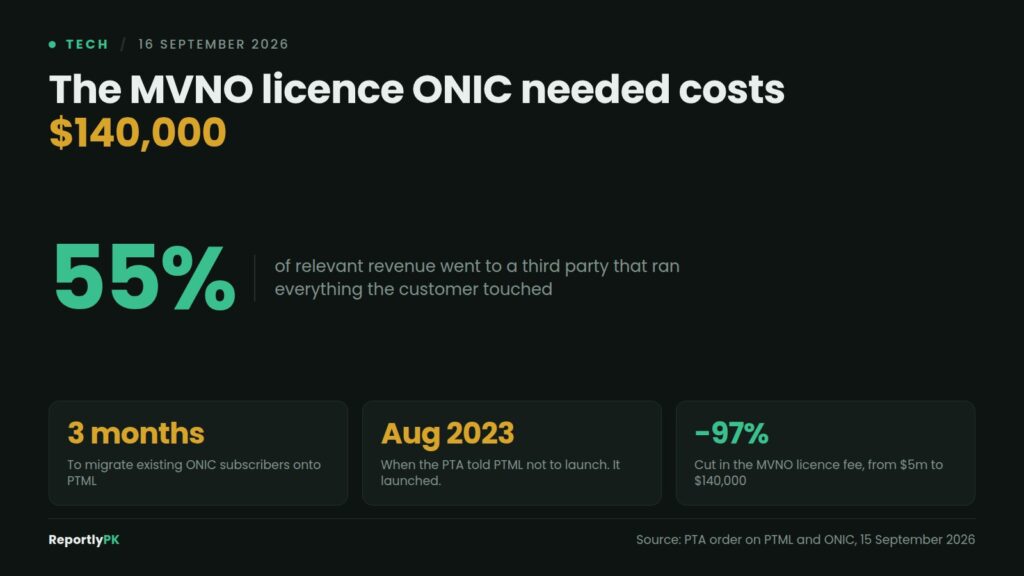
The number that decided this was not a technical one. Under the BOSA, DTMS was to receive 55 percent of relevant revenue for the first three years.
A marketing agency takes a fee. A distribution partner takes a margin. An entity that performs acquisition, onboarding, billing support and service, and takes the majority of revenue for doing it, is not a vendor — it is the operator, and the licensee is supplying it with wholesale network access. That is the textbook definition of the arrangement Pakistan created a licence category for.
The PTA also found gaps in the documentation on disaster recovery, business continuity and quality of service, and incomplete disclosure of the third-party arrangements with DTMS. Those are the findings that turn a structural disagreement into an enforcement action.
A licence that costs $140,000
Here is where the story turns. Under the 2025 MVNO Policy Framework, the initial national MVNO licence fee is $140,000 — roughly Rs39 million. Under the 2012 regulations it was $5 million. The fee was cut by about 97 percent.
Rs39 million is not a barrier to entry for a national mobile operator. It is less than a mid-sized advertising campaign. On today’s rules, the compliant version of ONIC was available for a rounding error.
That is the fair criticism, and it needs an equally fair qualification. ONIC was conceived in 2023, when the fee on the books was $5 million. A five-million-dollar entry cost for a virtual operator is a genuine barrier, and structuring around it was a rational response to a bad rule. The rule was fixed in 2025. The structure was not.
Three years of warnings
The timeline is the least flattering part of the file.
- June 2023 — PTML notifies the PTA that it intends to launch ONIC
- August 2023 — the PTA directs PTML not to launch pending evaluation
- February 2026 — the Islamabad High Court converts PTML’s petition into a representation and remands the matter to the PTA
- 15 September 2026 — the shutdown order
Between the second and third of those, ONIC was operating in five cities. A regulator that says do not launch, and is then litigated for two and a half years while the service runs, has a credibility problem that this order is partly designed to fix.
The customers nobody counted
The order gives three months to migrate existing ONIC subscribers onto PTML. Nowhere in the public account is there a number for how many people that is.
Those subscribers chose a product with app-based service and its own billing. Migration means moving onto a conventional operator stack and, in practice, losing the thing they signed up for. Whether they keep their numbers, their balances and their package terms is the question that matters to them, and the order as reported does not say.
What this settles for everyone else
PTML has two routes. Restructure ONIC as an unambiguous product inside its own mobile licence — which means taking the customer-facing functions and the majority revenue share back from DTMS. Or apply for the MVNO licence and keep the model.
For the rest of the market, the useful outcome is clarity. Pakistan now has a cheap MVNO licence and a regulator willing to apply a substance test to anyone who avoids it. The grey zone where a virtual operator could be dressed as a sub-brand has closed.
That is better for new entrants than it sounds. A $140,000 licence with enforced rules beats a free structure that can be shut down after three years of investment. The cost of this enforcement is borne by ONIC’s subscribers, who did nothing wrong and were not told any of this was in dispute.
Related: Pakistan Wants 8.5% of Satellite Internet Revenue. India Takes 4%.