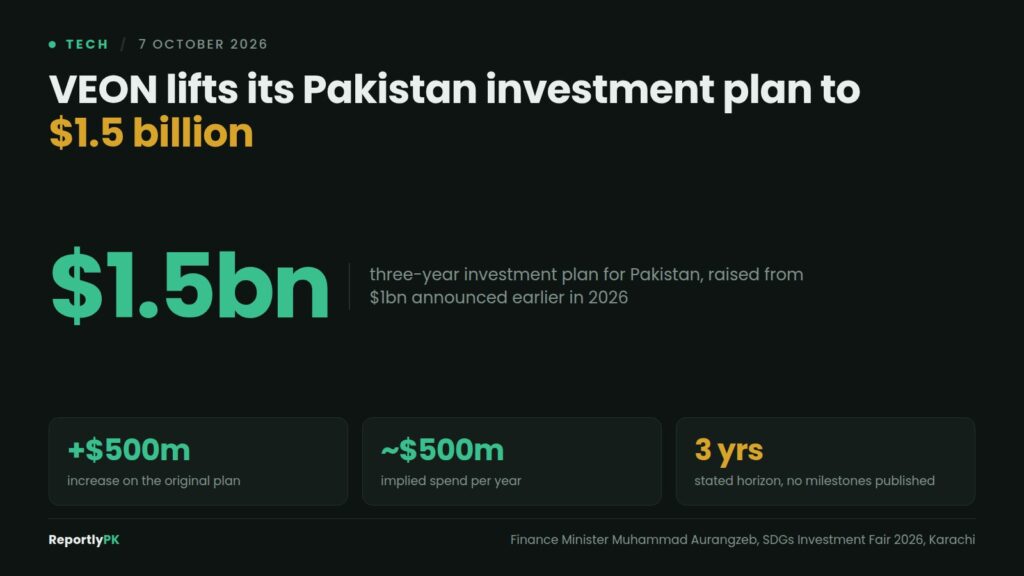
Jazz’s parent company has raised the amount it intends to spend in Pakistan by half. The VEON Pakistan investment plan now stands at $1.5 billion over three years, up from the $1 billion the group announced earlier in 2026, according to Finance Minister Muhammad Aurangzeb.
Aurangzeb disclosed the revision in a virtual address to the SDGs Investment Fair 2026 in Karachi on Tuesday, calling it “a significant jump” and presenting it as evidence of continued international investor confidence in the economy.
What the money is for
The original $1 billion commitment was framed around three areas: expanding connectivity, modernising network infrastructure and accelerating digital innovation. No revised breakdown has been published alongside the larger figure.
That matters because the three headings cover very different kinds of spending. Expanding connectivity means base stations and backhaul in places that currently have neither. Modernising infrastructure means replacing equipment where coverage already exists. Digital innovation, in VEON’s usage, generally refers to its app businesses rather than the network. Without the split, the $500 million increment cannot be mapped to any particular outcome for subscribers.
The scale, in context
- Revised plan: $1.5 billion over three years
- Previous plan: $1 billion, announced earlier in 2026
- Increase: $500 million, or 50 percent
- Implied average: about $500 million a year
- Announced at: SDGs Investment Fair 2026, Karachi, organised by UNDP Pakistan
Spread over three years, the commitment works out to roughly $500 million annually across VEON’s Pakistani operations, which include Jazz, JazzCash and the group’s digital services. For a market where foreign direct investment has been thin and concentrated in a handful of sectors, a sustained half-billion-dollar annual programme from a single operator is substantial.
The timing sits against a harder backdrop
The announcement lands in the same week that the Ministry of Information Technology and Telecommunication’s draft Telecommunication Competition Rules 2026 began circulating — a framework that would let the Pakistan Telecommunication Authority designate operators above a 25 percent market share as holding significant market power and attach tariff obligations to that designation.
Jazz is the largest mobile operator in Pakistan by subscribers, which makes it the most obvious candidate for such a designation if the rules are adopted as drafted. A capital commitment of this size is the sort of thing an operator points to when arguing that heavier price regulation would discourage investment. Nothing in the reporting connects the two, and the timing may be coincidental; the SDGs fair was a scheduled event. But the two sit in the same policy week.
Related: PTA could vet mobile tariffs under a 25pc market-power trigger
A commitment is not a disbursement
Announced investment figures in Pakistani telecom have a mixed record of conversion. The relevant test is not the headline number but what shows up in the State Bank’s foreign direct investment data and in PTA’s infrastructure statistics over the next three years.
Several things sit between the commitment and the spending. Spectrum availability shapes how much new capacity an operator can actually deploy; repatriation rules affect how a foreign parent treats capital it sends in; and the rupee’s trajectory determines what $1.5 billion buys in local terms by year three. None of those is settled.
No milestone schedule has been published, and no year-one figure has been named. Until one is, the $1.5 billion is a plan rather than a commitment with dates attached.
What else the minister said
In the same address, Aurangzeb pointed to foreign interest in the privatisation programme, noting that three Turkish companies had expressed interest in the first distribution company offered for sale. That matches the GEPCO shortlist published this week, on which Aktor Elektrik, Genvera Enerji and Cengiz Enerji are the three Turkish names among nine prequalified bidders.
Pakistan also used the fair to seek $26 billion of investment across 35 UNDP-backed projects aimed at the 2030 development goals. That is a solicitation rather than a commitment, and it is roughly seventeen times the size of the VEON plan — a useful measure of the gap between what is being asked for and what has so far been offered.
Why this one is worth watching
VEON is already operating in Pakistan at scale, which separates this from most investment announcements made at promotional events. The group is not deciding whether to enter; it is deciding how much to spend on a business it already owns, and that decision is made against revenue it is already collecting.
That makes the upward revision a more informative signal than a greenfield pledge from a company with no local operations. It also makes it falsifiable. Jazz’s capital expenditure is visible in VEON’s own quarterly disclosures, and a $500 million increase in a three-year plan should become legible there well before 2029.