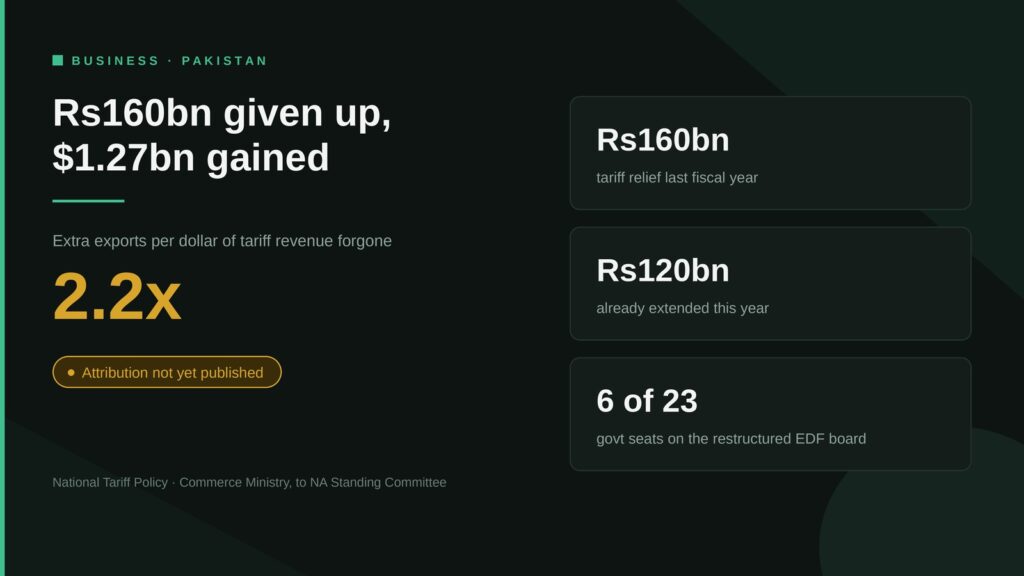
Pakistan’s Commerce Ministry has put a number on one of its central trade reforms. Tariff reductions worth Rs160 billion under the National Tariff Policy during the last fiscal year contributed to $1.27 billion in additional exports, the Commerce Secretary told the National Assembly Standing Committee on Commerce.
A further Rs120 billion in tariff relief has already been extended in the current fiscal year.
The claim deserves examination, because the ratio it implies is worth understanding before the policy is scaled further.
Doing the arithmetic
Rs160 billion in foregone revenue converts to roughly $575 million at an exchange rate of about Rs278 to the dollar. Set against $1.27 billion in incremental exports, that produces a return of a little over 2.2 dollars of export earnings per dollar of tariff revenue given up.
For a country whose central economic constraint is foreign exchange, that trade is defensible. Tariff revenue is rupees. Exports are dollars. Pakistan has a persistent shortage of the latter and can, at least in principle, raise the former through other means. Converting domestic revenue into hard currency at better than 2:1 is a reasonable transaction.
Two caveats belong alongside that figure, though.
Attribution is hard. Exports respond to exchange rates, global demand, buyer relationships, energy costs and competitor conditions as much as to input tariffs. Isolating the tariff effect from everything else requires methodology the committee did not appear to receive. When the Standing Committee asked whether the newest round of cuts would actually raise exports, the Commerce Secretary’s response was that the impact would be assessed at the end of the financial year — which is honest, but leaves the current figure resting on an assessment that has not been shown.
Revenue foregone is real and immediate. With federal debt at Rs83.6 trillion and growing, Rs160 billion in surrendered collection has an opportunity cost. The policy is a bet that the export response justifies it — a defensible bet, but a bet.
Why tariffs matter for exporters
The logic behind the policy is straightforward once you look at how Pakistani manufacturing is structured.
A textile exporter imports dyes, chemicals, machinery parts and specialised yarns. Every tariff on those inputs raises the cost of the finished garment. When that garment competes against Bangladeshi or Vietnamese production in the same European buyer’s tender, the tariff on imported inputs is effectively a self-imposed export tax.
Pakistan has historically maintained high input tariffs to protect domestic upstream industries. The trade-off is that it makes downstream exporters less competitive — protecting a smaller domestic supplier base at the expense of the sector actually earning foreign exchange.
The National Tariff Policy attempts to resolve that tension by lowering duties on inputs while retaining protection where a genuine domestic industry exists.
What else the committee heard
The Commerce Secretary outlined several parallel measures:
- EXIM Bank established to provide dedicated financing for exporters — addressing a persistent complaint that commercial banks are poorly suited to trade finance at competitive rates.
- Taxes on exports abolished, removing another layer of cost from outbound trade.
- Export Development Fund Board restructured, with increased private sector representation. Government representatives now account for six of the board’s 23 members — leaving the private sector in a clear majority on a body that allocates funds raised from exporters themselves.
That last change is more significant than it sounds. Export promotion bodies dominated by bureaucrats tend to fund what is administratively convenient. Exporter-majority boards tend to fund what exporters actually need. The reallocation of board seats is a structural governance change, not a cosmetic one.
The Karachi chambers proposal
The committee also considered a proposal for new chambers of commerce in Karachi, with Farooq Sattar suggesting district-based chambers that could result in several new bodies across the city.
Committee Chairman Javed Hanif noted the proposal was new. A Law Ministry representative advised that a fresh private member’s bill could not proceed until an earlier draft had been either approved or rejected. The committee opted to seek legal opinions from the Commerce and Law ministries before proceeding.
The underlying question is whether fragmenting Karachi’s business representation across district chambers would improve access for smaller traders or simply dilute the collective bargaining weight the city’s business community currently carries.
What to watch
The Rs120 billion currently in play this fiscal year will be measured against export performance at year-end. Services exports have already grown 19% in FY26, and goods exports will need to show comparable momentum for the policy to justify continuation at this scale.
Meanwhile, the constraints tariff policy cannot address remain firmly in place — energy tariffs, the 11.5% policy rate raising working capital costs, delayed refunds, and logistics disruption of the kind that halted 400,000 goods vehicles this month.
Cheaper imported inputs do not help an exporter who cannot get a container to the port.
FAQs
What is Pakistan’s National Tariff Policy?
A framework under which the government reduces tariffs, particularly on imported industrial inputs, to lower production costs and improve export competitiveness.
How much did tariff cuts cost and what did they deliver?
Rs160 billion in tariff relief during the last fiscal year contributed to $1.27 billion in additional exports, according to the Commerce Ministry.
How much tariff relief is being given this year?
Rs120 billion, with the impact due to be assessed at the close of the financial year.
What is the EXIM Bank of Pakistan?
An export-import bank established to provide specialised financing to exporters, addressing gaps in commercial trade finance.
Who controls the Export Development Fund Board?
Following restructuring, government representatives hold six of 23 seats, giving the private sector a clear majority.
2 Comments
[…] Rs160 Billion in Tariff Cuts Bought $1.27 Billion in Exports. Was It Worth It? […]
[…] Related: Rs160 Billion in Tariff Cuts Bought $1.27 Billion in Exports. Was It Worth It? […]
Comments are closed.