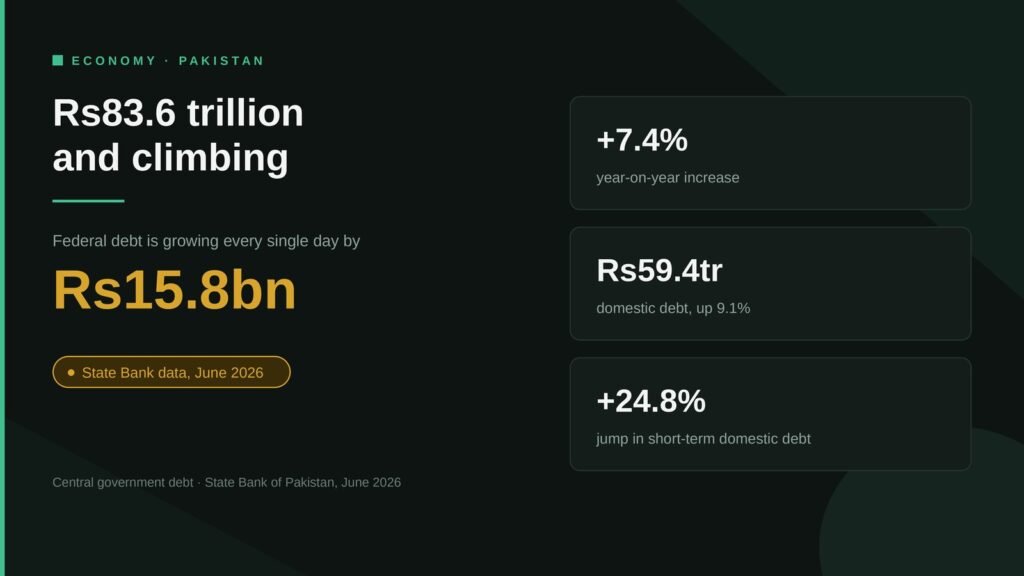
Fresh State Bank of Pakistan data puts central government debt at Rs83.642 trillion as of June 2026, a 7.4% increase year-on-year.
Broken into smaller units, the number becomes harder to look away from. Against the June 2025 figure, national debt has been accumulating at roughly Rs15.8 billion per day — about Rs183,000 every second.
The month-on-month movement is sharper still. Debt rose 2.1% from Rs81.955 trillion in May, meaning roughly Rs1.7 trillion was added in a single month.
Where the debt sits
| Category | June 2026 | Change |
|---|---|---|
| Total federal debt | Rs83.642 trillion | +7.4% YoY |
| Domestic debt | Rs59.441 trillion | +9.1% YoY |
| Long-term domestic | Rs48.446 trillion | up from Rs45.653tr |
| Short-term domestic | Rs10.928 trillion | up from Rs8.756tr |
Two features of this table deserve attention.
Domestic debt is growing faster than the total. At 9.1% year-on-year against 7.4% overall, borrowing is shifting toward the local market. That reduces external vulnerability — rupee-denominated debt does not become more expensive when the currency weakens — but it comes at a cost, because domestic borrowing at a policy rate of 11.5% is considerably more expensive than concessional multilateral lending.
Short-term debt jumped nearly 25%. The rise from Rs8.756 trillion to Rs10.928 trillion is the most concerning line in the release. Short-term instruments mature quickly and must be rolled over continuously, which exposes the government to interest rate movements in a way long-term paper does not. If rates rise, the entire short-term stock reprices within months. It is the fiscal equivalent of financing a mortgage on a credit card.
Why the number keeps climbing
Debt accumulation is not primarily a spending story. It is largely a compounding story.
Pakistan runs a persistent primary deficit and, critically, debt servicing itself now consumes the largest single share of federal expenditure — routinely exceeding development spending, defence and civil administration combined. With interest rates in double digits, servicing existing debt requires new borrowing, which adds to the stock, which increases next year’s servicing bill.
Three factors have kept the cycle turning:
- A narrow tax base. Pakistan’s tax-to-GDP ratio remains among the lowest in the region. Retail, agriculture and real estate remain substantially under-taxed relative to their share of economic activity.
- Loss-making state enterprises. Power distribution companies, PIA and other SOEs continue to absorb subsidies and generate circular debt.
- High interest rates. The 11.5% policy rate, held to contain inflation running near 9.2%, simultaneously makes every rupee of government borrowing more expensive.
What it means for ordinary Pakistanis
The abstraction becomes concrete in three ways:
Crowding out. When the government absorbs the bulk of available domestic credit, less remains for private businesses. Firms that would expand and hire face higher borrowing costs — one reason industrial investment has stayed weak despite reasonable headline growth.
Fiscal space. Every rupee committed to interest payments is unavailable for health, education, flood resilience or infrastructure. This is why development budgets get compressed even as needs grow.
Inflation risk. Heavy government borrowing complicates monetary policy. It is one of the structural reasons inflation has proven difficult to bring durably into the State Bank’s 5–7% target range.
The trajectory question
Debt is not inherently a crisis. What matters is whether it is growing faster than the economy’s ability to service it.
With GDP growth projected at 3.5–4.5% for FY27 and debt expanding at 7.4%, the ratio is moving in the wrong direction. Sustainability requires either faster growth, a larger tax base, lower interest rates, or some combination.
The government’s own signals suggest awareness of the squeeze. The planning minister has stated plainly that the country needs dollars. Tariff reductions worth Rs160 billion have been deployed to stimulate exports. An easy tax scheme for traders is being launched to broaden collection.
These are the right instruments. The question is scale and speed — because at Rs183,000 per second, the arithmetic does not pause while policy is debated.
FAQs
How much debt does Pakistan have?
Federal government debt stood at Rs83.642 trillion in June 2026, according to State Bank of Pakistan data.
How fast is Pakistan’s debt growing?
Approximately Rs15.8 billion per day, or around Rs183,000 per second, based on the year-on-year change from June 2025.
How much of Pakistan’s debt is domestic?
Rs59.441 trillion, up 9.1% year-on-year — meaning domestic debt is growing faster than the overall total.
Why is short-term debt a concern?
Short-term instruments must be rolled over frequently, exposing the government to interest rate risk. Pakistan’s short-term domestic debt rose from Rs8.756 trillion to Rs10.928 trillion over the year.
What is Pakistan’s biggest budget expense?
Debt servicing, which consistently accounts for the largest single share of federal expenditure.
One comment
[…] Pakistan’s Federal Debt Reaches Rs83.6 Trillion — and Grows Rs183,000 Every Second […]