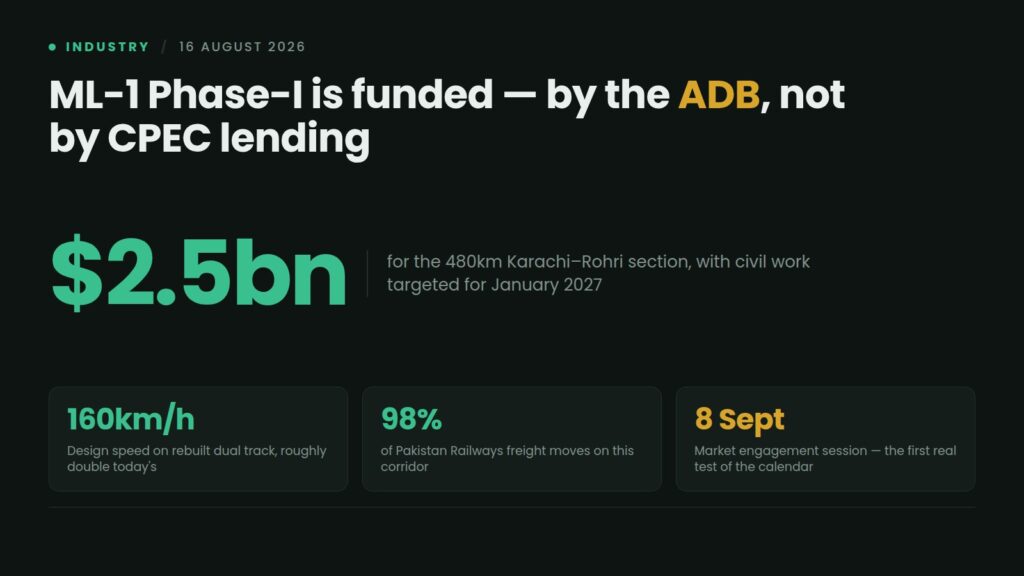
Civil work on ML-1, the reconstruction of Pakistan Railways’ main line from Karachi to Peshawar, is scheduled to begin in January 2027. Phase-I covers the 480km Karachi–Rohri section at a cost of $2.5 billion.
The detail that makes this different from every previous ML-1 announcement is not the timeline. It is who is paying.
The financing changed, and that is the story
Phase-I is being financed by the Asian Development Bank, with co-financing from the AIIB, the World Bank and the Islamic Development Bank.
ML-1 has spent most of the last decade as the flagship railway component of CPEC, structured around Chinese financing, and it did not start. Terms could not be agreed. The cost estimate moved. Pakistan’s debt position made a large bilateral loan progressively harder to justify on both sides.
Moving the project to a multilateral consortium changes several things at once. Multilateral lending carries concessional rates and long tenors that bilateral commercial terms generally do not. It also carries procurement rules — international competitive tendering, published qualification criteria, and audit obligations that are enforced by institutions with no other stake in the outcome.
That is slower. It is also the reason a project that stalled for years now has a tendering calendar.
What 480km actually buys
The scope is a rebuild rather than a repair: new dual tracks, reconstruction of bridges and culverts, stations, freight yards, and fencing along the alignment to prevent unauthorised access.
Design speed is 160km/h. That is not high-speed rail, and it is not meant to be — it is the standard for a conventional mixed-traffic mainline, roughly double what much of the existing track safely supports.
The fencing deserves more attention than it usually gets. An unfenced alignment running through populated districts forces trains to slow through level crossings and settlements regardless of what the track can take. Sealing the corridor is often what converts a design speed into an actual average speed.
The corridor carries 76 percent of passenger traffic and 98 percent of freight on the network. Pakistan Railways is, in practical terms, this line.
Why the freight number is the important one
That 98 percent figure describes a share of a small total. Rail’s slice of Pakistan’s overall freight market has fallen for decades, and almost everything now moves by road — which is why a strike by goods transporters can put containers on the ground at Karachi’s ports within a week.
A rebuilt Karachi–Rohri section is the segment that matters most for changing that. It is the link between the ports and the upcountry network: the leg where rail’s economics against trucking are strongest, because container volumes are highest and the distance is long enough for rail’s cost advantage per tonne-kilometre to overcome the expense of transferring cargo at each end.
If ML-1 shifts a meaningful share of port-bound container traffic onto rail, it reduces exactly the single-point dependency the past fortnight has exposed. That is a stronger argument for the project than journey times for passengers.
The timeline, read carefully
- 8 September 2026 — market engagement session with prospective contractors
- 30 October 2026 — deadline set by Railway Board Chairman Syed Mazhar Ali Shah for completing the review phase, with weekly progress monitoring
- 4–5 months — estimated international tendering and bidding period
- January 2027 — civil work begins
- 2.5 to 3 years — estimated construction duration
Railways Minister Hanif Abbasi was candid about where the pressure is coming from, saying the ministry is trying its level best and that the prime minister wants commencement by January by all means.
Run the arithmetic on that. A market engagement in September, followed by four to five months of international tendering, lands contract award in January or February at the earliest. Award is not the same as breaking ground: contractors mobilise, sites are handed over, and advance payment arrangements are settled first.
January 2027 for actual civil work is therefore tight to the point of being optimistic. The risk in compressing it is the familiar one — rushing procurement on a multilateral-funded contract invites the challenges and re-tenders that cost far more time than the schedule saved.
What to watch
The market engagement session on 8 September is the first real test, and the agenda is more revealing than the date: package sizes, qualification criteria, joint-venture structures and signalling packages.
Package sizing decides whether Pakistani contractors can bid at all or whether the work goes entirely to international firms in joint ventures. Signalling being handled as a separate package is standard practice and also the element most likely to slip, since it is the most technically specialised part of the job and the part that determines whether the rebuilt line can actually run at its design capacity.
ML-1 has been announced, costed, re-costed and relaunched for the better part of a decade without a rail being lifted. A funded Phase-I with named lenders and a published procurement calendar is genuinely further than it has ever got. The 8 September session, and whether the 30 October review deadline holds, will say more about whether this time is different than any ministerial statement will.
Related: Port Qasim Is Getting a 150-Acre Auto Zone. The Target Is $500 Million in Exports.