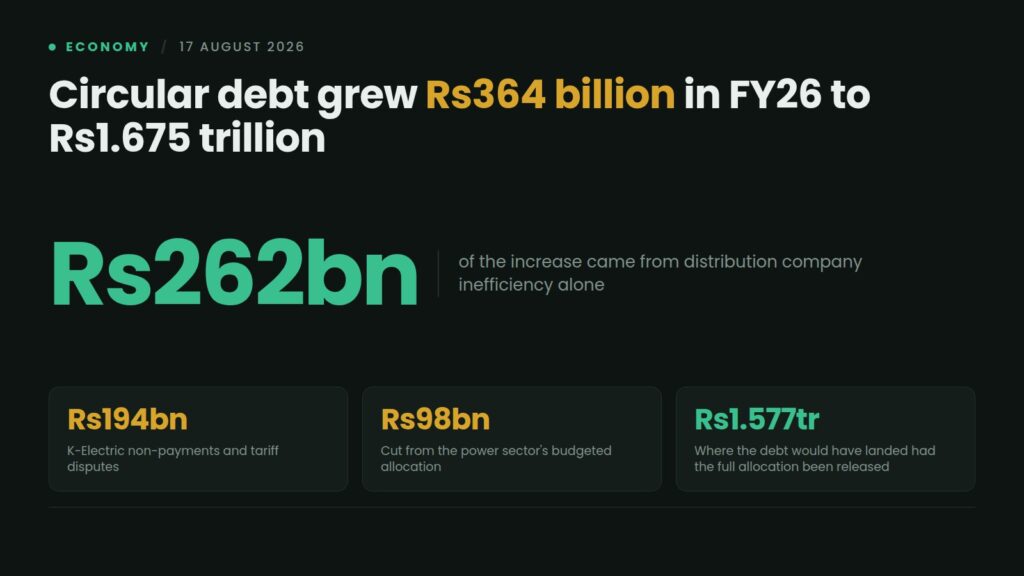
Pakistan’s power sector circular debt grew by Rs364 billion in FY2025-26, taking the total stock to Rs1.675 trillion by June 2026.
The IMF had allowed a flow of up to Rs400 billion, on the condition it be cleared through budgeted subsidies. So the increase is technically within the permitted band — and the condition attached to it was not met.
This is the same result Pakistan has produced every year for more than a decade, and the breakdown of where the money went explains why it keeps happening.
Where the Rs364 billion came from
- Rs262 billion — inefficiency losses at distribution companies
- Rs194 billion — K-Electric non-payments and tariff disputes
- Rs75 billion — delayed implementation of tariff adjustments
- Rs64 billion — shortfall in bill recovery
- Rs14 billion — accumulated interest
The gross figures exceed the net increase because subsidies and recoveries offset part of it. The government allocated Rs302 billion in subsidies against the flow, and Rs893 billion for the power sector overall — then cut Rs98 billion from that allocation.
The Power Division’s own position is that had the full budgeted allocation been released, circular debt would have fallen to Rs1.577 trillion instead of rising.
Read that carefully, because it is an unusually direct admission. One arm of government is saying the debt rose because another arm withheld money it had already budgeted. The Rs98 billion cut that helped produce a clean fiscal deficit number reappeared as Rs98 billion of circular debt.
Two-thirds of it is operational failure
Rs262 billion of distribution company inefficiency is the number that should dominate any discussion of this.
That is electricity bought from generators and never paid for by anyone — lost in transmission, stolen from the network, or delivered to customers who were billed and did not pay. Add the Rs64 billion recovery shortfall and roughly Rs326 billion of the year’s damage comes from distribution companies failing at their core function.
No tariff adjustment fixes that. Raising the price of electricity to cover losses on unbilled electricity increases the incentive to bypass the meter, which is the mechanism by which Pakistan’s power tariffs have risen for years while the deficit has not closed.
The K-Electric line at Rs194 billion is a different kind of problem. Non-payments and tariff disagreements between a private utility and state entities are a contractual dispute, not an operational loss — which means it is in principle resolvable by adjudication rather than investment. It has been outstanding for years regardless.
The privatisation plan has an obvious flaw
The government is pursuing privatisation of three profitable distribution companies — Faisalabad, Gujranwala and Islamabad — rather than bundling them with loss-making ones.
Commercially, that is the only way to attract a buyer. Nobody bids for a package designed so the good asset pays for the bad one.
But the arithmetic of what remains is unforgiving. Sell the three companies that recover their bills and the state is left holding the ones that do not. The circular debt is generated overwhelmingly by the weak distributors; removing the strong ones from the portfolio removes the cross-subsidy that partially masks it. The flow gets worse before any buyer improves anything.
That may still be the right sequence — proving a sale can be executed at all has value, and a buyer with capital and no political constraints on disconnecting non-payers may demonstrate what is possible. It just should not be presented as a solution to circular debt. In the near term it is the opposite.
The customers are leaving
The most consequential line in the reporting is the one about behaviour: a decade of rising tariffs has pushed consumers toward rooftop solar and, increasingly, off the grid entirely.
This is where circular debt stops being an accounting problem and becomes structural.
The customers who can afford to install solar are the ones who consume most, pay reliably, and cross-subsidise everyone else. When they leave, the fixed costs of the system — capacity payments to generators, network maintenance, debt service — do not fall. They are spread across a smaller base of remaining customers, whose tariffs must rise further, which pushes the next tier toward solar.
Utilities elsewhere call this the death spiral, and the defining feature is that each round of tariff increases accelerates it. Pakistan has been raising tariffs to close the circular debt gap for a decade and the gap is Rs1.675 trillion.
What the number really measures
Circular debt is not really debt. It is the running total of electricity Pakistan has consumed and not paid for — arrears owed to generators, fuel suppliers and lenders that accumulate because the money coming in does not cover the power going out.
At Rs1.675 trillion it is roughly half the size of the entire federal fiscal deficit that was celebrated as a 22-year low last week. One number is reported as a national achievement and the other sits in the power sector’s accounts, and they describe the same public finances.
Until distribution companies collect what they bill, everything else is a financing arrangement for the shortfall.
Related: Pakistan’s Fiscal Deficit Hit a 22-Year Low. Cheaper Debt Did Most of the Work.
2 Comments
[…] Related: Circular Debt Grew Rs364 Billion. A Rs98 Billion Budget Cut Explains Part of It. […]
[…] Related: Circular Debt Grew Rs364 Billion. A Rs98 Billion Budget Cut Explains Part of It. […]