Pakistan’s Power Division has found that coal-fired power plants were not consistently buying from the supplier offering the best available discount — despite having multiple contracted suppliers to choose from.
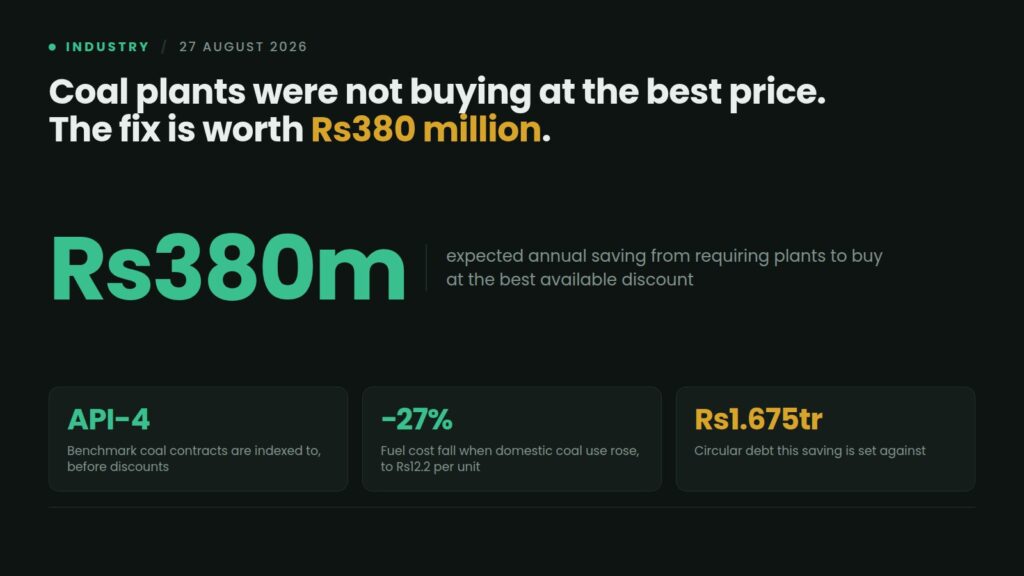
Fixing it is expected to save the national treasury about Rs380 million a year.
Against a power sector carrying Rs1.675 trillion of circular debt, Rs380 million is a rounding error. The reason it is worth reading anyway is what it reveals about how the money moves.
How imported coal is priced
Coal contracts are indexed to API-4, the South African export benchmark. The index sets the reference; what a plant actually pays depends on the discount it negotiates against that reference.
Plants involved include three 1,320MW facilities at Port Qasim, Hub and Sahiwal, plus the Lucky and Jamshoro plants. Each holds contracts with several suppliers, and the discounts differ between them.
The finding is that plants sometimes bought from a supplier offering a worse discount when a better one was contractually available. Federal Power Minister Awais Ahmed Khan Leghari chaired the reviews of procurement data that surfaced it, and the Power Division has introduced a best available discount principle — plants must buy from the contracted supplier with the highest discount against the applicable benchmark, and are barred from buying from lower-discount suppliers.
Why the plants had no reason to care
This is the structural point, and it is not really about coal.
Pakistani power plants operate under agreements in which fuel is a pass-through cost. The plant buys coal, burns it, and the cost is recovered through the tariff. It is not the plant’s money.
A commercial buyer spending its own funds shops every consignment, because every rupee saved on fuel is a rupee of margin. A buyer whose fuel cost is reimbursed in full has no financial reason to work the discount, and no penalty for taking the easier supplier relationship.
That is not an accusation of wrongdoing. It is what pass-through contracting does to incentives, everywhere it is used. The Power Division’s rule works by removing the discretion entirely rather than by trying to create an incentive that the contract structure cannot supply.
Where the saving actually lands
Because fuel is a pass-through, Rs380 million of procurement savings does not improve a generator’s profit. It reduces the fuel cost component of the tariff — which means it reaches either the consumer’s bill or the subsidy the government pays to hold that bill down.
Every rupee of unrecovered generation cost ends up in the circular debt, which grew Rs364 billion in FY26. Rs380 million is roughly a tenth of one percent of that year’s increase. Set against the Rs262 billion that came from distribution company inefficiency alone, the proportions are stark.
Procurement discipline at the generation end is worth doing. It is not where the sector’s money is being lost.
The domestic coal comparison
One figure in the review points somewhere more consequential. In March 2025, increased use of domestic coal brought average fuel cost down to Rs12.2 per unit — a 27 percent reduction from Rs16.8 previously.
That is a saving measured in billions, produced by changing the fuel rather than the supplier. Pakistan spends over $2.5 billion a year importing coal for industrial use, in dollars, against reserves of $18.4 billion.
Thar lignite is domestic and paid for in rupees. Its constraints are real — lower calorific value, transport infrastructure, and plants engineered for imported specifications — but a 27 percent fuel cost reduction is an order of magnitude beyond what discount discipline on imported cargoes can deliver.
The same logic is being applied elsewhere this month. A UK-funded project is building Pakistan’s first commercial plant converting cotton stalks and sugarcane waste into bio-coal pellets priced 40 to 50 percent below imported coal, aimed at textile mill boilers.
Worth doing, and worth keeping in proportion
A ministry examining actual procurement data, identifying a specific behaviour and issuing a rule that closes it is exactly the kind of unglamorous administrative work that is usually absent from Pakistani energy policy. Rs380 million recovered every year, with no capital cost and no legislation, is a real result.
It should not be mistaken for reform of the power sector. The circular debt is generated overwhelmingly by electricity that is billed and not paid for, and by consumers with the means to install rooftop solar leaving the grid entirely — spreading fixed costs across a shrinking base.
Coal discounts are a housekeeping problem. Collection is the sector’s actual one.
Related: Circular Debt Grew Rs364 Billion. A Rs98 Billion Budget Cut Explains Part of It.