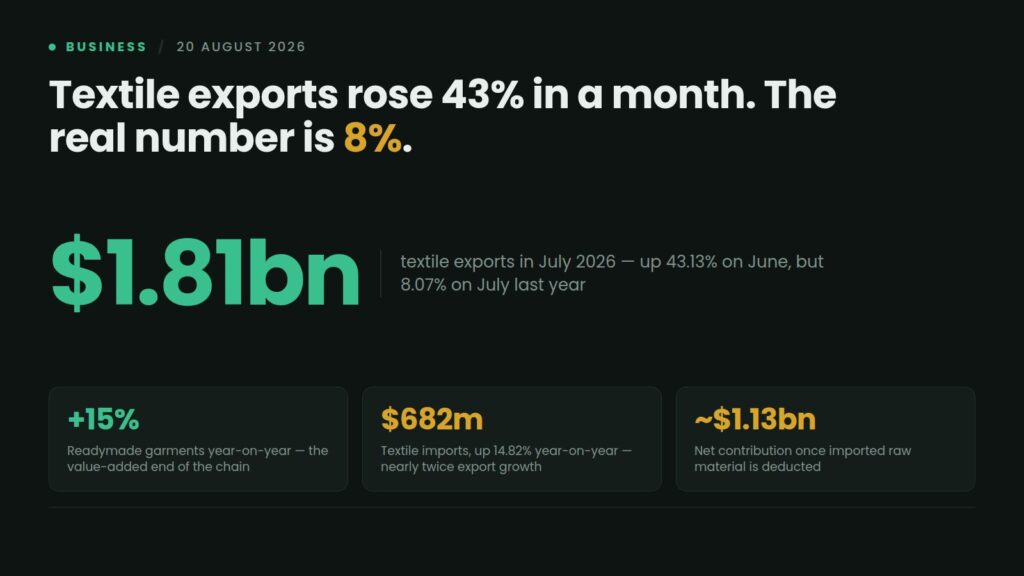
Pakistan’s textile exports hit $1.81 billion in July 2026, up 43.13 percent on June’s $1.27 billion.
Against July 2025, the increase was 8.07 percent.
The second number is the one that describes the industry. The first describes a calendar.
Why June was low
June is the last month of Pakistan’s fiscal year, and shipment timing around a year-end is never neutral. July is the first month of the new one. A 43 percent swing between two consecutive months in an industry that cannot change its production capacity by 43 percent is a scheduling artefact, not a surge in demand.
Eight percent year-on-year is the real growth rate, and in the context of the past three years it is respectable. It is not transformative.
The composition is better than the headline
Product-level detail is where this month gets genuinely interesting. Year-on-year growth by category:
- Readymade garments — $459.99m, up 15%
- Cotton yarn — $66.53m, up 18.69%
- Bedwear — $308.50m, up 4.16%
- Knitwear — $533.84m, up 4.06%
Readymade garments growing at nearly four times the rate of knitwear and bedwear matters more than the totals suggest.
Pakistan’s textile industry has historically sat at the low-value end of the chain — spinning yarn and weaving cloth, selling an intermediate product that someone else turns into a garment and captures the margin on. Every step up that chain, from yarn to cloth to made-ups to finished garments, multiplies the dollars earned per kilogram of cotton.
Garments at 15 percent growth while the commodity categories crawl is the mix shifting in the right direction. One month does not establish a trend, but it is the trend the country has been trying to produce for two decades.
The import line nobody quotes
Textile imports rose to $682.21 million in July — up 5.37 percent on June and 14.82 percent year-on-year.
Imports growing at nearly twice the rate of exports is the number that should temper the celebration.
Netted off, the sector contributed roughly $1.13 billion in July rather than $1.81 billion. That gap is largely raw cotton and man-made fibre that Pakistani mills have to buy abroad because the domestic crop does not cover them.
The connection to this week’s crop data is direct. Ginning factories had received 1.11 million bales by mid-August — an improvement on last year, and roughly half the 2.12 million recorded at the same point in 2023. A textile industry running above its domestic cotton supply imports the difference, in dollars, to make goods it then exports for dollars.
Rising textile exports on a shrinking cotton crop is not the success it appears to be. It is a widening dependence on imported raw material.
Towels and made-ups are the other signal
Two smaller categories posted the sharpest month-on-month moves: towels at $106.36 million, up 60.35 percent, and made-up articles at $77.21 million, up 58.51 percent.
Those are small bases and the monthly swing carries the same calendar distortion as everything else in this release. They are worth noting anyway, because both sit on the finished-goods side of the chain rather than the commodity side.
Towels in particular are a category where Pakistan has real manufacturing depth and established buyer relationships in Europe and North America. Made-ups — home textiles, furnishings, assembled products — carry a similar profile. Growth concentrated in these rather than in yarn and cloth is the same directional signal the garment number gives.
Cotton cloth, by contrast, grew 26.27 percent on the month — respectable, and the slowest of the finished-goods categories.
What the sector has been absorbing
Eight percent growth came out of a difficult few weeks.
Mills spent much of August dealing with a goods transport strike that idled thousands of vehicles and backed containers up at Karachi’s ports — with the industry association warning publicly that export shipments were at risk. Diesel rose Rs72 a litre before this week’s negotiated cut. Energy costs have moved against the sector from every direction for three years.
July’s figures predate the worst of the strike, which means the disruption lands in the August numbers rather than these. That is worth remembering when next month’s release appears and the month-on-month comparison runs the other way.
What would make it durable
Two things, neither of which is an export incentive.
A cotton crop that covers domestic demand. The single largest constraint on net textile earnings is the import bill for raw material. Restoring the crop does more for the sector’s dollar contribution than any subsidy on the export side.
More of the mix in garments. The 15 percent growth line is where the value is. Moving from selling yarn to selling finished product is the difference between competing on cost and competing on capability — and it is the only version of this industry that grows faster than its input bill.
Related: Sindh Has Delivered Twice Punjab’s Cotton. The 2023 Number Is Twice Them Both.