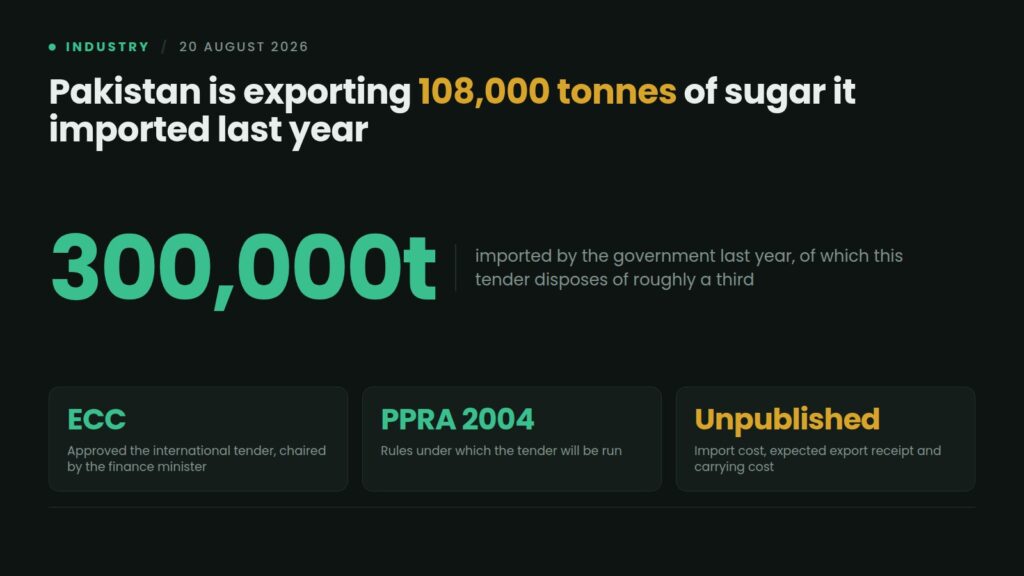
The Economic Coordination Committee has approved an international tender to export 108,000 metric tons of sugar held by the Trading Corporation of Pakistan.
The decision was taken Wednesday at a meeting chaired by Finance Minister Muhammad Aurangzeb, with the tender to run under PPRA Rules 2004.
The detail that makes this worth reading: the sugar being exported is part of 300,000 metric tons the government imported last year, on the recommendation of the Steering Committee on Sugar.
Bought abroad, stored, sold abroad
Strip away the procedure and the transaction is straightforward. The state bought sugar on the world market in dollars, brought it to Pakistan, held it in storage, and is now selling it back onto the world market.
Every stage of that carries a cost the exchequer bears. Import freight and handling. Storage over months, with sugar requiring dry conditions and degrading if it does not get them. Financing on the capital tied up. Then export freight and handling again.
The recovery is whatever an international tender fetches. Sugar imported into a domestic shortage is bought at elevated prices; sugar tendered out of surplus is sold at whatever the market offers. The spread between those two conditions is a loss before a single logistics cost is counted.
No figure for the original import cost, the expected export receipt, or the carrying cost has been published. That absence is itself informative.
The cycle is the point
Pakistan has run this loop repeatedly. Prices rise domestically, the government permits or arranges imports, the crop and the imports arrive together, a surplus appears, exports are allowed to clear it, stocks tighten again, and prices rise.
The mechanism generating it is the lag between the decision and the harvest. A shortage becomes visible when prices spike, but the decision to import takes months to work through procurement, shipping and distribution. By the time the sugar lands, the domestic crop it was meant to supplement has often already come in.
The state ends up buying at the top of the price cycle and selling at the bottom of it, in dollars both ways, in a country holding reserves of $18.4 billion.
Why sugar specifically
Sugarcane is not an ordinary crop in Pakistan’s political economy, and that explains why this particular market keeps producing these outcomes.
Cane has a support price and mills are obliged to purchase it, which is precisely the certainty cotton growers lack — and precisely why cotton area has been drifting into cane for years. Guaranteeing the grower a price and the mill a supply produces reliable planting, and reliable planting produces surpluses in good years that then have to be disposed of.
Sugarcane is also among the most water-intensive crops grown in Pakistan, cultivated in a country with acute water stress. Every tonne exported represents water that could have supported a less thirsty crop.
The contrast with tobacco this month is instructive. Tobacco growers are being offered Rs350 per kilogram against an official rate of Rs740 because nobody enforces it. Cane growers get their price, mills have to buy, and the state carries the resulting surplus. Two agricultural support regimes, opposite failure modes.
The case for doing it anyway
Given the stock exists, exporting it is defensible.
Sugar in storage is a depreciating asset generating no return and accruing carrying costs every month. Releasing it into the domestic market instead would depress local prices and hit the same growers and mills the support regime exists to protect. An international tender under PPRA rules is at least a transparent disposal route, and it earns foreign exchange rather than spending it.
The criticism is not of the export. It is of the position that made the export necessary.
Why the state is holding it at all
One question rarely asked about these episodes is why the government owns the sugar rather than the private sector.
Pakistan has a large, commercially sophisticated sugar milling industry entirely capable of importing when domestic supply is short. It does not do so at scale during a shortage, because a mill has no incentive to import a commodity whose domestic price is high — the high price is the mill’s margin.
So the state steps in as importer of last resort to protect consumers from the price, then becomes the holder of the resulting surplus when the crop arrives. The Trading Corporation of Pakistan ends up carrying commodity price risk that no part of its mandate equips it to hedge.
The alternative used elsewhere is a strategic reserve with published rules — defined trigger prices for release and replenishment, and a mandate to buy low and sell high rather than the reverse. That is a different institution from an ad hoc committee recommending an import when prices spike.
What should be published
Three numbers would settle whether this was a costly error or reasonable insurance against a shortage that did not materialise.
What the 300,000 tonnes cost to import. What the 108,000 tonnes fetches at tender. What storage and financing cost in between.
All three are known to the Trading Corporation of Pakistan. None has been released. Until they are, the question of who decided to import 300,000 tonnes, on what forecast, has no answer — and the same committee will make the same decision the next time prices spike.
Related: The Official Tobacco Price Is Rs740. Growers Are Being Offered Rs350.