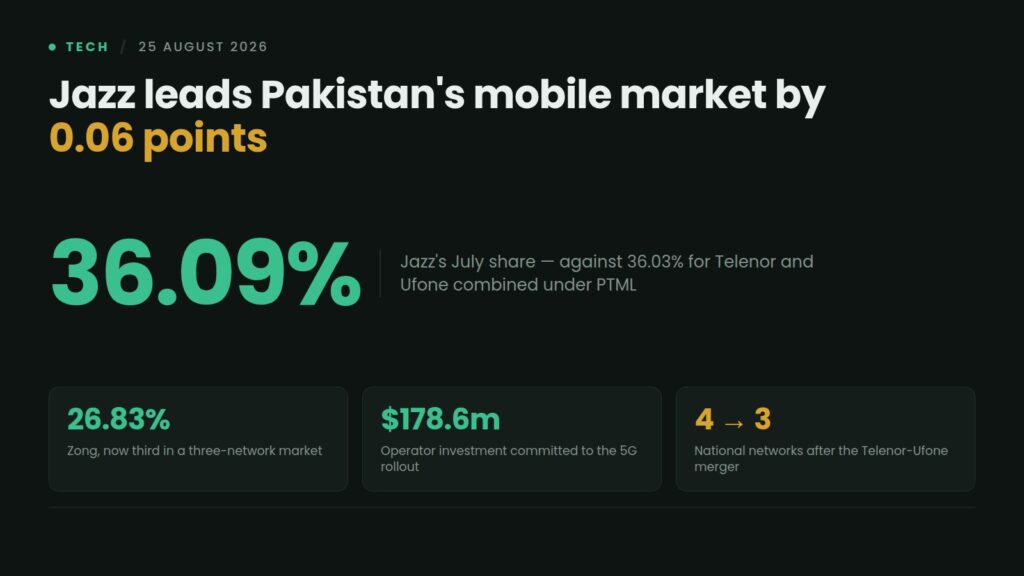
PTA’s July 2026 subscriber data shows Jazz slipping to 36.09 percent of the market from 36.25 percent, with Ufone up to 14.97 percent and Zong to 26.83 percent.
Those are movements of roughly a tenth of a percentage point. On their own they are noise.
Add two of the lines together and the picture changes completely.
The market now has two leaders, not one
The reported shares for July:
- Jazz — 36.09% (from 36.25%)
- Zong — 26.83% (from 26.72%)
- Telenor — 21.06% (from 21.17%)
- Ufone — 14.97% (from 14.81%)
- SCO — 1.04% (from 1.05%)
Telenor Pakistan and Ufone merged into PTML under PTCL in July. They are still reported as separate lines while subscriber bases and networks are integrated, but commercially they are one operator.
Combined: 36.03 percent.
Against Jazz’s 36.09 percent, that is a gap of six hundredths of a percentage point. Pakistan’s mobile market, led by a single dominant operator for well over a decade, now has two players of effectively identical size.
Why that matters more than the monthly drift
Mobile networks are a scale business in the most literal sense. Spectrum, base stations, core network and backhaul are largely fixed costs; each additional subscriber on an existing network costs almost nothing to serve. The operator with the largest base spreads capital expenditure across more revenue and can therefore invest more per rupee earned.
For years that advantage sat with one company. A challenger at 21 percent and another at 15 percent were both sub-scale against a 36 percent incumbent, and neither could fund a network build that would close the gap.
One combined entity at 36 percent can. It also removes an operator from the market — four national networks become three — which changes the competitive arithmetic in both directions. Fewer players usually means less price competition. It can also mean the survivors are finally large enough to invest.
The capital numbers behind it
Operators have committed $178.6 million to Pakistan’s 5G rollout, which has reached 1.3 million users across 23 cities on more than 1,200 sites since the March spectrum auction.
That figure is best read against the constraint the industry actually faces. Operators earn rupees and buy equipment and spectrum in dollars. $178.6 million is a meaningful commitment in that context and a modest one against the cost of national 5G coverage — which is precisely why consolidation to two scale players matters. Three networks investing at this level go further than four.
The regulator appears to have reached the same conclusion. Having imposed Rs3.41 billion in service quality penalties over four years, the government has now ruled out further fines — an explicit judgement that money is better spent on networks than on penalties.
What subscribers should expect
Consolidation of this kind produces a predictable sequence, and Pakistani users are in the early part of it.
Network integration first — combining two sets of towers and spectrum holdings generally improves coverage and capacity, because each network fills gaps in the other. Then rationalisation: overlapping sites in dense areas get consolidated, and duplicate retail and back-office functions removed.
Pricing is where it gets less comfortable. Pakistan has had some of the lowest mobile tariffs anywhere, sustained by four operators competing hard for a price-sensitive market. Three operators, two of them at similar scale, is a structure that historically supports firmer pricing.
Whether that materialises depends on whether Jazz and the merged entity compete for share or settle into a comfortable duopoly with Zong. That is the question the regulator will need an answer to, and it is not one licence conditions address.
Zong is the one with a decision to make
Lost in the arithmetic of the top two is the operator sitting between them and the exit.
Zong at 26.83 percent is comfortably third and roughly nine points behind either leader — large enough to matter, not large enough to enjoy the same scale economics. In a three-network market, that is the least comfortable position: too big to be a niche player, too small to match the leaders’ investment capacity site for site.
It also has the most visible strategic answer already in motion. Zong launched Z-Wallet with Zindigi this month, embedding bank-grade financial services inside an app with 22 million monthly active users. Building revenue that does not depend on selling data at Pakistani prices is a rational response to being third in a consolidating market.
The number to watch
Not monthly market share, which will keep moving in tenths of a point and mean very little.
Watch when PTA starts reporting Telenor and Ufone as a single line, because that indicates technical integration is complete rather than merely legal. Watch average revenue per user, where any pricing shift appears first. And watch the geographic spread of the next tranche of 5G sites — whether a larger, better-capitalised challenger extends coverage beyond the 23 cities that already had service.
The case for allowing this merger was that scale would fund investment. The next twelve months are when that gets tested.
Related: Pakistan Has 1.3 Million 5G Users. Plenty of People Still Cannot Get 4G.