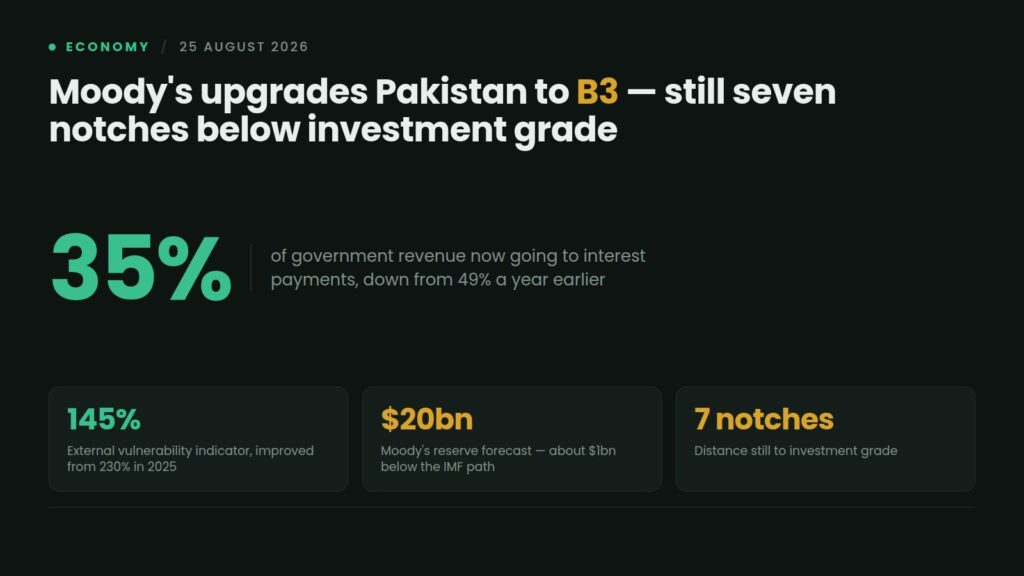
Moody’s has upgraded Pakistan’s sovereign credit rating from Caa1 to B3, with a stable outlook.
It is a one-notch move. It leaves Pakistan seven notches below investment grade.
Both of those facts matter, and the second is doing more work than the coverage suggests.
What actually improved
Two numbers carried this upgrade, and both are genuine.
Interest payments fell to 35 percent of government revenue in FY2026, from 49 percent in FY2025.
That is the single most important solvency metric a rating agency looks at, because it measures how much of what the state collects is spoken for before it does anything. Half of every rupee of revenue going to creditors leaves nothing for anything else. Just over a third is still severe and is a different order of distress.
The external vulnerability indicator improved to 145 percent in 2026 from 230 percent in 2025. That ratio compares external debt falling due against reserves available to meet it. Above 100 percent means obligations exceed the buffer; 230 percent meant Pakistan needed more than twice its reserves to cover the year’s external payments, which is the arithmetic of a country one bad quarter from a default conversation.
Both improvements trace to the same source: the collapse in interest costs that also produced the FY26 fiscal deficit of 2.6 percent of GDP, and the reserve rebuild from crisis levels to $18.4 billion.
What Moody’s said in the same breath
The list of structural weaknesses is not softened, and it reads as a summary of everything covered on this site over the past fortnight.
- A small export base
- Minimal foreign direct investment
- Heavy dependence on remittances
- A narrow revenue base
- A fragile external position
Together, the agency said, these leave Pakistan exposed to shifts in external financing conditions. It also noted that international surveys continue to point to weak rule of law and control of corruption.
Each item has a number attached from recent data. FDI at $179 million in July, down 20 percent year-on-year. Remittances above $41 billion — more than twice the reserve buffer, and roughly twenty times annualised FDI. The FBR missing its IMF-agreed collection target by Rs975 billion. Textile exports growing 8 percent while textile imports grew 14.8 percent.
Moody’s upgraded the rating and described an economy that has not fixed any of the things that caused the crisis.
The reserve forecast is a warning
The detail most worth pulling out: Moody’s projects reserves reaching only $20 billion by fiscal year-end — about $1 billion below what has been understood with the IMF.
The State Bank’s own forecast is above $21 billion. So the agency granting the upgrade is simultaneously saying it expects Pakistan to fall short of the reserve path underpinning its programme.
A billion dollars is not a rounding error in a $20 billion buffer, and it is the kind of gap that becomes a live issue at a review. The fourth Extended Fund Facility review and second Resilience and Sustainability Facility review are already carrying the FBR shortfall.
What B3 is worth in practice
Sovereign ratings matter through borrowing costs, and the effect is real but bounded.
Caa1 is the tier at which many institutional mandates simply cannot hold the paper. B3 is still deep in speculative territory, but it widens the pool of funds permitted to buy — which lowers the yield Pakistan pays on any future eurobond issue and improves terms on commercial borrowing. It also feeds into the pricing of trade finance for importers, which is a direct cost to Pakistani businesses.
S&P moved Pakistan to B in July, citing improved political stability supporting reform implementation. Two agencies moving in the same direction within two months is a stronger signal than either alone.
What it is not is a change in the underlying economy. Ratings are lagging assessments; this one reflects the stabilisation of the past two years, which is already visible in every published statistic.
The honest reading
Pakistan has stopped being a country markets price for imminent default and become a country markets price as a poor credit. That is a real and hard-won improvement, and the people who delivered the interest-cost reduction and the reserve rebuild deserve the credit.
Getting from B3 toward investment grade requires the list Moody’s published: a larger export base, meaningful FDI, a wider tax net, less dependence on remittances. None of those has moved. Several have moved the wrong way this year.
Seven notches is a long way, and every one of them has to be earned by something structural rather than by a favourable rate cycle.
Related: Pakistan’s Fiscal Deficit Hit a 22-Year Low. Cheaper Debt Did Most of the Work.
2 Comments
[…] Moody’s Upgraded Pakistan to B3. That Is Still Seven Notches Below Investment Grade. […]
[…] Related: Moody’s Upgraded Pakistan to B3. That Is Still Seven Notches Below Investment Grade. […]
Comments are closed.