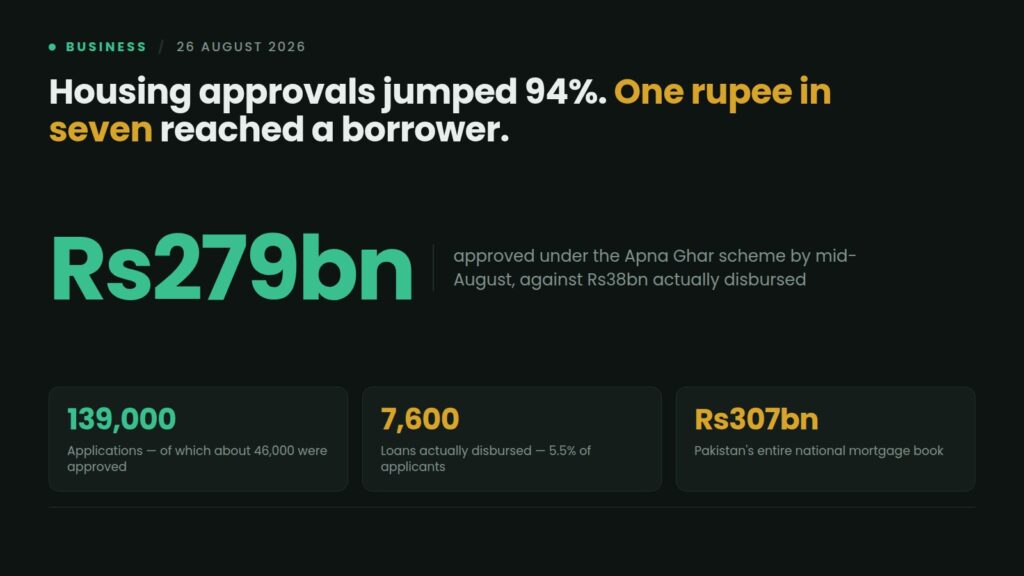
Approved financing under the Prime Minister’s Apna Ghar housing scheme rose 94 percent between the end of June and mid-August — from Rs144 billion to Rs279 billion.
Applications climbed 52 percent to nearly 139,000. Approvals rose 84 percent to over 46,000.
Disbursements reached just over 7,600 loans, worth Rs38 billion.
Follow the funnel
Those four numbers tell a story the headline does not.
- 139,000 applications
- 46,000 approvals — about a third get through
- 7,600 disbursed — about 5.5 percent of applicants have money
- Rs38 billion actually paid out, against Rs279 billion approved
Roughly one rupee in seven that has been approved has reached a borrower.
Some of that gap is timing and nothing more. A mortgage approved in August is not disbursed in August — valuation, title verification, documentation and construction milestones all sit between approval and money. On a scheme scaling quickly, a large approved-but-undisbursed balance is expected.
But 84 percent growth in approvals against 59 percent growth in disbursements means the gap is widening rather than closing. Approvals are being generated faster than the machinery behind them can convert into loans.
Why mortgage lending barely exists here
The scale explains the enthusiasm. Total housing finance nationwide moved from Rs294 billion at end-June to Rs307 billion in mid-August.
Rs307 billion is the entire country’s mortgage book. Against agriculture financing of Rs1.26 trillion across 3.37 million borrowers, and SME financing of Rs1.05 trillion across roughly 330,000 businesses, housing is the smallest of the three by a wide margin — in a country of more than 250 million people with a large and well-documented housing shortage.
Banks have avoided mortgages for a specific reason, and it is not lack of demand. A mortgage is a twenty-year loan secured on property. If the borrower stops paying, the lender’s recourse is to take the property — and enforcing that in Pakistan has historically meant years of litigation with an uncertain outcome. A security interest you cannot realise is not really security.
Which is why the most consequential item here is not the growth rate.
The recovery law is the actual reform
Finance Minister Muhammad Aurangzeb pointed to the Financial Institutions (Recovery of Finances) Amendment Act, 2026, saying stronger recovery rules could encourage banks to increase mortgage lending.
That is the correct diagnosis. Subsidised markup makes a loan cheaper for the borrower; it does nothing about whether the bank can recover its money. Only enforcement changes the risk calculation, and only a changed risk calculation produces mortgage lending at scale without permanent state support.
It also cuts the other way, and the scheme’s own terms make that worth stating plainly. A 90:10 loan-to-value ratio means the borrower puts down a tenth; a 65 percent debt-burden ratio allows nearly two-thirds of documented income to service debt. Both are generous by any standard.
Faster repossession applied to thinly capitalised borrowers carrying heavy debt burdens is a policy that will eventually take houses from families. That is the trade-off in every functioning mortgage market, and it is worth being honest that it is being made.
What is holding disbursement back
The scheme’s own design tells you where the bottleneck sits. Among the incentives listed are streamlined property valuation and documentation, digital processing and extended tenors — which is an admission that valuation and documentation were the binding constraints.
Both trace back to the same place. Establishing what a property is worth and who legally owns it requires a land record, and Pakistan’s are provincial, unevenly digitised, and different again for cantonment, cooperative society and development authority land. A bank cannot lend against a title it cannot verify quickly.
That is the same infrastructure gap that makes tokenising real estate a bad idea in this market, and the same reason a mortgage takes months here and days elsewhere. Approvals can be generated by policy. Disbursements wait on a registry.
Until that changes, a widening gap between approved and disbursed is the predictable outcome of pushing volume through the front of the funnel.
Where this fits
Housing is the third leg of a broader credit push. The government is targeting Rs1.5 trillion each in agriculture and SME financing by June 2027, rising to Rs2 trillion each by June 2028.
All of it is running with the same tailwind. Falling policy rates cut instalments for borrowers and collapsed the risk-free yields that made government paper more attractive to banks than lending. SME credit crossed Rs1 trillion for the first time on that shift; auto loans hit a record Rs386 billion on it.
Housing is the same story with a longer tenor — which makes it the most exposed of the three when rates turn. A twenty-year floating-rate mortgage written at today’s instalment is a very different obligation at tomorrow’s.
The number to watch is not approvals. It is whether Rs279 billion of approvals becomes Rs279 billion of disbursements, and what the arrears look like on the loans written this year once the rate cycle turns.
Related: Auto Loans Hit a Record Rs386 Billion. Credit Cards Are the Line to Watch.