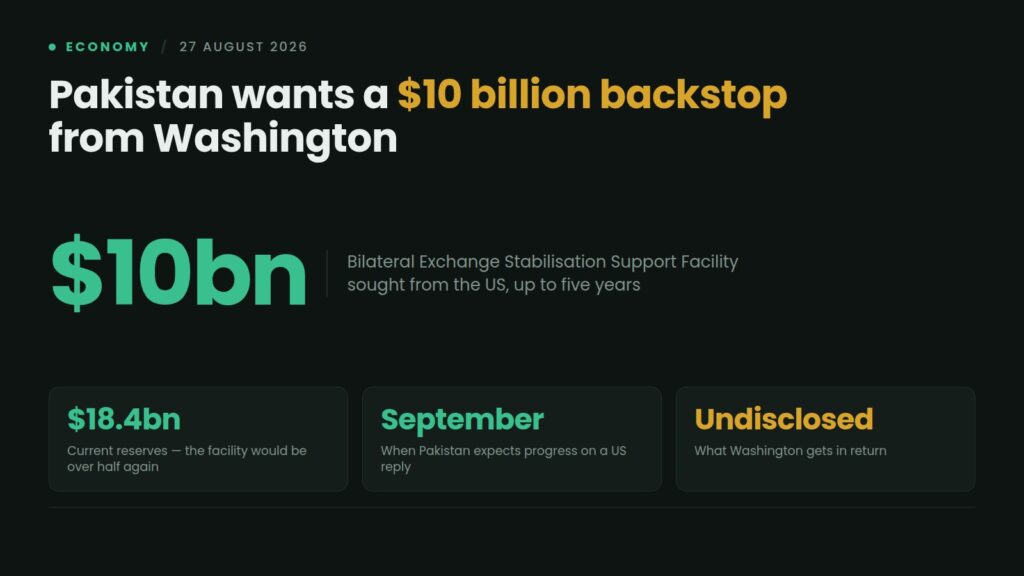
Pakistan is asking the United States for a $10 billion Bilateral Exchange Stabilisation Support Facility, with maturity of up to five years. Finance Minister Muhammad Aurangzeb put the proposal to US Treasury Secretary Scott Bessent, and officials expect a response within a couple of months, with progress anticipated by September.
The framing is unusual, and deliberately so. Aurangzeb described it not as a loan or a credit line but as a signal about currency stability and exchange rate stability, intended to support market access and attract private investment. An adviser called it a potential backstop and confidence signal.
That language is doing something specific, and it is worth unpacking before deciding whether this is a good idea.
What a backstop actually does
The instrument being described is closer to a swap line than to borrowing. A country does not draw on it in normal conditions; the facility sits available, and its existence changes how markets price the currency.
The mechanism is straightforward. Currency pressure in a country like Pakistan is partly self-fulfilling — importers accelerate purchases, exporters delay converting receipts, and households move into dollars, all because everyone expects the rupee to weaken. A credible backstop breaks that loop by making the expectation unreasonable. If the money is available, the run does not start, and the facility is never used.
Against reserves of $18.4 billion, a $10 billion facility is more than half the existing buffer again. That is a meaningful change in the arithmetic anyone modelling Pakistan’s external position would run.
Why it is being sought now
Two things converged.
The economics improved enough to make the request plausible. Moody’s upgraded Pakistan to B3 this week, citing interest payments falling to 35 percent of government revenue from 49 percent and the external vulnerability indicator improving from 230 percent to 145 percent. A country asking for a backstop is a better prospect when it has just been upgraded than when it is being downgraded.
The diplomacy improved too. Pakistan’s role in brokering talks around the Iran conflict raised its standing in Washington, and a request of this kind is a political decision before it is a financial one.
Moody’s also forecast reserves reaching only $20 billion by fiscal year-end — about a billion below what has been understood with the IMF. A backstop covering exactly that kind of shortfall has obvious appeal to a government heading into a programme review carrying an FBR revenue miss.
The part that is not being discussed
What the United States gets has not been stated publicly, and facilities of this size are not granted as favours.
Arrangements like this typically carry conditions — on policy, on alignment, on access to something the provider wants. Pakistan’s mineral resources and its geographic position have both featured in recent commercial and diplomatic conversations with Washington. None of that appears in the public account of these talks, which describes a constructive meeting and an expected reply.
A $10 billion commitment from the US Treasury to a country seven notches below investment grade is not a technical decision taken by officials. It requires political authorisation, and political authorisation has a price. Pakistani readers are entitled to know what it is before the facility is signed rather than after.
The risk of a backstop that works
There is a harder objection, and it applies precisely when the facility does its job.
Pakistan’s external fragility is not a confidence problem. It is a structural one, and Moody’s listed it plainly this week: a small export base, minimal foreign direct investment, heavy dependence on remittances, a narrow revenue base. FDI was $179 million in July, down 20 percent year-on-year. Textile exports grew 8 percent while textile imports grew 14.8 percent. The FBR missed its target by Rs975 billion.
A confidence backstop removes the pressure that has been forcing those problems onto the agenda. Reform in Pakistan has historically happened under duress and stopped when the duress lifted. A facility that makes the next balance-of-payments squeeze survivable also makes it postponable.
That is not an argument against the facility. It is an argument for being clear-eyed about what it buys: time, on terms not yet disclosed, to fix things that a decade of crises has not yet fixed.
What to watch for
The reply is expected within two months, and three things will tell you what it is worth.
Whether it is genuinely undrawn. A standby facility that is never used costs nothing and delivers the confidence effect. One that is drawn to plug a reserve gap is borrowing with a friendlier name.
What is published alongside it. If the terms are disclosed in full, this is a straightforward financial arrangement. If they are not, the omission is the story.
What happens to the reform agenda. The clearest test of whether a backstop is a bridge or a cushion is what the government does with the year it buys.
Related: Moody’s Upgraded Pakistan to B3. That Is Still Seven Notches Below Investment Grade.