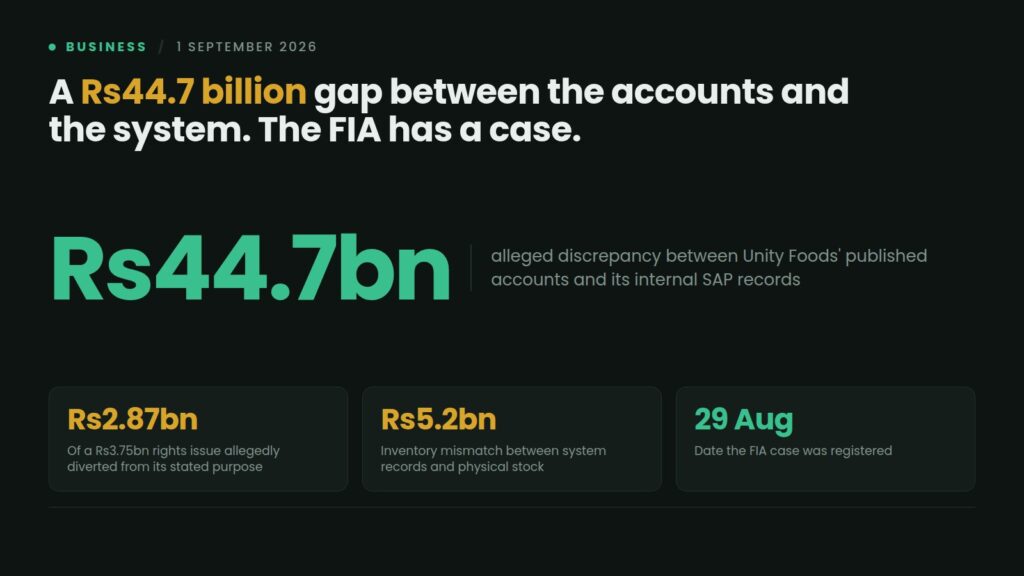
An SECP investigation into Unity Foods Limited, a company listed on the Pakistan Stock Exchange, has led to an FIA case registered on 29 August 2026 under provisions covering criminal breach of trust, fraud and falsification of records.
The alleged discrepancies are large. The largest single item is a Rs44.7 billion gap between the company’s published accounts and its own internal SAP records.
These are allegations at the investigation stage. Nothing has been proven, and the company’s response has not been reported. The figures are worth setting out precisely because of what they would mean if established.
What the regulator says it found
- Rs3.75 billion raised in a 2019 rights issue for expansion and diversification
- Rs2.87 billion of that allegedly diverted from its stated purpose, with no evidence of utilisation
- Rs5.318 billion in payments to the former chief executive’s mother, claimed as loans
- Rs2.6 billion advanced through a subsidiary to undisclosed parties
- Rs44.7 billion discrepancy between published accounts and internal SAP records
- Rs5.2 billion inventory mismatch between system records and physical stock
- Rs5 billion in aged receivables without evidence of delivery
The FIA is examining the criminal liability of the accused and the role of directors, officers, beneficiaries and connected parties.
Why the SAP gap is the number that matters
Of everything listed, the Rs44.7 billion discrepancy is the one with the widest implications, and it is worth explaining why.
SAP is the enterprise system a company runs its actual operations on — purchases, sales, inventory movements, payments. Published accounts are supposed to be a summary of what that system records. The two are different views of the same underlying business, and they should reconcile.
A gap of that size between them is not a classification error or a judgement call about provisioning. If established, it would mean the numbers presented to shareholders described a company materially different from the one the internal system was tracking.
The Rs5.2 billion inventory mismatch points the same way. Inventory is countable — it exists in a warehouse or it does not. A discrepancy between system records and physical stock is the most straightforwardly verifiable item on the list.
The rights issue is the shareholder question
The 2019 rights issue is where the harm to investors, if any, is clearest.
A rights issue asks existing shareholders for new money against a stated purpose — here, expansion and diversification. Shareholders subscribing were funding a specific plan. The allegation is that Rs2.87 billion of the Rs3.75 billion raised went elsewhere, with no evidence of use for the declared purpose.
That is the transaction where a listed company’s obligations to its investors are most explicit, and it is the one where a regulator has the clearest standing to act.
The Rs5.318 billion characterised as loans to a related individual raises a separate governance question: related-party transactions require disclosure and board approval precisely because they are the route through which company money leaves without a commercial rationale. The SECP’s finding is that documentation and approvals were absent.
The sector context
Unity Foods operates in edible oils, and the sector has had a conspicuous few weeks.
The Supreme Court upheld a penalty against the vanaspati manufacturers’ association for collective price-setting between 2007 and 2009 — conduct that took seventeen years to reach a final judgment. The government launched a National Olive Value Chain Policy aimed at a $4 billion annual edible oil import bill. The ECC approved exporting 108,000 tonnes of sugar the state had imported the previous year.
Edible oil is a large, import-dependent, thinly documented sector with substantial cash flows. That combination is where governance failures tend to be found when somebody looks.
The audit question
A listed company in Pakistan files audited accounts every year. Those accounts carry an auditor’s opinion, and the auditor has access to the same systems the SECP examined.
If discrepancies of this scale were present across multiple reporting periods, the obvious question is what the audits found and what they said. Inventory verification and reconciliation of the general ledger to the operating system are standard procedures, not specialist forensics.
That is not an accusation against anyone. It is the line of inquiry a case built on a gap between published accounts and internal records inevitably opens — and the FIA’s stated scope, covering directors, officers and connected parties, is broad enough to reach it.
For anyone holding Pakistani listed equities, that is the question with implications beyond one company.
What this says about enforcement
The referral itself is the encouraging part. A securities regulator investigating a listed company, reaching findings and passing them to a criminal investigation agency is the process working as designed.
The test is what follows. The vanaspati case took seventeen years from conduct to final judgment and produced a Rs30 million penalty. The SECP referred an alleged Rs408.6 million Ponzi scheme to the FIA earlier this month. Referral is not resolution.
For minority shareholders — the people the disclosure regime exists to protect — what matters is whether a case registered in August 2026 reaches a conclusion while the facts are still recoverable and the money is still traceable.
Related: They Fixed Prices Downward, at the Government’s Request. The Supreme Court Still Fined Them.