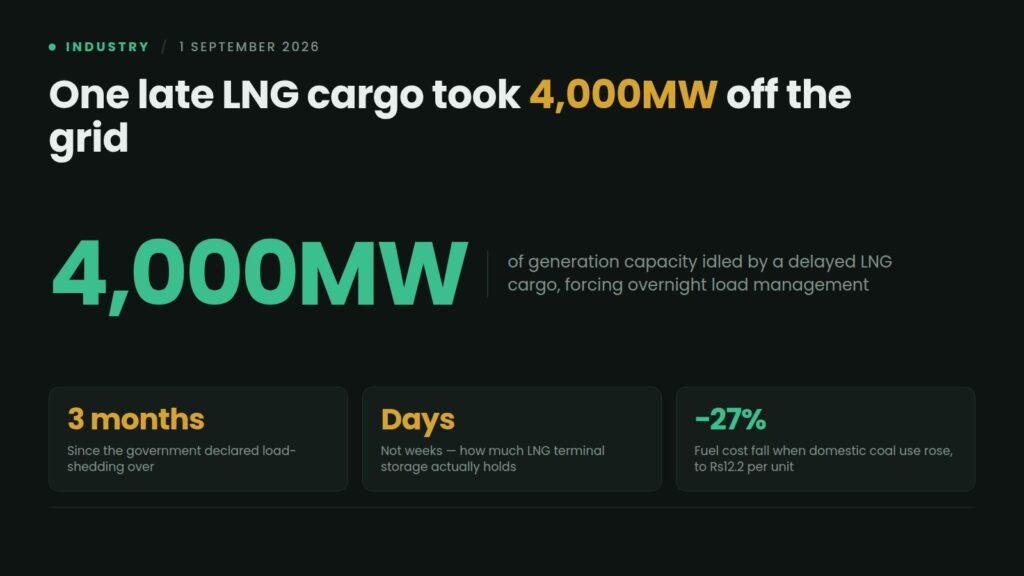
A delayed LNG cargo took roughly 4,000 megawatts off Pakistan’s generation capacity, forcing distribution companies into overnight load management. Power Minister Awais Leghari apologised, saying the outages were caused by factors beyond the government’s immediate control.
The government declared the end of load-shedding roughly three months ago.
One ship being late should not remove 4,000MW from a national grid. That it did is the finding here, not the delay.
What 4,000MW represents
Pakistan’s installed generation capacity runs well above peak demand on paper. The country has spent years adding plants and now carries substantial capacity payment obligations for them — payments made whether or not the plant generates, and a significant contributor to the Rs1.675 trillion of circular debt.
So a shortfall of this kind is not a capacity problem. It is a fuel problem. The plants exist, they are contracted, and they were idle because the gas to run them had not arrived.
RLNG-fired generation is a large block of Pakistan’s dispatchable capacity — the plants that respond to demand rather than depending on water flow or sunlight. Losing that block at once, at night, is why the load management fell where it did.
Why a single cargo can do this
LNG does not store the way coal or furnace oil does. It is kept as a cryogenic liquid, it boils off continuously, and terminal storage holds days of supply rather than weeks. A country running gas plants on imported LNG is running them on a delivery schedule, not on a stockpile.
Miss a cargo and there is no buffer to draw on. The plants stop.
That fragility is structural to the fuel rather than a failure of anyone’s planning, and it is the trade-off accepted when a system leans on imported gas: cleaner and more flexible than the alternatives, and dependent on ships arriving on time.
It also sits in dollars. Every cargo is paid for in foreign exchange, against reserves of $18.4 billion — the same constraint that puts a $2.5 billion annual coal import bill and a $4 billion edible oil bill on the same balance sheet.
The declaration was the mistake
The apology is more defensible than the announcement that preceded it.
Declaring the end of load-shedding tells households and businesses they can plan around a reliable supply. Factories schedule shifts, cold chains are relied upon, and firms decide against buying backup generation. When the supply then fails without warning, the cost falls on people who acted on the assurance.
Unannounced outages are worse than scheduled ones for exactly that reason. A published schedule lets a business work around it. An unannounced cut at night does not.
A system dependent on imported fuel deliveries cannot honestly promise uninterrupted supply, because the promise is contingent on shipping. Saying so plainly costs less credibility than declaring victory and apologising afterwards.
This is what accelerates grid defection
The deeper cost is not the lost hours. It is what each episode does to the decision every Pakistani business and household is already making about whether to stay on the grid.
A decade of rising tariffs has pushed consumers toward rooftop solar and, increasingly, off the grid entirely. The customers who can afford to leave are the ones who consume most and pay reliably — and when they go, the system’s fixed costs are spread across a smaller base, raising tariffs for those who remain and pushing the next tier toward the same decision.
Reliability is the grid’s remaining argument. A connection that costs more than solar but never fails still has a case. A connection that costs more and fails without warning does not.
Every unannounced outage converts a marginal solar buyer into a committed one, and that decision is not reversed when the next cargo docks.
Who absorbs an outage like this
Overnight load management sounds like the least disruptive timing available, and for households it largely is. For industry it is not.
Textile mills, which anchor Pakistan’s largest export sector, run continuous processes. Spinning and dyeing lines do not stop and restart cleanly — an unplanned cut mid-run spoils work in progress, and bringing a plant back up costs hours. Night shifts exist precisely because the machinery is meant to keep running.
That sector has already had a difficult few weeks: a goods transport strike that backed containers up at Karachi’s ports, diesel rising Rs72 a litre before a negotiated cut, and a cotton crop roughly half the size of 2023’s forcing mills to import raw material. Textile exports grew 8 percent year-on-year in July while textile imports grew 14.8 percent.
An unannounced power cut is the kind of cost that does not appear in any energy statistic and shows up later in an order book.
What would reduce the exposure
Not better scheduling. Fuel mix.
The Power Division’s own data makes the point: increased use of domestic coal brought average fuel cost down to Rs12.2 per unit, a 27 percent reduction from Rs16.8. Domestic fuel is paid for in rupees and does not arrive by ship.
The same ministry has spent this month tightening imported coal procurement to recover Rs380 million a year through better discounts. Useful housekeeping. A single late LNG cargo cost the system more than that in a night.
Related: Circular Debt Grew Rs364 Billion. A Rs98 Billion Budget Cut Explains Part of It.