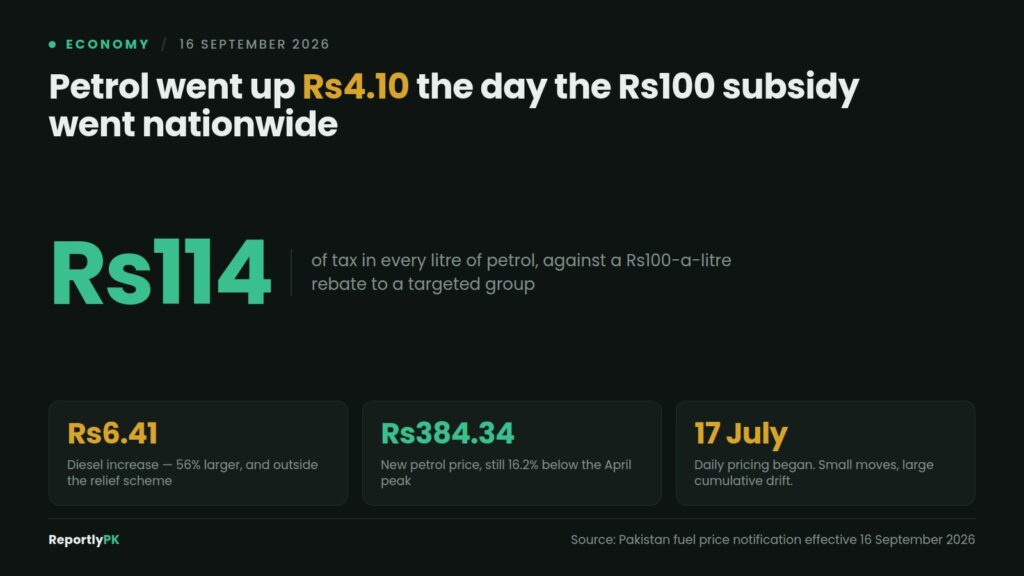
The Pakistan fuel price revision effective 16 September raises petrol by Rs4.10 to Rs384.34 a litre and high-speed diesel by Rs6.41 to Rs415.83. It takes effect on the same day the government’s Rs100-a-litre fuel relief scheme goes nationwide.
The subsidy’s first job, in other words, is to absorb an increase announced three days after it was.
Rs114 of every petrol litre is tax
At the new price, the government collects Rs114 per litre of petrol in taxes and duties and Rs100 per litre of diesel. That is 29.7 percent of the petrol pump price and 24.1 percent of the diesel price.
Set the two policies beside each other. The state takes Rs114 a litre from every petrol buyer, and returns Rs100 a litre to motorcyclists and owners of cars up to 800cc, within monthly caps, out of a Rs75 billion budgetary grant.
For a subsidised rider the effective tax on their quota falls to about Rs14 a litre. For everyone else it stays at Rs114. This is not an argument against the scheme — targeting relief at low-income users is a defensible choice, and a levy on fuel is one of the few taxes Pakistan actually collects. It is an argument for describing it accurately. The relief is a partial rebate of the state’s own levy to a chosen group, financed by borrowing, not a reduction in the cost of fuel.
Diesel rose more, and diesel is the one that matters
Petrol went up 1.08 percent. Diesel went up 1.57 percent — an increase 56 percent larger in rupee terms.
High-speed diesel is the fuel that moves freight, runs tractors and powers the generators that keep small industry going through a cut. Its price does not stay in the transport line of the consumer price index. It travels into food, into construction materials, into anything that arrives on a truck.
And diesel receives no relief. The fuel scheme covers motorcycles, Qingqi rickshaws and cars up to 800cc — petrol vehicles. The fuel with the larger increase and the broader inflationary reach is outside the scheme entirely.
That is the gap worth watching over the next quarter. A subsidy that softens the petrol component of the CPI while diesel runs uncovered will flatter the headline inflation number more than it improves the cost of living.
The scale of relief against the scale of the rise
For a motorcyclist drawing the full 20-litre monthly quota, the subsidy is worth Rs2,000 a month. This increase costs them Rs82 on the same 20 litres.
The relief comfortably swamps the rise, roughly twenty-four times over, and for that household the scheme is doing exactly what it was designed to do. A haulier running a diesel truck through a few hundred litres a month gets the full Rs6.41 and nothing back.
Prices are still well below April
Context the announcement does not supply. Petrol peaked at Rs458.41 on 3 April and diesel at Rs520.35 the same day. Against those highs, petrol is down 16.2 percent and diesel 20.1 percent.
This is a rise inside a fall. Anyone reading Tuesday’s announcement as a return to April conditions is reading it wrong, and the government would do itself a favour by publishing the comparison rather than leaving it to be inferred.
Daily pricing hides the drift
Pakistan moved to daily fuel price setting on 17 July, after renewed hostilities between Iran and the United States made fortnightly revisions unworkable.
The change is defensible. Daily pass-through tracks the import cost more honestly, removes the fortnightly political set-piece, and stops the state absorbing losses between revisions.
It has a side effect that deserves naming. Sixty small adjustments do not register the way four large ones do. A rupee here and two rupees there accumulate without any single announcement that anyone argues about, and the cumulative move over a quarter can be substantial while every individual step looks trivial. Under a daily regime the number that matters is not today’s change. It is the level three months ago.
What it depends on
All of it rests on crude. The State Bank held the policy rate at 11.5 percent last week against an inflation path built on oil near $95 a barrel, and Brent has been trading above $100 on the same Middle East tensions that forced the move to daily pricing.
If that holds, the Rs75 billion allocated to the relief scheme buys fewer months than three, because every rupee on the pump price is a rupee the subsidy has to work harder against. The scheme was sized for a fuel price. The fuel price is moving.
Related: Pakistan Is Delivering a Rs75 Billion Subsidy Over SMS. That Is the Right Call.