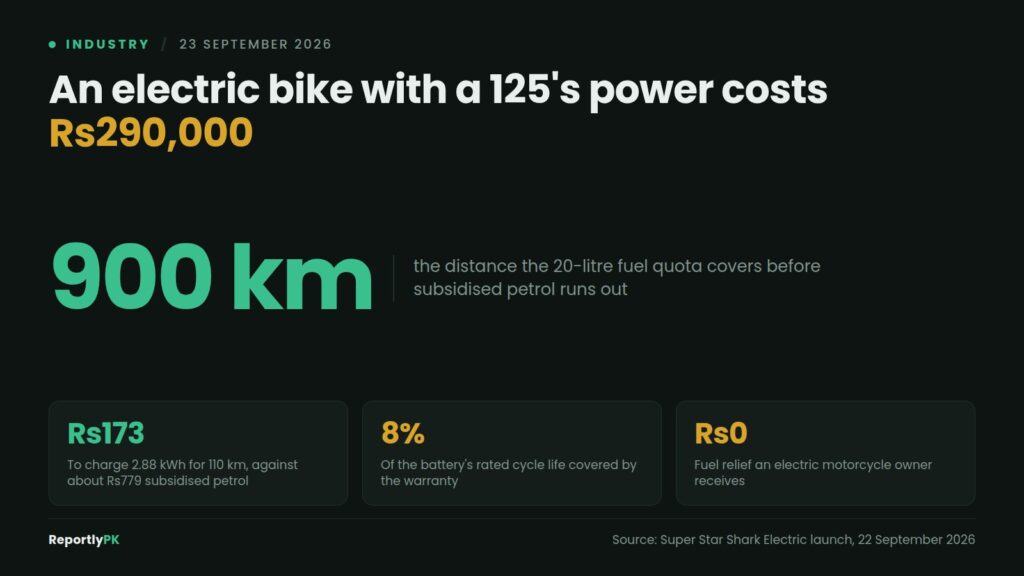
The Shark Electric motorcycle launched by Super Star this week is a 2,000W machine on a conventional motorcycle frame — 17-inch alloys, disc brakes front and rear, and a claimed top speed of 120 km/h. It costs Rs290,000 in its 30Ah form and Rs325,000 with the larger 40Ah battery.
The Rs75 billion fuel relief scheme now running nationwide pays motorcyclists Rs100 a litre on 20 litres a month. It pays the owner of this bike nothing.
What it is
- Rs290,000 — 72V 30Ah, quoted range 80 to 100 km
- Rs325,000 — 72V 40Ah, quoted range 100 to 120 km
- LiFePO4 battery chemistry, 8A charger included
- Economy and sport modes, reverse function, digital instrument panel
- Warranty of three years or 18,000 km, whichever comes first
The positioning is the interesting part. This is not a scooter. It is styled and laid out as a direct replacement for the 70cc and 125cc commuter motorcycles that carry most of Pakistan, which sold 178,119 units alongside two- and three-wheelers in August alone — more than eleven for every car.
The running cost is not close
Work it through on the 40Ah version. A 72V 40Ah pack holds 2.88 kWh, and that is quoted to deliver 100 to 120 km.
A 125cc petrol bike covering 120 km at roughly 45 km per litre burns about 2.67 litres. At today’s pump price of Rs392.05 that is about Rs1,045. With the fuel scheme’s Rs100-a-litre relief applied inside the monthly quota, it falls to about Rs779.
Charging 2.88 kWh at a domestic tariff of, say, Rs60 a unit costs about Rs173.
Those assumptions are mine and should be treated as such — fuel economy varies with load and traffic, and Pakistani domestic electricity is charged on slabs that move a household’s marginal rate around considerably. But the gap is wide enough to survive a lot of adjustment. Even against the subsidised petrol price, the electric bike is running at roughly a quarter of the cost per kilometre.
The state is paying people not to switch
Here is where policy cuts across the arithmetic.
The fuel relief scheme is petrol-only. A rider drawing the full 20-litre quota receives about Rs2,000 a month, which over three years comes to roughly Rs72,000 — a quarter of the price of this motorcycle, paid to the owner of the petrol one.
The scheme is defensible on its own terms. It is targeted at low-income users, it reaches them through an SMS system that needs no smartphone, and it was designed to soften a fuel price shock rather than to shape the vehicle fleet. Nobody set out to disadvantage electric two-wheelers.
But the effect is what it is. Pakistan’s stated objective is to cut the oil import bill, and two-wheelers are the highest-leverage place to do it because of sheer volume. The state is currently spending about Rs25 billion a month lowering the running cost of the petrol alternative at exactly the moment a credible electric substitute reaches the market at a purchase price ordinary buyers might finance.
Meanwhile new energy vehicles carry a flat 1 percent sales tax and locally built hybrids pay 18 percent. The tax code is pushing one way and the subsidy the other.
The subsidy runs out at 900 kilometres
The fuel quota has a distance attached to it that nobody has published, and it changes who this bike is for.
Twenty litres a month at roughly 45 km per litre is about 900 km. Past that, the relief is exhausted and the rider pays the full Rs392.05 on every further litre.
For a commuter doing 400 or 500 km a month, the subsidy covers the whole ride and the case for switching is weak. For a delivery rider, a ride-hailing captain or anyone whose motorcycle is a working asset rather than transport to an office, monthly distances run well beyond 900 km — and every kilometre past that point is unsubsidised petrol against roughly Rs1.6 of electricity.
On a 1,200 km month, the difference between subsidised petrol and home charging works out at something in the order of Rs6,500, on the assumptions used above. That is the segment an electric commuter motorcycle should be sold into, and it is the segment the fuel scheme reaches least.
The warranty is the weak point
Three years or 18,000 km sounds generous until it is converted into charge cycles.
At a quoted 110 km per charge, 18,000 km is about 164 full cycles. Lithium iron phosphate cells are commonly rated for 2,000 cycles or more before meaningful capacity loss. The warranty therefore covers roughly 8 percent of the chemistry’s expected working life.
The battery is also the single most expensive component in the vehicle. A buyer weighing Rs325,000 against a cheaper petrol bike is being asked to accept the residual value risk on the part that determines whether the machine is worth anything in year four. That is the disclosure the market needs, far more than a top-speed figure.
What is not disclosed
No assembly location, no local parts content, no dealer or service network, and no indication of battery replacement cost or availability.
Local content matters commercially and fiscally: an electric two-wheeler assembled in Pakistan from imported cells is a different proposition for the import bill than a fully built unit, and a different proposition for the buyer if the importer stops trading. Service network matters more. A petrol 70cc can be repaired in any workshop in any town in the country. A 72V battery pack cannot.
The product is credible and the economics are compelling. What is missing is everything that determines whether it is still running in 2031.
Related: Pakistan Is Delivering a Rs75 Billion Subsidy Over SMS. That Is the Right Call.