Pakistan’s car assemblers want a notification withdrawn. The Pakistan Automotive Manufacturers Association has asked the government to suspend the Engineering Development Board’s revised rules on commercial used car import, arguing that the changes strip out safeguards and expose local manufacturing to competition it was not built to absorb.
The notification, dated 30 September, is already the subject of a Federal Investigation Agency inquiry. The dispute is therefore running on two tracks at once: whether the policy is right, and whether it was lawfully issued.
What the notification changed
- Minimum capital requirements for importers removed
- Mandatory after-sales service provisions removed
- Inspection duties transferred from EDB to PSQCA
- Third-party post-shipment inspection replaced with pre-shipment certificates
- Proprietorships and partnerships permitted, not only SECP-registered companies
- Scope narrowed to used vehicles, where the previous version covered new and used
Taken together these lower the bar to becoming a commercial importer from a capitalised company with a service obligation to, in effect, anyone able to fund a shipment. The inspection change is the one with consumer-safety content: a pre-shipment certificate is issued before the vehicle leaves its origin market, while post-shipment inspection happens where the buyer is.
The import numbers behind the complaint
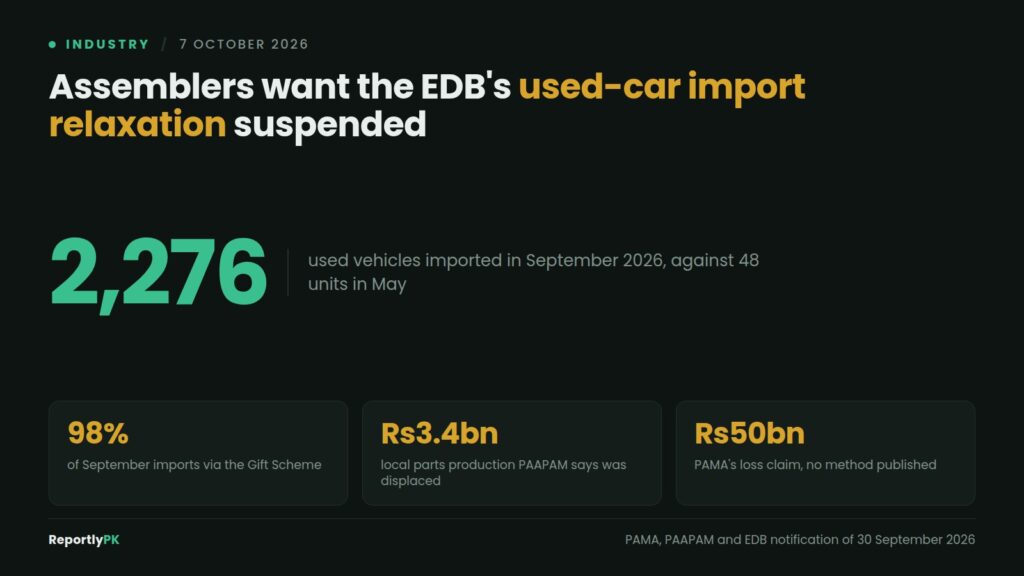
Commercial used vehicle imports went from 48 units in May 2026 to 2,276 units in September — a roughly 47-fold increase in four months. The intervening months were 1,938 in July and 1,445 in August, so the trend is sharply up but not smooth.
One detail in the September figure deserves attention: 2,238 of the 2,276 vehicles came through the Gift Scheme. That is 98 percent, and it means the September surge is overwhelmingly a gift-scheme phenomenon rather than a commercial-import one — which sits awkwardly with a complaint directed at the commercial import notification issued at the end of that month.
The wider context is two earlier policy moves: the abolition of the Personal Baggage Scheme this year, and duty reductions of 20 to 25 percent on new vehicles in the 2026-27 budget.
Rs50 billion, and Rs3.4 billion
PAMA’s director general put the potential damage from removing the safeguards at “more than Rs50 billion.” No methodology has been published for that figure — no unit assumption, no time period, no statement of whether it counts lost sales, lost investment or both.
A second figure is traceable. Abdul Rehman Aizaz, chairman of the Pakistan Association of Automotive Parts and Accessories Manufacturers, said locally produced cars carry up to 60 percent local parts by value, averaging Rs1.5 million a vehicle, and that September’s 2,276 imports therefore displaced about Rs3.4 billion of local parts production. That arithmetic checks out, and it rests on a stated assumption a reader can argue with.
Both associations represent the manufacturers who would gain from restricting imports, and both figures should be read with that in mind. The gap between the two — Rs50 billion asserted, Rs3.4 billion shown — is wide enough to matter.
Related: Pakistan car imports and NEV volumes, July-August 2026
The importers’ answer
Mian Shoaib Ahmed, chairman of the All Pakistan Car Dealers and Importers Association, said importing used cars “was completely legal if done as per the government regulations” and pointed to the demand that exists for them.
That demand is the part of the argument assemblers rarely engage with directly. Buyers choosing an imported used vehicle over a locally assembled new one are responding to price, specification and delivery time. Manufacturers argue the comparison is distorted by a depreciation allowance worth up to 36 percent on imports, which lowers assessed value and therefore duty.
Both can be true. A depreciation allowance can be too generous and the local product can still be uncompetitive on its own terms.
After-sales service is the clause that will be missed
Of the safeguards the notification drops, the after-sales service obligation is the one whose removal lands on buyers rather than on assemblers. A commercial importer previously had to provide service support; now it does not.
For an imported used vehicle, parts availability is already the weak point. Models brought in from Japan or elsewhere often have no local parts channel, and a buyer discovering that after a failure has limited recourse. Pairing that with the removal of minimum capital requirements compounds the exposure: an importer with no capital base and no service obligation can exit the market entirely, leaving owners with vehicles nobody is obliged to support.
This is also where PAMA’s interest and the consumer interest happen to align, which is worth stating plainly rather than letting it strengthen the association’s case by implication. Assemblers want the obligation restored because it raises their competitors’ costs. Buyers would want it restored for a different reason. Both can hold at once, and the second is the stronger argument.
The procedural question is separate
The FIA has sought EDB records on policies and recruitment. Sources cited in reporting allege the notification was issued without the approval of the competent authority, and the officer who signed it has been repatriated to the Establishment Division.
The Economic Coordination Committee had earlier deferred the matter and directed further work on inspection mechanisms, and Federal Minister Musadik Malik is reported to have held that commercial imports should not reopen until that committee reports. These are allegations and reported positions; the FIA had not issued a statement at the time of reporting, and EDB has not published a response.
If the notification is found to have been issued without authority, it can be withdrawn on that ground alone, and the policy argument PAMA is making never gets tested. That would resolve the immediate dispute while settling none of the underlying questions about depreciation allowances, local content or why demand is moving toward imports.
Those questions are the ones that will return with the next notification.