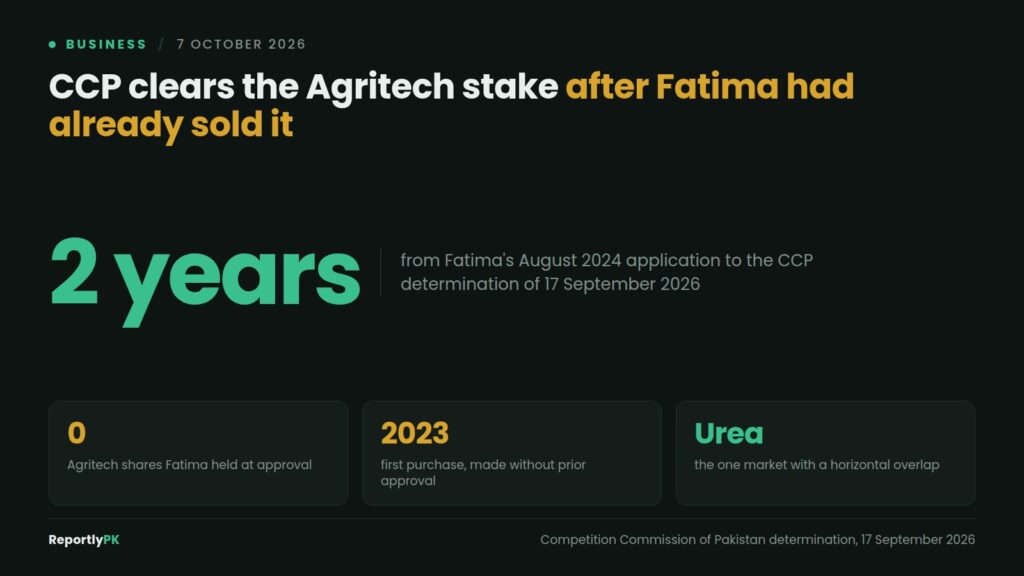
The Competition Commission of Pakistan has approved a transaction that no longer exists. Its determination on the Fatima Fertilizer Agritech shareholding clears share purchases made on the Pakistan Stock Exchange in 2023 and 2024 — by which point Fatima had already sold the entire holding and abandoned any intention of taking control.
Read as a merger clearance, the decision is close to meaningless. Read as a compliance ruling, it is not, because the first of those purchases was made without seeking the Commission’s approval beforehand.
The sequence
- 2023: Fatima Fertilizer buys Agritech shares through the PSX, without prior CCP approval
- 2024: a further purchase follows
- 22 August 2024: Fatima applies to CCP for authorisation, after the fact
- 5 March 2026: a hearing directs both parties to give undertakings on future pre-merger compliance
- 17 September 2026: CCP issues its determination; Fatima holds no Agritech shares
Just over two years passed between the application and the determination. In that window the holding was built, held and disposed of in full.
What the Commission actually assessed
CCP defined two relevant product markets — urea and granulated single super phosphate — with Pakistan as the geographic market. Fatima manufactures and trades fertilisers and chemicals; Agritech produces both urea and SSP.
In urea the Commission found a horizontal overlap, meaning both firms sell the same product, and that the combined shareholding raised their joint market share. In SSP it found no overlap at all, because Fatima holds no position in that segment; Agritech’s standing there was unchanged by the transaction.
The Commission concluded that the combined urea share “did not substantially lessen competition” and that the transaction did not create entry barriers, significantly enhance the parties’ market power, or create or strengthen a dominant position. It has not published the share percentages underlying that conclusion, which is the figure that would let an outside reader test it.
Why the ex-post-facto review is the real story
Pakistan’s merger control regime is meant to work before a transaction closes. A party crossing the notification threshold applies, the Commission reviews, and only then does the deal complete. Reviewing a holding after it has been acquired — and here, after it has been sold — reverses that order entirely.
The remedy available to a regulator that disapproves a completed acquisition is divestment, which is slow, contested and rarely clean. The remedy available before closing is simply to say no. Every ex-post-facto review therefore moves the regulator from a strong position to a weak one, regardless of how the substance turns out.
That is why the undertakings directed at the March 2026 hearing matter more than the clearance. They are the Commission’s response to the procedural breach, and they are the part of this determination that binds future conduct.
Related: Nine bidders clear the GEPCO privatisation screen as K-Electric withdraws
Open-market purchases are the awkward case
Buying shares through the exchange rather than negotiating a block from an identified seller complicates the question of when notification is triggered. A buyer accumulating on market may cross a threshold incrementally and without a single moment that looks like a deal.
That is an explanation rather than a defence. Listed acquirers track their own holdings precisely, because they have to disclose them, and the threshold is knowable in advance. The Commission’s insistence on undertakings suggests it did not treat the open-market route as an excuse either.
Two years is the number that should worry dealmakers
Set aside the procedural breach and the elapsed time is still the most consequential fact here. An application filed in August 2024 produced a determination in September 2026. For a transaction that had genuinely needed clearance before closing, that interval would have been fatal to the deal.
Acquirers price regulatory delay. Where clearance is slow and its timing unpredictable, buyers either discount what they are willing to pay, insist on long-stop dates that sellers will not accept, or structure around the review entirely — which is one reading of what happened here. None of those outcomes serves the regulator’s purpose.
Pakistan is simultaneously trying to attract foreign capital into large transactions, from the DISCO privatisations to the industrial deals announced through the year. Merger review timelines are part of what an international acquirer assesses before committing, and a two-year clock on a case this straightforward — one overlapping product, one unaffected product, and a buyer who exited midway — is a poor advertisement.
What has not been disclosed
The stake percentages in each of the two purchases have not been published, nor the consideration paid, nor the price and date at which Fatima exited. Without the exit details it is not possible to say whether the disposal was a commercial decision, a response to the pending review, or both.
Nor has the Commission said what the combined urea share would have been. In a market with a small number of large producers, the difference between a benign overlap and a problematic one can turn on a few percentage points, and that number is the one on which the whole substantive finding rests.
Agritech’s own position is the other missing piece. Its urea operations have historically depended on gas allocations that have not been reliable, and a producer’s market share means something different when its plant runs intermittently. The determination does not address it.