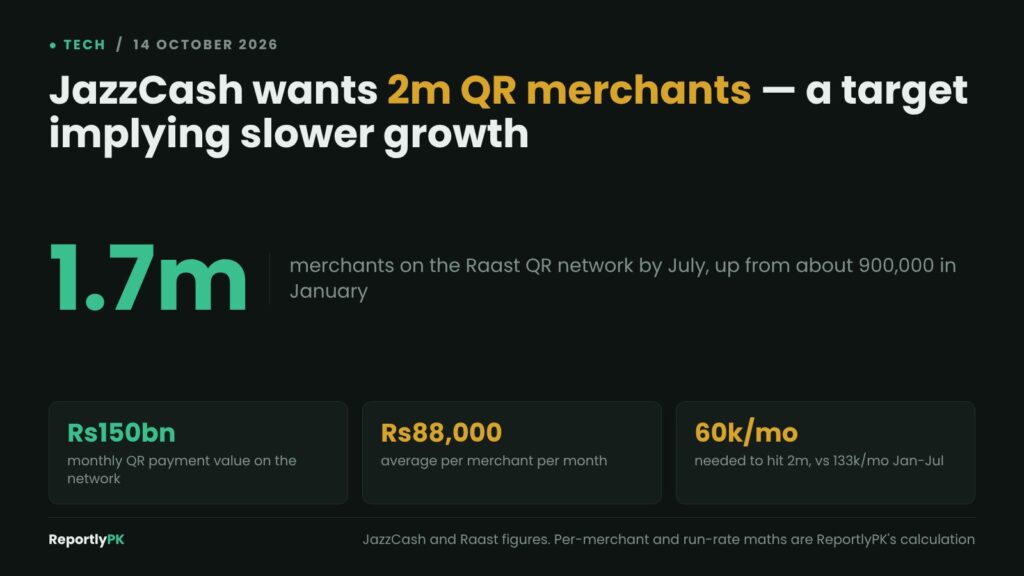
JazzCash has set itself a target of two million merchants on Pakistan’s interoperable QR network by the end of 2026. The JazzCash QR merchants figure stood at 1.7 million in July, up from roughly 900,000 at the start of the year.
The network in question is Raast, the State Bank’s interoperable payment rail. Interoperable is the operative word: a customer of any participating institution can pay any merchant displaying a Raast QR code, which is what distinguishes this from the closed-loop wallet QR codes that preceded it.
The numbers behind the target
- Merchants onboarded by July 2026: about 1.7 million
- Merchants in January 2026: about 900,000
- Growth over those six months: 88.9 percent
- Monthly QR payment value on the network: close to Rs150 billion
- Target: 2 million merchants by end-2026
Run the pace and the target looks conservative rather than ambitious. Between January and July the network added roughly 133,000 merchants a month. Reaching two million from 1.7 million in the remaining five months of the year requires about 60,000 a month — less than half the earlier rate.
That could mean the easy acquisitions have been made and the next tranche is harder. It could also mean the target was set to be beaten. Either way, a company announcing a goal that implies its own growth rate halving is a detail worth noticing rather than repeating.
Rs88,000 a month per merchant
Dividing close to Rs150 billion in monthly QR value across 1.7 million merchants gives an average of roughly Rs88,000 per merchant per month — about Rs2,900 a day.
Averages conceal distributions, and this one almost certainly does. A busy fuel station or pharmacy will run many multiples of that figure, which means a long tail of merchants is registered and transacting rarely or not at all. The gap between merchants onboarded and merchants actively accepting payments is the number that matters commercially, and it is not published.
There is a second reason for caution about the headcount. Pakistan has more than five million micro, small and medium enterprises, of which fewer than a quarter are estimated to have any digital footprint. Two million merchants on one provider’s books would be 40 percent of all MSMEs in the country — comfortably more than the share thought to be digitised at all. Both figures can be reconciled, but only if a meaningful share of registrations are dormant, duplicated, or attached to businesses too small to appear in MSME counts.
Related: TPL Insurance becomes JazzSure as VEON adds an insurer
The credit argument
Aamir Aftab, JazzCash’s chief product officer, has made the case that most of these merchants had no documented business history before onboarding, and that a digital record is the first step toward formal credit.
The logic is sound as far as it goes. A lender cannot assess a borrower with no verifiable revenue, and a year of QR receipts is exactly the kind of evidence that converts an informal trader into an assessable credit risk.
What the argument does not establish is that the credit follows. Transaction history removes one obstacle; it does not supply lending capacity, a risk appetite for unsecured micro-lending, or a recovery mechanism. Several markets have built large merchant-acceptance networks without the small-business lending that was supposed to follow, because the binding constraint turned out to be on the lender’s side rather than the borrower’s.
Merchants documented, taxed — or both
A digital record visible to a lender is also a digital record visible to a tax authority. For a small trader operating partly in cash, that is not an abstract consideration, and it is the most predictable reason for a merchant to register and then keep taking cash.
This is live policy ground rather than speculation. The Federal Board of Revenue has been extending digital monitoring across sectors, and the Punjab Revenue Authority is widening digital monitoring of restaurants and cafes specifically to curb evasion.
The documentation agenda and the financial-inclusion agenda point in the same direction, and the state has reasons to want both. Whether merchants see it that way determines how much of that Rs150 billion is the whole of their business and how much is the part they are willing to have recorded.
Onboarding is the easy half
Registration runs through the JazzCash Business App using digital identity and biometric verification, which is why the numbers can move as fast as they have. A merchant can be signed up in a single visit, and a field agent can cover a market in a day.
Keeping that merchant transacting is the harder half, and it depends on things the acquirer does not control: whether customers in that neighbourhood carry balances in a wallet, whether settlement reaches the merchant quickly enough to matter for working capital, and whether the code stays visible on the counter after the agent has moved on.
Acceptance networks elsewhere have been built quickly and then found that a large share of registered merchants never processed a second transaction. The published figure here is merchants onboarded, and the figure that would show whether the network is working — monthly active merchants — has not been disclosed by JazzCash or by the State Bank.
Why the rail matters more than the operator
JazzCash is the largest single onboarder, but the asset being built is the State Bank’s. Merchants acquired onto Raast can be paid by customers of competing institutions, which means the acquiring effort produces a public network rather than a proprietary one.
That is unusual and it is the point of the design. Interoperability removes the winner-takes-all dynamic that made QR payments in some markets a contest between incompatible apps, and it is why a merchant need display only one code.
It also means JazzCash bears acquisition costs for infrastructure its rivals can use. The return has to come from the payments it processes and the services it can attach — which is the strategic logic behind the wider financial-services build-out the group has been assembling this year.