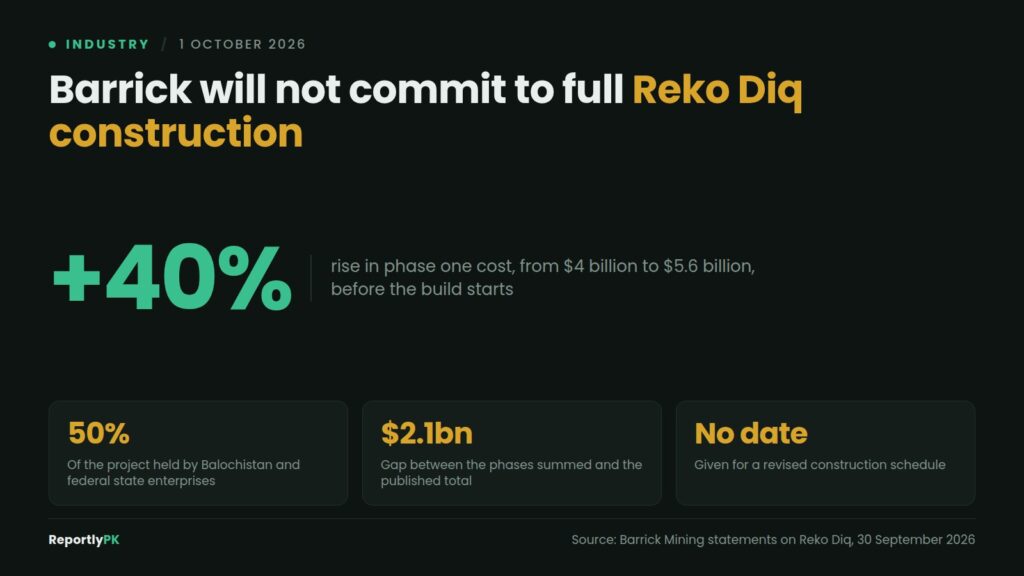
Barrick has slowed full Reko Diq construction and will not commit to a complete build schedule without what chief executive Mark Hill called some sort of security improvement. Phase one, originally costed at $4 billion, is now put at $5.6 billion — up 40 percent before the main construction programme has started.
Eight days ago Reko Diq was one of three items on Pakistan’s agenda with the US Export-Import Bank, alongside Boeing aircraft for a privatised PIA and refinery upgrades. That conversation now has a different backdrop.
The project, and who owns it
- Barrick — 50 percent
- Government of Balochistan — 25 percent
- Pakistani state-owned enterprises — 25 percent
Phase one is designed to process about 45 million tonnes of ore a year, with phase two potentially taking that to 90 million, over a stated mine life of 37 years. Employment is put at around 7,500 at peak construction and 4,000 in long-term production.
Pakistan holds half the asset. A delay is not something that happens to a foreign company here; it happens to the federal government and Balochistan in equal measure.
The capex number does not close
Phase one at $5.6 billion plus phase two at $3.5 billion comes to $9.1 billion. The total investment figure in circulation is approximately $7 billion.
That is a $2.1 billion gap, and the likeliest explanation is that the $7 billion headline predates the phase one revision and has simply not been updated in the reporting. But it should be, because the figure quoted publicly for a project Pakistan half-owns is now understating its cost by almost a quarter.
The 40 percent escalation on phase one is the part that deserves more attention than the security headline. Cost overruns on a mine of this scale are normal, and this one has arrived before the heavy spending does — which is the better time to find out. What has not been published is how the increase is funded across the three shareholders, and therefore what share of an extra $1.6 billion falls on Pakistani balance sheets.
The security figure is the government’s own
The context Hill is responding to is not disputed. Pakistan’s security forces conducted more than 31,000 intelligence-based operations in Balochistan during 2026.
That figure is usually cited as evidence of determination. Read from a project finance committee’s seat it reads differently: it describes the scale of the problem rather than its resolution. An operator deciding whether to move thousands of workers and billions of dollars of equipment into a remote site reads the operations count as a measure of how much there is to operate against.
Barrick’s position is also the responsible one. A company that commits to a full construction schedule it cannot staff safely, and then has to stop, destroys more value than one that waits. Declining to start is cheaper than starting twice.
What this does to the dollar story
Reko Diq has been doing heavy work in Pakistan’s medium-term external narrative, and this matters more than the construction timetable.
The honest description of Pakistan’s current foreign exchange position is that reserves rose three billion dollars in a week because the country sold a Eurobond, remittances are running at $7.3 billion a quarter, and textile exports grew 0.34 percent across the whole of last fiscal year. Borrowing and household transfers are carrying the external account; exports are not growing.
Copper concentrate from a 37-year mine was the answer to what eventually replaces that. It is the single largest identified source of future non-debt export earnings in the country. Every year it slips is a year the external position stays dependent on bond issuance and the Gulf labour market.
Export credit agencies price this
The financing angle is where the delay bites fastest, and it connects directly to what Pakistan was discussing in Washington last week.
Export credit agencies lend against assets and against country risk, and they price both. An operator publicly stating it will not begin full construction until security improves is the clearest possible signal to any lender assessing the same question, and it arrives while Reko Diq sits on the agenda with the US Export-Import Bank.
A mine is also weaker collateral than an aircraft. An aeroplane can be repossessed and flown to a liquid secondary market; an open pit in Balochistan cannot be moved. Lenders to mining projects therefore rely far more heavily on the operator’s commitment and on political risk cover — and the operator has just qualified its commitment.
None of that stops the project. It raises the cost of the money, which lands partly on the 50 percent of the equity that Pakistan holds.
Thirty-seven years is a long time
Against which, proportion is worth keeping. A mine with a 37-year life that starts a year late loses under 3 percent of its operating horizon, and copper demand is not expected to weaken across that period.
What is lost immediately is the construction phase — 7,500 jobs, deferred, in the province with the weakest labour market and the security problem those jobs would partly address. The sequencing is unfortunate in both directions: the employment that might ease the conditions is waiting on the conditions easing.
No revised construction date has been given, and the absence of one is the most informative detail in Hill’s remarks. A company with a date announces it. A company reviewing plans and timelines does not have one yet.
Related: Pakistan Says It Is Not Buying PIA Aircraft. The Denial Came Before the Announcement.