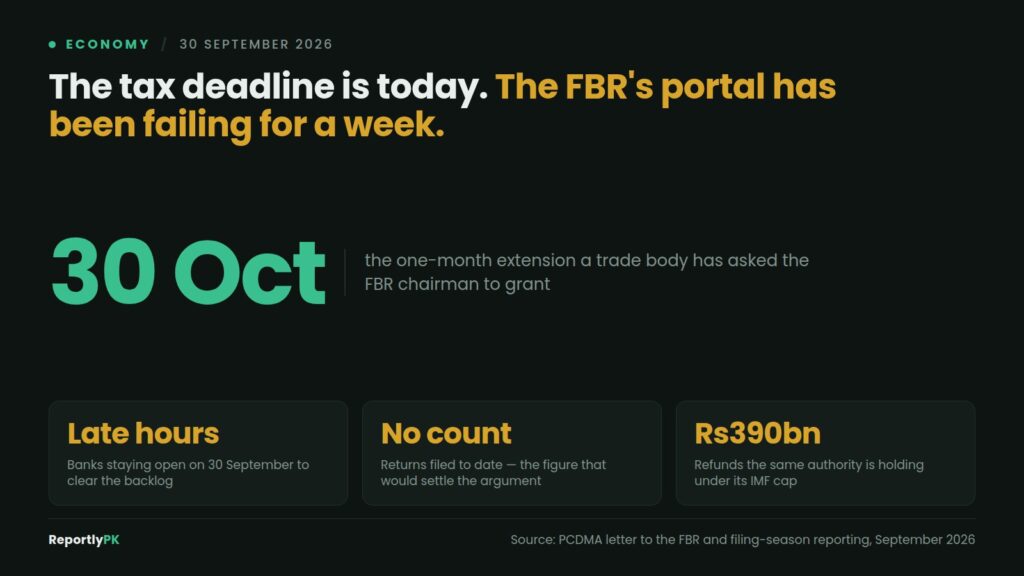
The income tax return deadline falls today, 30 September. Pakistani banks are staying open late to handle last-minute filings, and a trade body has written to the FBR chairman asking for a month’s extension because the tax authority’s own filing portal has been malfunctioning for over a week.
This happens most years, which is the part worth examining rather than the extension request itself.
What was asked
The Pakistan Chemicals & Dyes Merchants Association, through chairman Salim Valimuhammad, has asked FBR chairman Rashid Mehmood Langrial to move the deadline to 30 October.
The stated reason is that IRIS — the portal through which returns are transmitted — has suffered persistent instability, and that repeated requests for remedial measures went unresolved. Banks extending their hours on the final day is the corroborating detail: the state is visibly managing congestion it expected.
Extensions punish the wrong people either way
There is no clean answer here, and it is worth setting out both sides properly rather than siding with whoever wrote the letter.
Granting an extension is a tax on the compliant. Somebody who organised their affairs, paid an accountant and filed in August gains nothing; somebody who left it to the final week is rewarded. Repeated annually, an extension stops being relief and becomes the real deadline, and the announced one becomes advisory.
Refusing one, when the government’s own system is the thing that failed, penalises taxpayers for a state failure. A filer who tried for a week and could not transmit has not defaulted on an obligation. They were prevented from meeting it.
The resolution that satisfies both is narrow and nobody offers it: extend, and publish the portal’s uptime for the filing period so next year’s argument starts from a measurement rather than an assertion.
The number the FBR does not publish
Nowhere in this exchange is the figure that would settle most of it: how many returns have actually been filed, against how many were filed by the same date last year, against a target.
The size of Pakistan’s filer base is the central fact of its fiscal position. It is the reason the country runs a tax-to-GDP ratio that requires an IMF programme, the reason the petroleum levy does as much work as it does, and the reason the FBR spends its energy on withholding taxes it can collect at source rather than income taxes it must assess.
A daily filing count during the final fortnight costs nothing to publish and would be the single most informative statistic the FBR produces all year. Its absence means that when the deadline passes, both the authority and its critics will characterise the outcome without either being checkable.
Expanding the net while the door jams
The timing sits awkwardly against everything else the FBR has done this month.
On 23 September it notified a procedure taxing social media creators at 5 percent, deeming income at Rs195 per 1,000 YouTube views where earnings cannot be established, with quarterly advance payments and a dedicated section of the annual return. Earlier in the month it disclosed an IMF-agreed ceiling of Rs390 billion on the stock of refunds it has not paid back.
So in a single month the authority has added a new class of filers, confirmed it is holding roughly $1.4 billion of other people’s money, and presided over a portal that reportedly would not accept returns in the week before its own deadline.
Each of those is defensible alone. Together they describe an institution expanding its obligations faster than its capacity to service them, and a creator filing quarterly advance tax from next year will be using the same IRIS.
Simplification is the actual answer
The FPCCI this week endorsed the Asaan tax scheme, and simplification is where the argument should be, because the deadline fight is a symptom.
A return that a salaried person cannot complete without paying a practitioner is a return most people will not file. Countries that raised filer numbers substantially did it by pre-filling returns from data the authority already holds — withholding records, bank profit, property transactions — and asking the taxpayer to confirm rather than construct.
The FBR already receives most of that data. A pre-filled return would shrink the final-week crush that breaks the portal, reduce the practitioner cost that deters marginal filers, and remove the annual ritual in which a trade association writes a letter and the country waits to see whether the date it was given was real.
Related: The IMF Capped Pakistan’s Unpaid Tax Refunds at Rs390 Billion. One Company Has Waited Six Years.