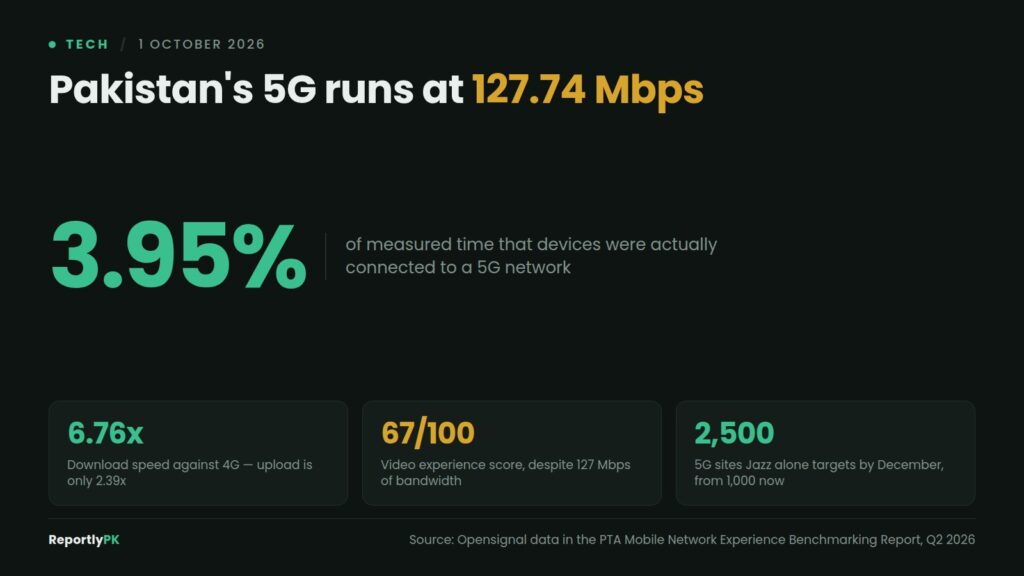
Pakistan 5G speeds averaged 127.74 Mbps on download and 12.7 Mbps on upload in the second quarter of 2026. Devices were actually connected to 5G for 3.95 percent of the measured time.
Both numbers come from the same Opensignal dataset published in the PTA’s Mobile Network Experience Benchmarking Report, and together they settle a question this site raised yesterday.
The puzzle, resolved
Yesterday’s figures had Zong fastest on 4G at 18.55 Mbps, with a national average quoted at 18.9 — higher than the fastest operator on the list, which an average cannot be. The conclusion here was that the operator figures were 4G-specific while the national number was blended across technologies.
That is confirmed. A device spending even a small fraction of its time on a connection running at 6.76 times the 4G rate pulls a blended average upward. On an illustrative calculation, 3.95 percent of time at 127.74 Mbps and the remainder near 19 adds roughly four megabits to the blend — enough to lift a national figure above any single 4G operator.
One correction to yesterday’s framing while we are here. The Opensignal data and the PTA’s work are not separate exercises in opposition; the crowdsourced measurements were published inside the regulator’s own benchmarking report. The PTA is running both methods, which is better practice than either alone.
Excellent, and almost absent
127.74 Mbps is a genuinely good number. It is comfortably enough for anything a phone does, and it is roughly seven times what the same user gets on 4G.
Connected 3.95 percent of the time means that on a sixteen-hour waking day, a 5G-capable handset spends around 38 minutes on 5G and the rest on something slower. The honest description of Pakistani 5G today is that it is excellent and almost absent, and the PTA says so itself — noting that deployment remains at an early stage with limited coverage and a small user base, and cautioning that the results are indicative rather than conclusive.
That caveat deserves credit. A regulator publishing a flattering headline speed alongside the figure that undercuts it is doing the job properly.
The upload number gives away the architecture
The most technically revealing line in the data is the one nobody will quote. Download on 5G is 6.76 times the 4G rate. Upload is only 2.39 times.
That asymmetry is the signature of non-standalone deployment, where a 5G radio is bolted onto an existing 4G core and the uplink continues to ride largely on the 4G anchor. It is how almost every operator starts, because it reuses existing network investment, and it is why early 5G often feels faster for watching than for sending.
For most consumers that is fine. For the uses Pakistan keeps saying it wants — freelancers uploading deliverables, creators publishing video, businesses running cloud backups — upload is the constraint, and a 2.39-fold improvement is a much smaller upgrade than the headline suggests.
Experience scores say bandwidth is not the problem
The report also gives experience scores: 67.33 out of 100 for video and 62.05 for games.
Those are middling numbers sitting next to a very good speed, and the gap between them is informative. Video and gaming experience depend on latency, jitter, and whether a connection holds under congestion — not on peak throughput. Scores in the sixties alongside 127 Mbps mean the bottleneck is not how much data the network can move but how consistently and how quickly it moves it.
This site noted yesterday that latency was absent from a download-and-upload framing. These scores are a partial substitute, and they point at exactly the thing the raw speed hides.
The 3.95 percent should move
The availability figure is the one worth tracking, and it has a reason to rise.
Jazz confirmed this month that it has passed 1,000 active 5G sites and intends to be above 2,500 by the end of 2026 — more than 1,500 additional sites from one operator inside four months, with the other networks building too. Q2’s 3.95 percent predates most of that.
The constraint on that build is the one that has run through Pakistani telecom reporting all month: right of way. The amendment bill meant to create a single national process for it passed the National Assembly in June, was withdrawn from the Senate in August on a ninety-day clock, and went back to redrafting in September with a clause restoring owner consent. Every one of those 1,500 sites needs permission from whoever owns the ground.
What to ask for next quarter
Three things would turn this from a scorecard into a usable series. 5G availability broken out by operator, so buyers can tell whose network they will actually reach. The same figure by city, because a national availability number averages Karachi against places with no 5G at all. And latency published directly rather than inferred from experience scores.
Until then, the number to quote is not 127.74. It is 3.95.
Related: Zong Is Pakistan’s Fastest Network at 18.55 Mbps. The National Average Is Higher Than That.