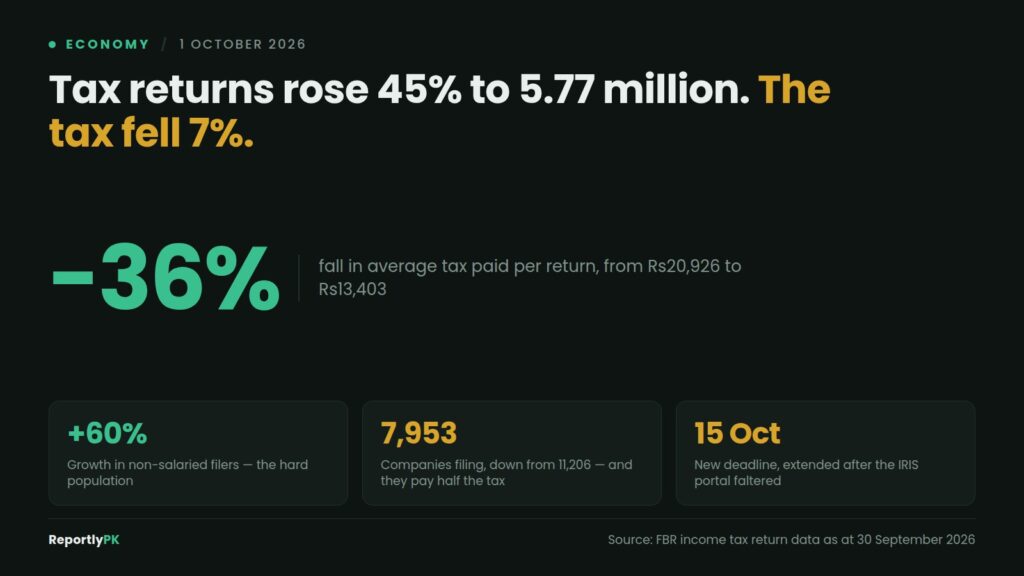
Pakistan income tax returns reached 5,767,384 by 30 September, up 45 percent on the 3,980,692 filed by the same date last year. The FBR also extended the deadline to 15 October.
Tax collected with those returns came to Rs77.3 billion, against Rs83.3 billion a year earlier. Forty-five percent more filers paid 7 percent less money.
Two numbers that have to be read together
Divide the tax by the returns and the picture sharpens. Average tax paid with a return fell from about Rs20,926 to Rs13,403 — a drop of 36 percent.
That is not a scandal and it is not a failure. It is the mechanism working exactly as designed. Pakistan taxes non-filers more heavily than filers on banking transactions, vehicle registration and property transfers, which makes filing cheaper than not filing for a large population that owes little or no income tax. Those people are now filing.
What it produces is documentation rather than revenue, and the two get reported as the same achievement. A country that knows who its earners are can tax them later. A country that collected Rs6 billion less this September than last cannot spend documentation.
Where the growth came from
- Non-salaried individuals — 3.81 million, up 60 percent from 2.38 million
- Salaried individuals — 1.9 million, up 22 percent
- Associations of persons — 53,756, up 33 percent
- Companies — 7,953, down from 11,206
The non-salaried line is the genuinely good news. Salaried filers are the easy population — already withheld at source, already visible, already in the system. Non-salaried earners are the hard ones, and they grew nearly three times faster.
Across four years the total has gone from 1.86 million in 2022 to 5.77 million now — roughly 3.1 times. Whatever else is true, the filer base has genuinely widened.
The company number needs explaining
Companies filing by the deadline fell from 11,206 to 7,953 — down 29 percent — and tax paid by companies fell from Rs49 billion to Rs39.1 billion.
Those 7,953 companies are 0.14 percent of all filers and paid 50.6 percent of the tax collected with returns. Fewer than eight thousand entities carry half the revenue in this dataset.
Interestingly, the companies that did file paid more each — about Rs4.92 million against Rs4.37 million last year. So this is a count problem, not a payment problem, and there are at least three possible explanations: companies restructuring into associations of persons to access lower rates, genuine deregistration, or simply more corporate filers taking extensions than last year.
Those have very different implications and the FBR has not said which it is. A 29 percent fall in corporate filers is the most consequential figure in the release and the least examined.
Why Pakistan still taxes fuel instead
Set Rs77.3 billion against the rest of the fiscal picture and the structural problem becomes obvious.
The government has committed Rs75 billion to a single three-month fuel relief scheme. The entire income tax paid alongside 5.77 million returns is roughly what that one subsidy costs. Meanwhile taxes and duties account for about Rs114 of every litre of petrol sold — collected automatically, from everyone, without a return being filed by anybody.
In a country of more than 240 million people, 5.77 million filers is around 2.4 percent of the population. That is why the petroleum levy does the work it does, why the FBR concentrates on withholding it can take at source, and why the Finance Ministry spent last week insisting the levy is not the centrepiece of the IMF programme.
Indirect taxes are regressive and everyone involved knows it. They are also the only instrument that currently raises money at scale. A filer base growing 45 percent a year is how that changes, but only once those filers start paying — and this year’s figures show the base widening while the payment per filer falls.
The number appeared the day after it was asked for
Credit where it is owed. This site wrote yesterday that the FBR publishes no running count of returns filed, that it would be the single most informative statistic the authority produces all year, and that without it both the FBR and its critics would characterise the outcome unverifiably.
The count was published the following day, with a four-way composition breakdown and tax paid by category. That is a good disclosure and a better one than most tax authorities in the region manage.
The extension to 15 October also went the way the trade bodies asked, after a week in which the IRIS portal was reported as unstable. Extending while the state’s own system was failing was the defensible call. The thing still missing is portal uptime for the filing period, which would let next year’s argument start from a measurement.
What the extension does to the comparison
One caution on reading the 45 percent. The figures are as at 30 September, and the deadline has moved to 15 October, so the final number will be higher and the growth rate will change.
Whether last year’s 3.98 million was also a pre-extension figure matters for whether this is a like-for-like comparison, and the release does not say. If last year’s count was measured after an extension and this year’s before one, the true growth is understated. If the reverse, overstated.
The fix is trivial: publish the same figure on the same basis, and publish it again on 16 October. The FBR has just shown it can produce the number. Producing it twice would make it a series rather than an announcement.
Related: The Tax Deadline Is Today. The FBR’s Own Portal Has Been Failing for a Week.