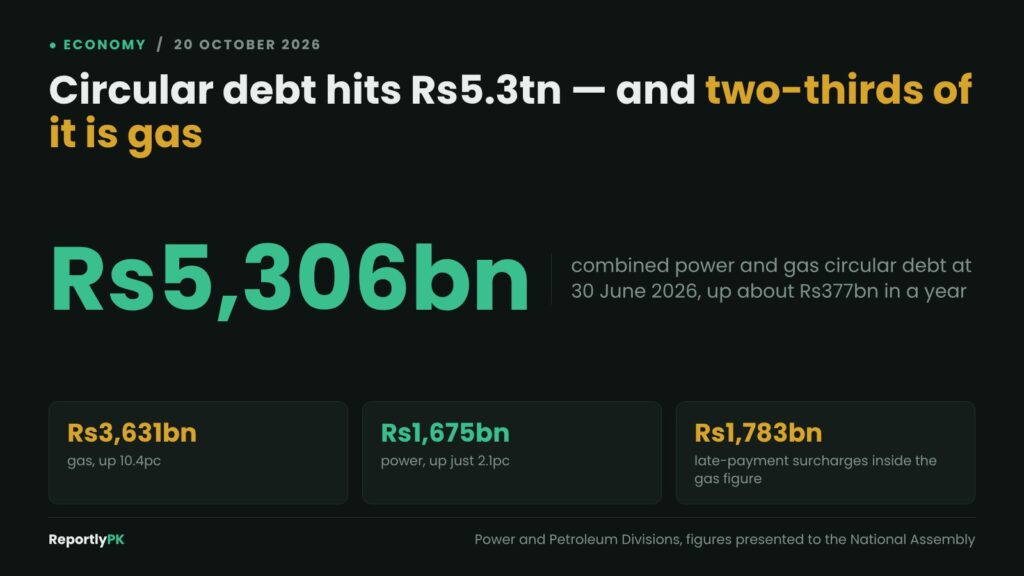
Pakistan’s combined energy circular debt stood at Rs5,306 billion on 30 June 2026, figures presented to the National Assembly show. Almost every public argument about that number concerns electricity. More than two-thirds of it is gas.
The Power Division put the electricity component at Rs1,675 billion. The Petroleum Division put the gas component at Rs3,631 billion — 2.17 times larger, and growing five times faster.
The split, and the direction of travel
- Combined: Rs5,306 billion, up about Rs377 billion year on year
- Power: Rs1,675 billion, up Rs34 billion from Rs1,641 billion — growth of 2.1 percent
- Gas: Rs3,631 billion, up Rs344 billion from Rs3,288 billion — growth of 10.4 percent
- Gas share of the total: 68.4 percent
- Late-payment surcharges inside the gas figure: Rs1,783 billion
Nine-tenths of the year’s increase came from gas. The power number, which absorbs nearly all the political attention and almost all of the reform effort, rose by Rs34 billion — an increase of roughly 2 percent, or close to flat in real terms.
Half the gas debt is not unpaid gas
Of the Rs3,631 billion owed in the gas chain, Rs1,783 billion is late-payment surcharges. That is 49.1 percent of the gas figure and 33.6 percent of the entire national energy debt.
A late-payment surcharge is a penalty levied for not paying on time. It is not the cost of gas delivered and not consumed. It means a third of what the state describes as circular debt is interest accumulated on the original arrears — a figure that compounds on itself regardless of whether a single additional cubic foot of gas goes unpaid for.
That reframes what the stock actually is. Clearing the underlying gas arrears would leave nearly Rs1.8 trillion of accumulated penalties standing, and the surcharge continues to run while the arrears do. Any settlement that addresses the principal without addressing the surcharge is solving the smaller half of the problem.
Related: IMF staff-level agreement unlocks $1.2bn for Pakistan
The power number has one named cause
The Power Division attributed its Rs34 billion rise mainly to non-payment for electricity supplied from the national grid to K-Electric, with a court case over recovering those dues pending.
That is a specific and contained explanation, and it is worth weighing against what it implies. If a single disputed counterparty accounts for most of the year’s electricity-side increase, then the distribution companies’ own losses and recovery failures — the problem the privatisation programme is meant to fix — did not materially add to the stock this year.
It is also a dispute rather than a loss. Money owed and contested in court is a different category from money consumed and never billed, and whether it stays in the circular debt column depends on a judgment rather than on a tariff.
The reform effort is aimed at the smaller number
Pakistan’s energy reform agenda is almost entirely electrical. The government has ended take-and-pay agreements with independent power producers and moved to a hybrid take-and-pay model. The Privatisation Commission is selling distribution companies, with nine bidders prequalified for GEPCO and FESCO and IESCO behind it. The IMF’s last review called for tariff adjustments to stop circular debt rebuilding.
Every one of those measures addresses the Rs1,675 billion. None of them touches the Rs3,631 billion.
There are reasons for the asymmetry. Electricity reaches almost every household, so its tariff is politically visible in a way gas pricing is not. The power sector has an independent regulator in NEPRA with a public tariff process, and privatisable assets with identifiable buyers. The gas chain — the two distribution utilities, the exploration companies, the LNG importers and the fertiliser and power offtakers behind them — has no equivalent structure to sell or restructure.
Why the gas chain compounds faster
The mechanism behind the divergence is worth setting out, because it explains why the gas number grows even in a year when the power number barely moves.
Electricity arrears accumulate when consumers do not pay, or when the tariff NEPRA sets does not cover what generation costs. Both are domestic and rupee-denominated, and both respond to tariff decisions. Gas arrears have an additional source: imported LNG is bought in dollars at contracted volumes, while the price charged to domestic consumers is set administratively. Every cargo delivered at a price above what the end user is billed adds to the gap, regardless of collection performance.
Layer the late-payment surcharge on top and the stock compounds twice over — once from each cargo, and again from the penalty running on what has already accrued. That is a different problem from unpaid bills, and it does not have a collection-side fix.
What the resource numbers do not change
The same disclosure put recoverable gas reserves at 68,803 bcf against 48,140 bcf produced, and recoverable oil at 1,378 million barrels against 1,102 million barrels of crude production.
Those are depletion figures rather than solutions. Pakistan has produced roughly 70 percent of its recoverable gas, which is why imported LNG has become structural rather than supplementary — and imported LNG priced in dollars is precisely what makes the gas chain’s arrears grow faster than the electricity chain’s.
The honest summary is that the number the state reports as circular debt is now mostly a gas problem, that a third of it is penalty interest rather than unpaid energy, and that the policy machinery built to attack it was designed for electricity. Until a gas-side equivalent exists, the combined figure will keep rising whatever happens to the power sector.