Investors have their money back, and the regulator has opened a file. The SE Fruits IPO probe now under way at the Securities and Exchange Commission of Pakistan follows the discovery of what the Commission calls material discrepancies in a prospectus that had already cleared both the exchange and the Commission itself.
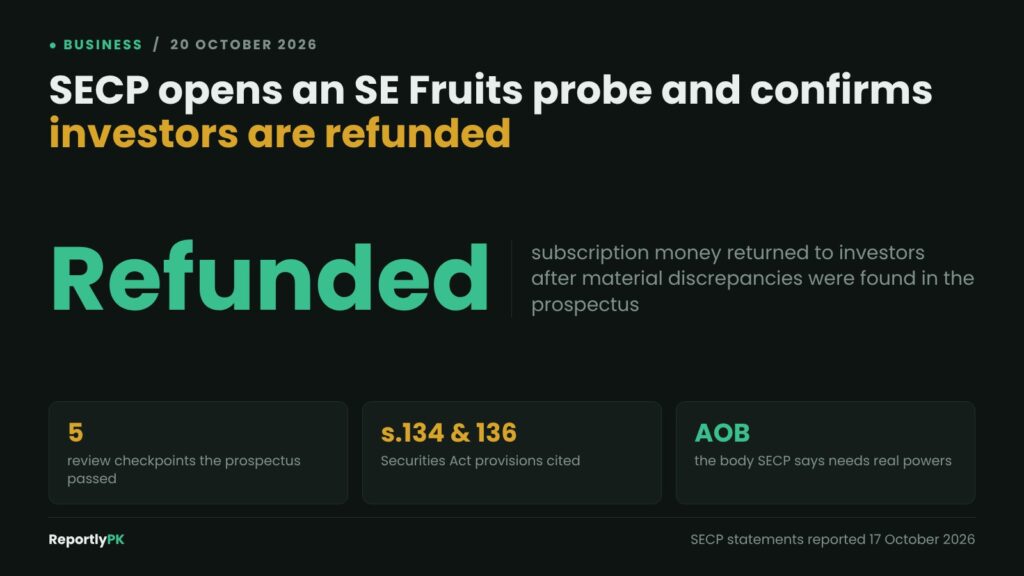
Subscription money has been refunded. That answers the question left open when SE Fruits and Vegetable Limited withdrew its listing application on 13 October, weeks after raising Rs1.2 billion through book-building and public subscription.
What the Commission has said
- Material discrepancies were found in the prospectus
- The prospectus was based on information drawn from audited financial statements
- SECP suspended further proceedings after book-building to protect investors
- Subscription money has been refunded
- The Commission is reviewing the case to determine responsibility for procedural irregularities
- Action will follow where violations are established
One detail reframes the company’s own account. SE Fruits described the withdrawal as a procedural step taken by its board. The Commission says it suspended proceedings after book-building to protect investors. Both can be true in sequence — a regulator halts the process, a board then withdraws — but they are not the same story, and the company’s framing left out the part where someone else stopped it.
Related: SE Fruits pulls its IPO application — after collecting Rs1.2bn
The criminal provisions now in view
The Commission has pointed to sections 134 and 136 of the Securities Act, 2015. The first concerns fraudulently inducing a person to deal in securities; the second concerns false or misleading statements. Both are criminal offences.
Citing a provision is not charging anyone under it, and the Commission has said it is still determining responsibility. The distinction matters here because the chain of people who touched this prospectus is long: the company prepared the records, an external auditor audited them, an issue consultant conducted due diligence and drafted the document, the exchange’s listing committee reviewed it and invited public comment, and the Commission approved it for circulation.
A discrepancy that originated in audited financial statements implicates a different party from one introduced during drafting, and the Commission has not said which this was. Neither the auditor nor the issue consultant has been named.
The Commission is pointing at audit oversight
Rather than treating this as a one-off, SECP has linked the case to the Audit Oversight Board and argued that it needs effective inspection and enforcement powers, adequate technical staff and stable funding, with Pakistan’s framework aligned to international practice and IFIAR principles.
That is a significant statement for a regulator to make about a failure that occurred partly on its own watch. The AOB supervises the firms that audit listed companies, and an audit oversight body without inspection powers or funding cannot do much about audit quality beyond registering firms.
It is also, conveniently, a diagnosis that locates the weakness one step upstream. The approvals still happened, and an approval regime that relies on audited figures without the capacity to test them is a design the Commission administers as well as describes.
Why the refund is the right outcome and still a cost
Returning the Rs1.2 billion is the cleanest available resolution. Investors are restored to cash rather than left holding allocations in an unlisted company whose disclosure the Commission considers deficient.
They are not made whole. Money committed in late September and returned in October earned nothing in a market where the policy rate is in double digits, and institutional subscribers had capital locked up for weeks. More to the point, the professional investors who bid set the strike price at Rs40 — the floor of a Rs40 to Rs64 band — on figures the Commission now says were discrepant. What they would have bid on corrected numbers is unknowable, which is itself the harm.
The company has said it intends to resubmit with enhanced disclosures. A fresh prospectus would require a fresh book-build, and the price struck at that point will be the market’s verdict on whatever the corrected numbers show.
The gate that did not catch it
The Commission has set out the approval sequence in unusual detail, and reading it back against what happened is instructive. The company prepares its financial records. An external auditor audits them. An issue consultant conducts due diligence and drafts the prospectus. The exchange’s listing committee reviews it and seeks public comments. The company answers observations. The exchange decides the listing application, and only then does the Commission decide on the prospectus.
That is five checkpoints, and the discrepancies passed all of them. The exchange approved on 7 September and the Commission on 9 September; book-building followed on 21 and 22 September and public subscription on 28 and 29 September.
A process with five reviewers that fails anyway usually has a structural reason rather than five independent lapses. The most likely one is that each step relies on the output of the step before it — if the audited figures carry an error, the consultant drafts from them, the committee reviews a document built on them and the Commission approves a prospectus that is internally consistent and externally wrong. Nobody in that chain is positioned to go back to the source records, which is the gap the Commission is describing when it talks about audit oversight.
What this costs the pipeline
Pakistan lists few companies, and the retail investors who subscribe to the ones that do are the constituency hardest to recover once lost. A refund protects their capital; it does not restore the assumption that an SECP-approved prospectus has been checked.
The Commission’s willingness to say publicly that its own approval framework needs work is unusual and, on balance, the encouraging part of this. The test is whether the AOB actually gets the powers and funding described, and whether anyone in the chain that produced this prospectus faces a consequence. If the episode ends with a refiling and no finding against anyone, the next issue consultant will draw the obvious conclusion.