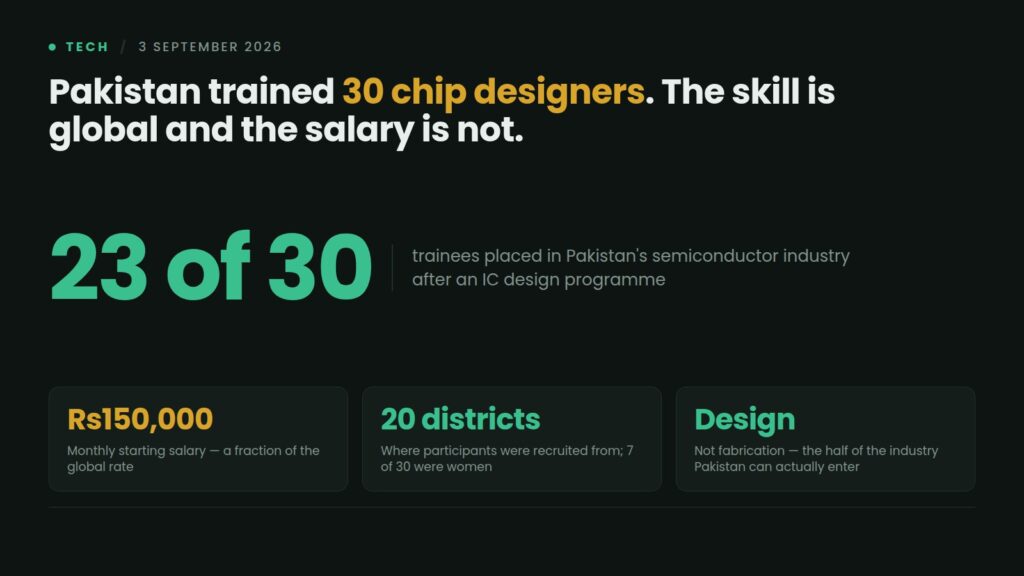
Pakistan has trained 30 engineers in integrated circuit design and verification, and 23 of them have taken jobs in the country’s semiconductor industry.
The programme was run by the Ministry of IT and Telecommunication with Ignite and FAST-NUCES, drawing participants from 20 districts and including seven women. It covered advanced IC design, VLSI verification, System-on-Chip architecture, industry-standard tools and the tapeout and fabrication process.
The ministry told the National Assembly that fresh professionals in the field earn around Rs150,000 a month or more. Both of those numbers deserve examining — for opposite reasons.
Chip design is the right thing to teach
Semiconductors split into two very different businesses, and the distinction decides whether this makes sense for Pakistan.
Fabrication — actually making chips — requires fabs costing billions of dollars, ultra-pure water, uninterrupted power and a supplier ecosystem measured in decades. It is not available to a country whose grid loses 4,000MW when an LNG cargo arrives late.
Design is the opposite. It needs engineers, licensed software and a network connection. The output is a file. Countries with no fabrication capability at all host substantial design operations, because the constraint is skill rather than infrastructure.
For a country with cheap engineering labour, a large young population and chronic foreign exchange problems, exporting design work is a far better fit than most of what gets proposed. It is high value per employee, requires no imported raw material, and is unaffected by whether the ships are running.
Thirty is not a policy
Now the number.
Thirty engineers, in a country of more than 250 million, where 7.1 million applications were filed against roughly 1,200 government job advertisements this year. Set against IT exports that are Pakistan’s fastest-growing export category, thirty is not a workforce. It is a proof of concept.
That is not necessarily a criticism. A first cohort establishes whether the curriculum works, whether local employers exist and whether graduates get hired — and 23 placements out of 30 answers all three affirmatively.
The question is what follows. A pilot that stays a pilot is a press release. What would make this consequential is the next cohort being 300, and the one after that being taught inside universities rather than as a special programme.
No figure for programme cost has been published, which makes it impossible to judge what scaling would require.
Rs150,000 is the problem, not the achievement
The ministry offered Rs150,000 a month as evidence of success. In Pakistani terms it is a strong graduate salary — well above what most engineering graduates command, and roughly double the top end of many public-sector scales.
Measured against the global market for the same skill, it is very low. IC design and verification engineers are scarce worldwide, and firms in the Gulf, Europe, North America and East Asia recruit them at multiples of this figure.
Which produces an uncomfortable result: the state has just trained thirty people in a globally portable, globally scarce skill, and the differential facing them is the largest of their careers.
Pakistan already exports this labour. Remittances exceeded $41 billion last year and are forecast at $44 billion — more than twice foreign exchange reserves and roughly twenty times annual FDI. Canada is actively recruiting Pakistani medical professionals. The country’s most reliable export has been people.
A trained chip designer who emigrates still sends money home. That is not nothing. It is also not a semiconductor industry.
Where the twenty districts matter
One design detail is better than it looks: participants were drawn from 20 districts, and seven of the thirty were women.
Pakistan’s technology sector is concentrated in a handful of cities, and specialist training normally follows that concentration — which reproduces it. Recruiting across twenty districts is a deliberate choice to find capability where it has not previously been looked for.
The same logic applies to the gender split. Seven of thirty is not parity, and it is far above the share of women in Pakistani engineering employment. In a field where the work is done at a screen and output is a file, there are fewer structural barriers than in most technical careers here.
Both choices matter more at scale than at thirty. They are the right defaults to have set before scaling, rather than corrections to make afterwards.
What would make them stay
Not salary matching, which Pakistan cannot afford and should not attempt.
What retains design talent elsewhere is the presence of enough employers doing interesting work that an engineer can build a career without leaving. That requires a cluster — several firms, competing for the same people, with clients abroad. Twenty-three engineers placed across an industry is the very beginning of one.
The institutional groundwork is arguably being laid elsewhere. The IT ministry is running a six-month review of eleven digital institutions including PSEB, STZA and Ignite, funded under the World Bank’s Digital Economy Enhancement Project, aimed at overlapping mandates. If that produces a coherent answer to who is responsible for building technology clusters, this programme becomes part of something.
If it does not, thirty engineers will have been trained at public expense for employers in other countries — which is a real contribution to Pakistan’s balance of payments, and not what the announcement claimed.
Related: Pakistan Is Reviewing Eleven Digital Institutions at Once. One of Them Is the Regulator.