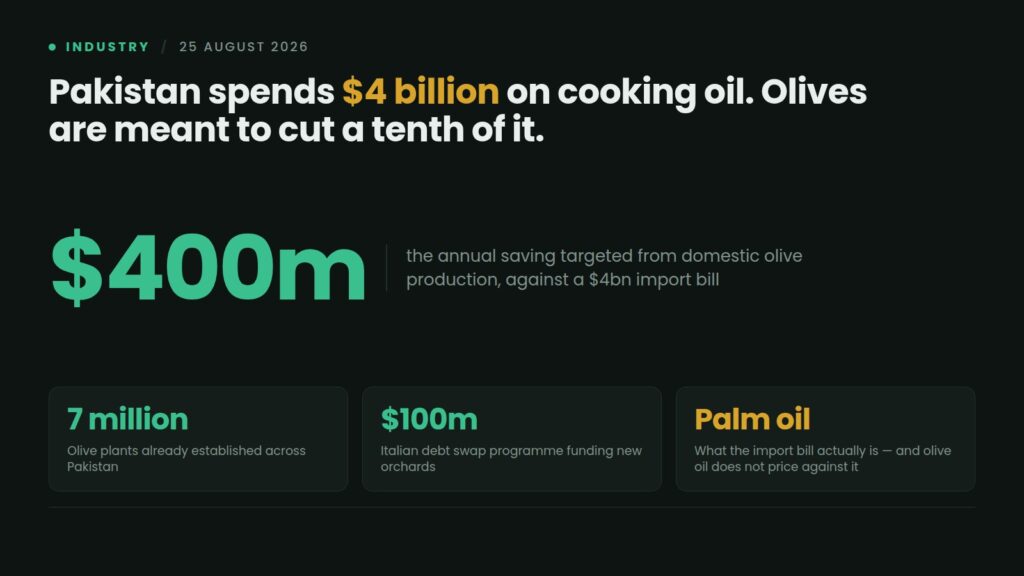
Pakistan spends roughly $4 billion a year importing edible oil. Prime Minister Shehbaz Sharif launched a National Olive Value Chain Policy this week and framed the target modestly: saving even $400 million a year would be significant.
That is 10 percent of the bill. The modesty is the most credible thing about the announcement.
Why edible oil is a real problem
Four billion dollars is not a marginal line in Pakistan’s import bill. Set against foreign exchange reserves of $18.4 billion, the country spends close to a quarter of its entire buffer every year on cooking oil — predominantly palm oil, bought in dollars, in a market where Pakistan is a price taker.
It is the same structural pattern as the $2.5 billion coal import bill and the cotton the textile industry now buys abroad: a commodity that could be produced domestically, purchased instead in currency the country has to earn.
The distinction with olives is that the domestic alternative is not obvious. Pakistan grows cotton and sugarcane at scale. It does not grow oilseed at anything like the volume its consumption requires, and the crops that would close the gap compete for land and water against food staples.
What is already planted
Seven million olive plants are established across Pakistan, largely in Potohar and parts of Balochistan and Khyber Pakhtunkhwa where the climate suits.
Seven million sounds substantial and needs converting into oil to mean anything. Olive trees take years to bear commercially, yield varies enormously with variety and management, and it takes a great deal of fruit to press a litre of oil. A mature orchard on good practice might produce a few litres per tree per year.
On any reasonable assumption, seven million trees at full maturity produce a quantity of oil that is meaningful for a premium domestic market and small against a $4 billion import bill dominated by cheap palm oil.
Which is presumably why the Prime Minister named $400 million rather than $4 billion.
Olive oil does not substitute for palm oil
This is the awkward point at the centre of the policy.
Pakistan’s import bill is overwhelmingly palm oil, used in cooking, in banaspati ghee and across food processing, and bought because it is the cheapest fat available. Olive oil is a premium product selling at a multiple of palm oil prices.
A household buying the cheapest available cooking oil does not switch to domestic olive oil because it is domestic. The substitution only happens at price parity, and olive oil does not reach palm oil pricing anywhere in the world.
So the honest framing is not import substitution. It is building an export-capable premium crop while displacing some imported olive oil at the top of the domestic market — which the policy acknowledges by targeting exports across South, East and Central Asia.
The value chain framing is right
Where the policy is genuinely well designed is in what it covers beyond planting.
The Prime Minister’s stated intent is to move beyond cultivation into oil production, processing and value addition. That distinction is exactly what Pakistani agriculture usually gets wrong — growing a commodity and selling it raw, capturing the smallest margin in the chain. Cotton growers sell lint. Tobacco growers sell leaf at whatever a buyer offers.
Olive oil is different because pressing must happen close to the harvest, which means the processing capacity has to be domestic. A farmer with access to a mill sells oil rather than fruit, and the margin stays in the country.
Membership of the International Olive Council matters for the same reason. Quality certification is what separates oil that can be exported at a premium from oil that competes on price — and it is the equivalent of the regulatory recognition Pakistan’s pharmaceutical exporters need for their own $10 billion ambition.
Italy is funding most of this
The support package is substantial and largely foreign:
- $100 million Italian debt swap programme for establishing orchards
- €20 million capacity-building initiative for high-value agriculture
- Over 700 stakeholders trained to date
- 100 agricultural graduates to be sent to Italy for advanced training at government expense
A debt swap is a sensible instrument here — debt Pakistan owes is written down in exchange for domestic spending on agreed development, so the orchards are funded without new borrowing.
Italy is also the right partner. It has the varieties, the milling technology, the certification expertise and a commercial interest in a supply base outside the Mediterranean.
The government’s own commitments — disease-free seed, technology to reduce crop losses, training — are the correct list. Whether olives become a Pakistani export industry or another well-funded pilot depends on the milling and certification infrastructure being built alongside the trees, not after them.
Related: Pharma Exports Hit $457 Million. The New Target Is $10 Billion.
One comment
[…] Related: Pakistan Spends $4 Billion on Cooking Oil. Olives Are Meant to Cut That by a Tenth. […]
Comments are closed.