Pakistan Railways has signed a freight forwarding agreement with RZD Logistics, the Russian state railway’s logistics arm, to run container trains between Pakistan, Russia and Central Asia — with Karachi, Faisalabad and Moscow named on the route.
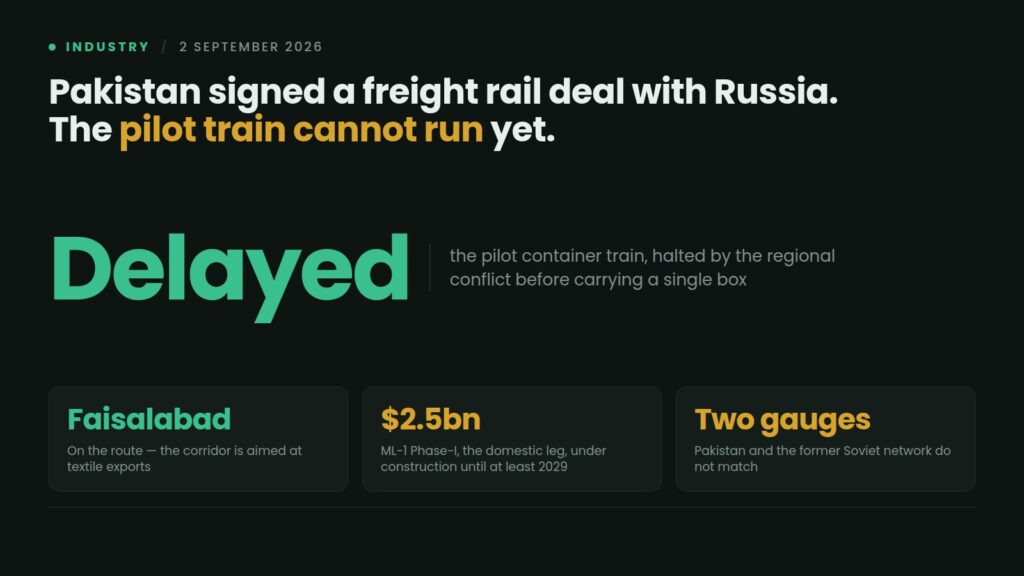
The pilot train has not run. It could not begin as planned because of the regional conflict, and both sides say they will proceed once conditions allow.
That single sentence is the most informative part of the announcement.
The route runs through the problem
Any overland rail corridor from Karachi to Moscow crosses Iran or Afghanistan. There is no third option — geography does not offer one.
So a corridor designed to reduce Pakistan’s dependence on sea freight has been halted by a conflict in the region it must transit, before carrying a single container. The alternative to shipping runs through the same instability now threatening shipping.
The finance minister warned this week that the US-Iran war threatens Pakistan’s growth and inflation outlook, with the Strait of Hormuz carrying roughly a fifth of global oil before the conflict escalated. The delayed pilot is the same disruption arriving through a different door.
Why the corridor is worth building anyway
Pakistani exports currently reach Central Asia and Russia by sea — out of Karachi, around the Arabian peninsula, through European or Chinese ports, then overland. It is long, it is expensive, and for a country whose export basket is dominated by textiles it puts Pakistani goods at a structural cost disadvantage in markets a few thousand kilometres away.
Rail through Central Asia is the direct line. Central Asian economies import textiles, food and consumer goods that Pakistan makes, and Pakistan imports commodities the region produces.
Faisalabad appearing on the route is the detail that shows this was designed for cargo rather than for a photograph. It is the centre of Pakistan’s textile industry — the corridor is aimed at the country’s largest export sector, not at general freight.
Pakistan’s rail cannot yet carry it
The harder constraint is domestic, and it sits at the Karachi end.
Rail carries a small share of Pakistan’s total freight. Almost everything moves by road — which is why a goods transport strike last month backed containers up at Karachi’s ports within a week, and why textile exporters warned publicly that shipments were at risk.
The main line from Karachi to Rohri is the segment this corridor would depend on, and it is being rebuilt. ML-1 Phase-I covers 480km at a cost of $2.5 billion, financed by the Asian Development Bank with AIIB, World Bank and Islamic Development Bank co-financing rather than CPEC lending. Design speed is 160km/h against track that supports roughly half that today. Civil work is targeted for January 2027, with construction running two and a half to three years.
Which means the domestic leg of an international freight corridor is a building site until at least 2029. A pilot train can run on the existing line. Commercial volumes at competitive transit times cannot.
What the agreement actually contains
Beyond the pilot, it covers exchange of technical expertise and best practice in railway freight operations.
That may prove more valuable than the trains. Russian Railways runs one of the largest freight networks in the world across enormous distances and difficult conditions. Pakistan Railways is rebuilding a mainline it has not modernised in decades and will shortly need to operate rebuilt track at double current speeds with new signalling.
Operating knowledge is the part of a railway that cannot be procured through a tender.
The gauge problem
There is a physical obstacle to any Pakistan-to-Russia rail corridor that no agreement removes.
Pakistan’s network runs on broad gauge, inherited from the subcontinental system. The former Soviet network across Central Asia and Russia runs on a different gauge again. Where two gauges meet, containers are either lifted between trains or the wagons have their bogies changed — both of which cost time and money at every transition.
That is routine on Eurasian freight routes and entirely workable. It is also why overland rail rarely beats sea freight on cost alone, and competes instead on transit time for goods where speed is worth paying for.
For Pakistani textiles chasing seasonal orders, transit time may well be worth paying for. Nobody has yet published what that transit time would be.
What is missing
Everything commercial. No cargo types, no transit time, no capacity, no pricing, no comparison against the sea route — which is the only number that determines whether an exporter switches.
A freight corridor competes on cost per container and reliability of transit time. Until both are published, this is an agreement to try something rather than a service.
There is also a question nobody has raised publicly: payment and settlement with Russian counterparties carry sanctions complications that a Pakistani bank, and a country negotiating a $10 billion facility with the US Treasury, would need to think carefully about.
The corridor is a good idea that Pakistan has been discussing for years. It now has a signature, a delayed pilot and a mainline under construction.
Related: ML-1 Finally Has Money and a Calendar. The Lender Is No Longer China.