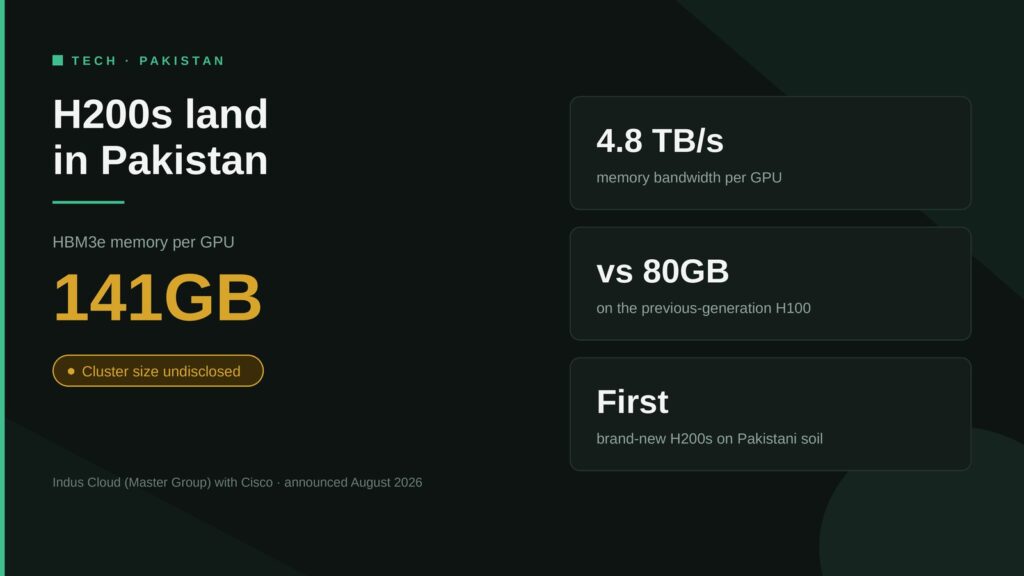
For the first time, brand-new NVIDIA H200 Tensor Core GPUs are running on Pakistani soil.
Indus Cloud, the enterprise cloud arm of Master Group of Industries, has launched what it says is the country’s first Cisco AI GPU cluster built around the H200 — a deployment that puts frontier-class accelerated computing inside Pakistan’s borders rather than several thousand kilometres away in a foreign data centre.
The announcement is a press release, and press releases deserve scepticism. But the underlying hardware question is real, and it has been a genuine bottleneck for anyone in Pakistan trying to do serious AI work.
The problem this is meant to solve
Until now, a Pakistani startup training a model, a university lab running experiments, or a bank building an internal AI system had essentially one option: rent compute from an overseas hyperscaler.
That arrangement carries three costs that do not show up on the invoice:
Latency. Every training run, every inference call, every dataset transfer crosses international links. For interactive workloads, the round trip is felt.
Data sovereignty. Sensitive data — patient records, financial transactions, government datasets — has to physically leave the country to be processed. For regulated sectors, that is frequently a hard stop rather than an inconvenience.
Compliance and cost. Foreign cloud billing is dollar-denominated, which in a market with persistent currency pressure makes budgeting difficult. Procurement rules at public-sector institutions often complicate offshore hosting further.
Indus Cloud is positioning the H200 cluster as the answer to all three. The stated audience is broad: researchers, enterprises, startups, universities and government organisations.
What the H200 actually brings
The H200 is NVIDIA’s successor to the H100, and its headline advantage is memory. It carries 141GB of HBM3e with roughly 4.8TB/s of bandwidth — a substantial jump over the H100’s 80GB.
That specification matters more than raw compute for the workloads Pakistan is likely to run. Large language model inference is memory-bandwidth-bound far more often than it is compute-bound. More on-chip memory means larger models fit without splitting across multiple GPUs, and inference throughput improves without adding hardware.
Per the announcement, the platform is built for LLMs, generative AI, model training and fine-tuning, high-performance inference, computer vision and advanced analytics — hosted on Cisco’s AI-ready infrastructure, which supplies the networking and orchestration layer that keeps GPU utilisation high across a cluster.
The networking piece is easy to overlook and expensive to get wrong. GPUs in a cluster spend a great deal of time waiting on each other. Interconnect quality frequently determines whether a deployment delivers close to its theoretical throughput or a fraction of it.
What the companies are saying
Shahzad Malik, Managing Director of Master Group of Industries, framed the investment in terms of participation rather than consumption — arguing that Pakistan needs to build the digital infrastructure required to take part in the AI transformation instead of merely buying its outputs, and describing the cluster as a step toward sovereign AI capability.
Rumman Dar, CEO of Indus Cloud, positioned the launch as removing a barrier rather than simply adding capacity, saying the goal is to make enterprise-grade AI infrastructure locally accessible so Pakistani organisations can innovate while keeping data and workloads inside the country.
Kashif ul Haq, Country Manager for Cisco Pakistan, described the deployment as demonstrating how AI-ready infrastructure combined with NVIDIA GPUs can support innovation across the market.
Indus Cloud also describes itself as renewable-powered — worth noting given that AI data centres are energy-intensive and Pakistan’s grid economics are strained. Whether the renewable claim covers the full load or a portion of it is not specified in the announcement.
The questions the announcement leaves open
A few things will determine whether this is infrastructure or a headline:
- Cluster size. The number of H200s deployed has not been disclosed. Eight GPUs and eight hundred are very different propositions.
- Pricing. Local availability only matters if the hourly rate is competitive with overseas alternatives after accounting for the friction it removes.
- Access model. Whether university researchers and early-stage startups get meaningful access, or whether capacity is effectively reserved for large enterprise contracts.
- Power reliability. Sustained AI training requires uninterrupted power. Backup architecture and uptime commitments matter enormously here.
The wider context
The launch fits into a broader push. The federal government has been advancing a national AI initiative — with hardware procurement including laptops and display infrastructure — alongside data centre investment and the Pakistan Venture Fund announced earlier this year to support technology startups.
Pakistan has also been climbing global responsible-AI rankings, and the country’s IT and ITeS exports have continued growing, with services exports up 19% in FY26.
Compute has been the missing input. A capable engineering base, improving policy attention and export momentum are all in place; the hardware to train and serve models domestically has not been. This deployment is the first serious attempt to close that gap.
Whether it becomes the foundation of a local AI industry or a well-appointed facility running below capacity depends almost entirely on what gets built on it over the next eighteen months.
FAQs
What is the NVIDIA H200?
NVIDIA’s Tensor Core GPU designed for AI workloads, featuring 141GB of HBM3e memory and roughly 4.8TB/s bandwidth — a significant upgrade over the H100 for large language model work.
Who launched Pakistan’s first AI GPU cluster?
Indus Cloud, the enterprise cloud business of Master Group of Industries, in partnership with Cisco.
Why does local AI compute matter for Pakistan?
It removes latency from international links, keeps sensitive data inside national borders for compliance purposes, and reduces dependence on dollar-denominated foreign cloud billing.
Can startups and universities use this cluster?
Indus Cloud has stated that researchers, startups, universities, enterprises and government bodies are all intended users. Specific pricing and access terms have not been published.
How many H200 GPUs are in the cluster?
The company has not disclosed the cluster size.


2 Comments
[…] Related: Pakistan Just Got Its First NVIDIA H200 GPU Cluster. Here’s Why That Matters. […]
[…] Related: Pakistan Just Got Its First NVIDIA H200 GPU Cluster. Here’s Why That Matters. […]
Comments are closed.