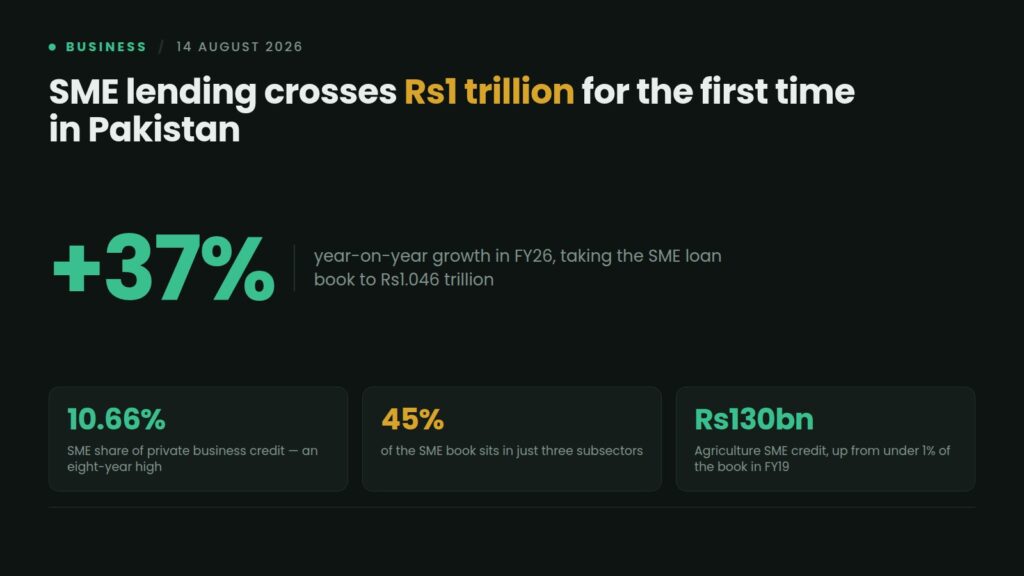
Lending to small and medium enterprises in Pakistan crossed Rs1 trillion for the first time in FY26, reaching Rs1.046 trillion — a jump of 37 percent in a single year.
For a segment that has been the perennial disappointment of Pakistani banking, that is a genuine milestone. SME loans now account for 10.66 percent of total private business credit, up 1.8 percentage points from FY25 and the highest share in at least eight years.
The State Bank’s National Financial Inclusion Strategy (NFIS) 2024-2028 had set a target of 10 percent by FY28. It has been cleared two years early.
The number underneath the milestone is more interesting than the milestone itself.
The trend genuinely reversed
Over five years, SME lending compounded at 17 percent a year, against 10 percent for non-SME business loans.
That average conceals a switch in the middle. Between FY21 and FY23, non-SME lending grew at an 11.1 percent CAGR — close to twice the pace of the SME book. Over the three years since, the ranking flipped.
The timing is not accidental. The earlier period covers the high-rate, high-yield window in which banks could park deposits in government paper and earn a risk-free return well above 20 percent. Lending to a Faisalabad textile unit with no audited accounts made no commercial sense in that environment. As policy rates came down, that trade stopped paying — and banks went looking for yield in the places they had been ignoring.
SME growth of 37 percent is, in large part, the mirror image of shrinking returns on treasury bills.
Where the Rs1.046 trillion actually went
Split by broad sector:
- Services — Rs570 billion, more than half the entire SME book
- Industry — Rs346 billion, up 21 percent year-on-year
- Agriculture — Rs130 billion, compounding at 62 percent a year over five years
The agriculture line is the standout. SME agricultural credit was under 1 percent of the book in FY19 and is 12 percent by FY26. In a country where farm output drives roughly a quarter of employment and most of the raw material for its largest export industry, credit finally reaching the sector is the most consequential shift in this data.
Industry’s 21 percent growth is respectable but trails the 37 percent headline. Manufacturing SMEs — the units that hire in volume and feed export supply chains — are still growing slower than the segment as a whole.
The concentration problem
Of 79 reported subsectors, only 15 carry an SME book above Rs10 billion. Three of them hold 45 percent of all outstanding SME credit:
- Retail trade — Rs178 billion
- Wholesale trade — Rs164 billion
- Crop and animal production — Rs130 billion
Two of the top three are trading rather than production. Trade finance is the easiest SME lending a bank can do: short tenors, visible stock as collateral, quick turnover, minimal underwriting judgement. It is useful working capital. It does not build a factory, add a production line, or create the kind of employment that shifts an economy.
Sixty-four subsectors sitting below Rs10 billion is the more telling statistic. Whole categories of Pakistani small business — light engineering, food processing, logistics, specialised services — remain effectively outside the formal credit system.
A target beaten, and a target quietly abandoned
Here is the context that reframes the achievement.
The previous edition of the NFIS set a goal of SME loans reaching 17 percent of private sector credit by FY23. That target was missed. The current edition set 10 percent by FY28 — a lower number, on a longer timeline.
So the celebration is for beating a goal that was reduced after the earlier one proved unreachable. Judged against what the State Bank originally thought Pakistan should achieve, 10.66 percent in FY26 is still well short of 17 percent three years ago.
Regional comparison sharpens the point further. SME lending shares in the high teens and above are unremarkable across much of emerging Asia. Pakistan is not catching up so much as stopping the slide.
What to watch next
Three things will determine whether FY26 was a turn or a blip.
Asset quality. A 37 percent expansion in one year in a segment banks historically avoided will be tested. SME non-performing loans have run far above the system average in Pakistan. The FY27 and FY28 NPL series is where the real verdict lands.
Rate sensitivity. If this growth was driven by the collapse in risk-free yields rather than by better credit infrastructure, the next tightening cycle will reverse it. Banks that entered SME lending for want of alternatives will leave when alternatives return.
Composition. Whether the mix keeps tilting toward trade finance, or starts reaching manufacturing and processing, decides whether this is credit that funds inventory or credit that funds capacity.
Rs1 trillion is a number worth marking. It is a floor to build from, not a finish line.
Related: Rs160 Billion in Tariff Cuts Bought $1.27 Billion in Exports. Was It Worth It?
2 Comments
[…] Related: SME Lending Crossed Rs1 Trillion for the First Time. Three Sectors Took Nearly Half. […]
[…] Related: SME Lending Crossed Rs1 Trillion for the First Time. Three Sectors Took Nearly Half. […]
Comments are closed.