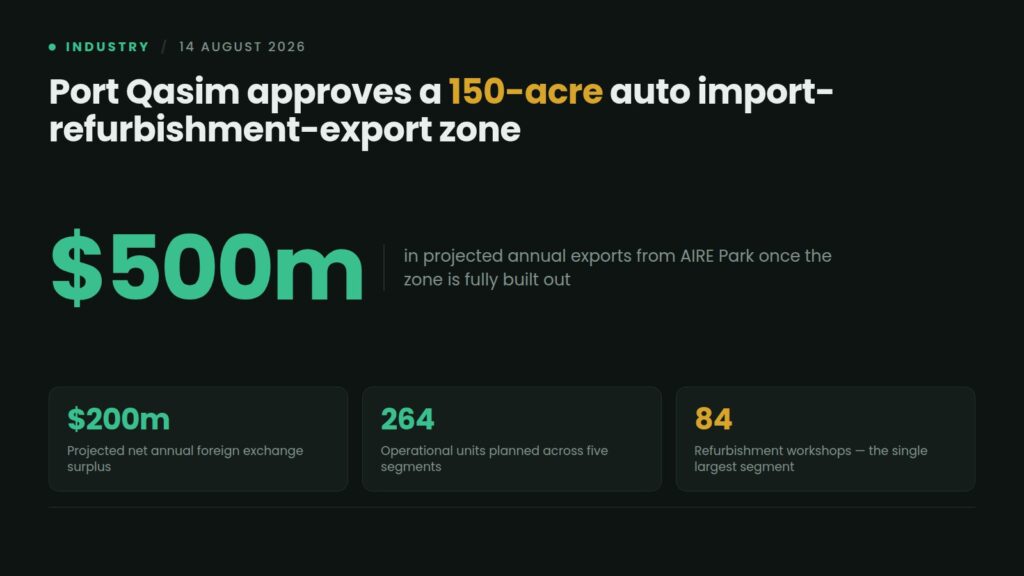
The Port Qasim Authority board has approved a 150-acre auto processing zone at Karachi’s Port Qasim, designed to bring vehicle import, refurbishment, display and re-export into a single site at the quayside.
The project is called AIRE Park — Auto Import, Refurbishment and Export — and it is Pakistan’s first attempt at a dedicated integrated automotive trade platform. The decision was taken at a PQA board meeting on 12 August 2026, announced by Federal Minister for Maritime Affairs Muhammad Junaid Anwar Chaudhry.
The projections attached to it are ambitious: roughly $500 million in annual exports and a net foreign exchange surplus of about $200 million a year once the zone is fully operational.
What is actually being built
The site is planned for 264 operational units across five segments:
- 84 refurbishment workshops
- 70 auto spare-parts units
- 60 vehicle display units
- 30 commercial units
- 20 machinery yards
The composition tells you what the zone is for. Refurbishment workshops and parts units together make up 154 of 264 units — nearly 60 percent. This is not an assembly plant and it is not a manufacturing cluster. It is an industrial-scale reconditioning operation.
The business model is straightforward: import used vehicles and machinery, restore them inside a bonded port-side facility, and ship them onward to markets where restored stock sells. Port Qasim’s position on the Arabian Sea corridor puts the Gulf and East Africa within short shipping reach — both markets with established demand for reconditioned vehicles at prices new units cannot meet.
PQA Chairman Rear Admiral (Retd) Syed Moazzam Ilyas said the phased approach would allow the project to expand according to market demand — sensible language for a project whose demand curve is not yet proven.
The gap between the two headline numbers
Two figures are being quoted: $500 million of annual exports and a $200 million net foreign exchange surplus.
The difference between them is the point. A gap of roughly $300 million represents what has to be imported to generate the exports — the vehicles themselves, plus parts, consumables and equipment. The zone earns on the value added inside the fence, not on the vehicles.
Which means the margin is roughly 40 percent of gross export value. For a refurbishment operation — labour, parts, paint, certification — that is optimistic but not absurd. It does, however, depend entirely on two things holding: that the imported units clear at low cost, and that finished stock actually sells abroad rather than leaking into the domestic market.
That second condition is the whole project. Pakistan’s used-vehicle market is chronically supply-constrained and price-inflated. A bonded facility sitting on 150 acres of refurbished stock will face continuous commercial pressure to sell locally. Whether AIRE Park delivers foreign exchange or simply becomes a new import channel depends on customs enforcement, not on the master plan.
Why a port-side location matters
The stated rationale is reducing inland logistics costs, and in Pakistan that is not a minor line item.
Under the present arrangement, an imported vehicle clears at the port, moves inland by trailer to a workshop, and — if it is going back out — returns to the port. Every leg adds trucking cost, transit time, handling damage risk and documentation. Collapsing all of it into one bonded site removes those legs entirely.
The wider case for it was made unusually vividly this month. Pakistani exporters spent much of August dealing with a nationwide goods transport stoppage that idled hundreds of thousands of trucks and threatened order books. A facility that does not need inland trucking to function is insulated from precisely that class of disruption.
It fits a policy shift already under way
The approval lands a day after the government publicly called on the automotive sector to make a fundamental shift toward exports rather than serving a protected domestic market.
That is a hard turn to execute. Pakistan’s assembly industry was built behind tariff walls to substitute imports, not to compete abroad. Localisation is shallow, volumes are small by regional standards, and unit costs reflect both.
Refurbishment is a plausible way in. It needs skilled labour rather than deep supplier ecosystems, it trades on cost advantage rather than brand, and it can reach export scale without waiting for a domestic parts industry to mature. If AIRE Park works, it creates trained technicians, a parts supply chain and export documentation experience — the inputs a real automotive export sector would need later.
The unanswered questions
No investment figure has been disclosed. No completion timeline has been given beyond “phased.” No developer or anchor operator has been named, and there is no indication of whether the units will be built by PQA, by private developers, or through a concession.
Pakistan has a long record of announced industrial zones that cleared board approval and then stalled at land allotment. The details that determine whether this one is different — who funds it, who runs it, when phase one opens, and what the customs regime looks like — are all still missing.
The concept is sound and the location is right. Phase one breaking ground is the moment to take the $500 million seriously.
Related: 400,000 Trucks Are Parked. Pakistan’s Factories and Export Orders Are Next.
2 Comments
[…] Related: Port Qasim Is Getting a 150-Acre Auto Zone. The Target Is $500 Million in Exports. […]
[…] Related: Port Qasim Is Getting a 150-Acre Auto Zone. The Target Is $500 Million in Exports. […]