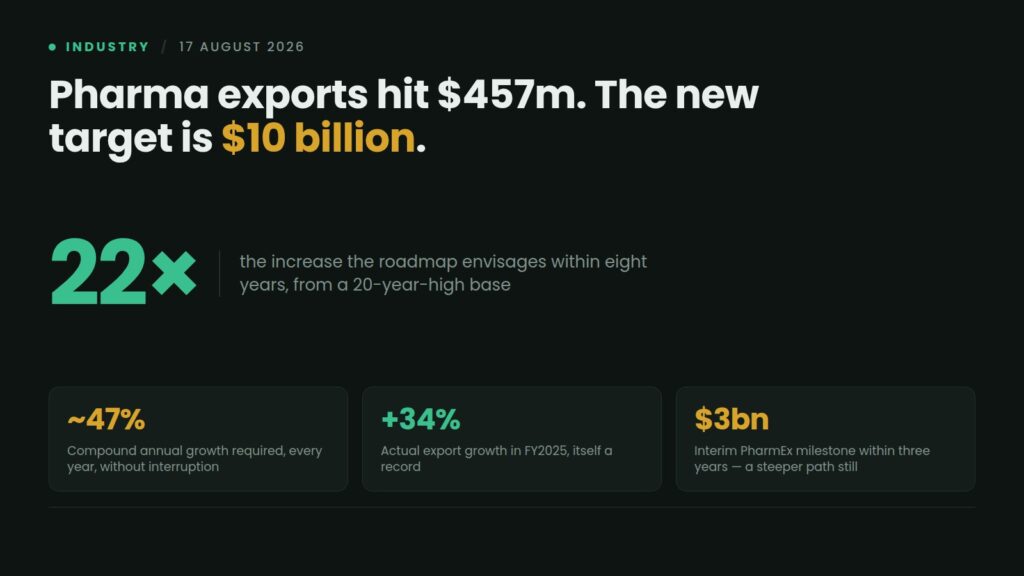
Pakistan’s pharmaceutical exports reached $457 million in FY2025 — a 20-year high, and 34 percent up on the year before.
The government’s new roadmap targets $10 billion within eight years.
That is a 22-fold increase. Planning Minister Ahsan Iqbal, who chaired the roundtable where the roadmap was presented, framed the question directly: whether Pakistan can become a pharmaceutical hub of the world in the next ten years.
It is worth taking the target seriously enough to work out what would have to be true.
The arithmetic of 22x
Going from $457 million to $10 billion in eight years requires compound annual growth of roughly 47 percent, sustained every year without interruption.
Last year’s 34 percent was itself a record, achieved from a small base after a long period of stagnation. Holding 47 percent for eight consecutive years, on a base that grows larger each year, is not a stretch target. It is a different category of claim.
The roadmap does contain intermediate steps, and they are more revealing than the headline: an industry target of $2 billion, and $3 billion within three years through a PharmEx initiative.
Even $3 billion in three years implies roughly 87 percent annual growth. The interim milestones are not a gentler path to the destination — they are steeper.
What actually limits pharmaceutical exports
The constraint on selling medicine abroad is not manufacturing capacity or price. It is regulatory approval, and it is slow by design.
Every destination market has its own authority, and each requires the manufacturing site itself to be inspected and approved, not just the product. Selling into regulated markets means clearing the relevant regulator’s Good Manufacturing Practice standard — the US FDA, the EMA in Europe, or a comparable authority. Site approval typically takes years and substantial capital investment to upgrade facilities to the required standard.
There is a second gate above the first. A country’s own drug regulator must be recognised internationally for its oversight to count for anything abroad — which is why the maturity level of the Drug Regulatory Authority of Pakistan is the binding constraint on the whole ambition. Exporters cannot outrun the credibility of the regulator that certifies them.
India’s pharmaceutical export industry, the standard comparison, was built over roughly three decades on exactly this foundation: a large base of internationally-approved manufacturing sites, and a regulator whose certification other authorities accept. It is not a target that was hit by announcing one.
Where Pakistan currently sells
The composition of that $457 million matters as much as the number.
Pakistani pharmaceutical exports go predominantly to markets with lighter regulatory requirements — Afghanistan, parts of Central Asia, Africa and Southeast Asia. These are real markets and the growth in them is real. They are also markets with limited absorption capacity and thin margins, and they are contested by Indian, Chinese and Bangladeshi manufacturers with established positions.
There is no plausible path from lightly-regulated markets to $10 billion. That number requires selling into the US, Europe and Japan, which requires the approvals described above, which requires years of preparation that has to start before the target is announced rather than after.
The domestic pricing problem nobody raised
There is a structural issue the roadmap discussion did not appear to address.
Pakistan controls the retail price of medicines domestically, for entirely defensible public health reasons. Price control compresses manufacturer margins, and compressed margins limit the capital available for the facility upgrades that international approval requires.
A manufacturer earning thin regulated margins at home cannot easily fund a multi-year, capital-intensive upgrade programme aimed at a market it does not yet serve. That tension between affordable domestic medicine and export-grade manufacturing is the central policy problem, and it will not be resolved by a coordination framework.
What is actually good here
Setting aside the headline number, the underlying direction is sound.
Pharmaceuticals are a genuinely attractive export category for Pakistan: high value per kilogram, so freight costs barely matter; skilled employment; an existing manufacturing base serving a large domestic market; and no dependence on the cotton crop or on energy-intensive processing. Compared with adding another percentage point to textile exports, it is a better use of policy attention.
The stated agenda — removing regulatory, administrative, financing and market-access barriers, and building domestic and international value chains — is the right list. The industry is running a month-long consultation to produce a detailed roadmap with the Planning Ministry, which is the correct next step.
Announce $10 billion and the target becomes the story; miss it and the whole effort is written off as another failed plan. Announce that Pakistan will get twenty manufacturing sites approved by a stringent regulator within five years, and you have set a goal that is measurable, achievable, and actually load-bearing for everything above it.
Related: Rs160 Billion in Tariff Cuts Bought $1.27 Billion in Exports. Was It Worth It?

One comment
[…] Related: Pharma Exports Hit $457 Million. The New Target Is $10 Billion. […]
Comments are closed.