Every winter Punjab burns. Farmers set fire to millions of tonnes of crop residue because clearing a field for the next planting is faster and cheaper than removing the stalks, and the smoke that results is a substantial contributor to the smog season.
A project now moving to commercial scale proposes to buy that waste instead.
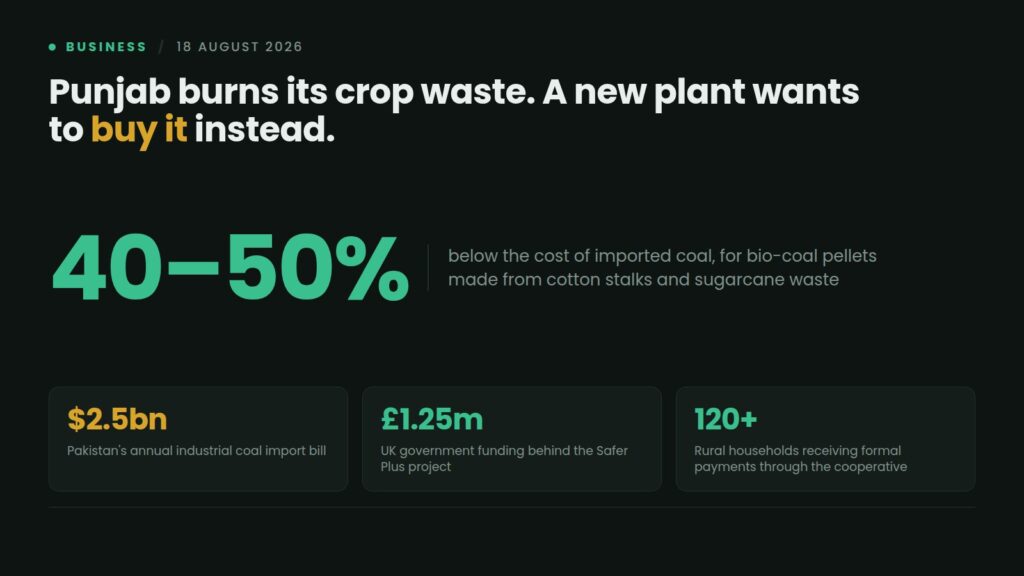
The Safer Plus project, led by Northumbria University’s School of Engineering, Physics and Mathematics with close to £1.25 million in UK government funding, is building Pakistan’s first full-scale plant to convert cotton stalks and sugarcane waste into bio-coal pellets.
The economics are the interesting part
The technology is torrefaction — heating biomass in a low-oxygen environment until it densifies into something that behaves like coal in an industrial boiler. It is well established. What makes this worth watching is the price.
The bio-coal is claimed to land 40 to 50 percent below imported coal. Pakistan spends over $2.5 billion a year importing coal for industrial use.
That framing matters more than the environmental one. A textile mill does not switch fuel to reduce smog. It switches to cut its energy bill, and to stop paying for a dollar-denominated input in a country with persistent currency pressure. Three Pakistani textile manufacturers have signed letters of commitment to test the bio-coal as boiler fuel — which is the correct sequence. Commitment to test is not a purchase order, but it is the step that has to come first.
If the fuel performs, the substitution logic is compelling on its own terms. Every tonne of domestic bio-coal displacing imported coal is foreign exchange retained, in the country’s largest export industry, on an input whose price Pakistan does not control.
Why the collection side is the hard part
Torrefaction plants are not difficult to build. Feeding one reliably is a different problem.
Crop residue is bulky, low in density and expensive to move relative to its value — the reason burning it in place is rational for the farmer in the first place. A plant needs a continuous supply aggregated from thousands of smallholdings, harvested in a narrow seasonal window, then stored dry until it is processed.
The project’s answer is a women-led biomass cooperative to collect and supply the waste, with more than 120 rural households receiving formal payments.
That is the genuinely novel component, and it inverts the farmer’s incentive completely. Residue currently costs money or labour to dispose of. Turning it into something with a buyer converts a disposal cost into farm income — which is the only mechanism that reliably stops the burning. Fines and bans have been tried across the region for years against a practice that is economically rational; paying for the waste is not.
“Formal payments” is doing quiet work in that sentence too. A documented payment to a rural household, through a cooperative, is a financial record where none existed — which is the entry point to credit for people the banking system has never seen.
The scale problem
Now the caution, and it is substantial.
£1.25 million is a research-to-commercialisation grant, not industrial capital. One plant supplied by 120 households is a demonstration. Punjab burns millions of tonnes of residue annually, and Pakistan’s $2.5 billion coal import bill represents a volume of fuel that a facility of this size cannot approach.
No capacity figure has been disclosed, which makes it impossible to say what share of anything this displaces. On the numbers available, the honest description is a pilot at commercial scale rather than a commercial solution — six years of research finally being tested against a real boiler and a real supply chain.
That is a meaningful milestone. It is not a smog policy.
Why textile mills are the right first customer
The choice of buyer is not incidental. Textile processing runs on steam, steam comes from boilers, and boiler fuel is one of the largest controllable costs in a spinning or dyeing operation.
Pakistani mills have spent three years absorbing energy costs that moved against them from every direction at once — gas tariffs, electricity tariffs, and a rupee that made every imported tonne of coal more expensive in local terms. Anything that takes 40 to 50 percent off that line gets a serious hearing.
There is a second reason, less about cost. Textiles are Pakistan’s largest export industry, and its principal customers are European and North American buyers who increasingly ask suppliers to document the carbon intensity of what they sell. A mill burning agricultural residue instead of imported coal has a materially better answer to that question than one that does not — which may eventually matter more to the order book than the fuel saving does to the margin.
What determines whether it replicates
Three things, none of them technical.
Whether the boiler trials pass. Bio-coal has different combustion characteristics, ash content and handling requirements than imported coal. A mill will not risk unplanned downtime on its main boiler for a cost saving until the fuel is proven over a full season.
Whether the collection model survives without grant funding. The cooperative is currently supported by a UK research budget. The test is whether the price a mill pays for bio-coal covers collection, transport, processing and a margin for the farmer, unsubsidised.
Whether anyone funds the second plant. This one exists because a British university won a grant. Replication across Punjab requires Pakistani industrial capital deciding the returns work — and that decision gets made on the first plant’s operating data, not on its press coverage.
A fuel that is cheaper than the imported alternative, made from a waste product that is currently set on fire, in a country that burns dollars to buy coal. If the arithmetic holds outside the pilot, the case builds itself.
Related: Circular Debt Grew Rs364 Billion. A Rs98 Billion Budget Cut Explains Part of It.