Google opened its Pakistan office in Islamabad on Tuesday, inaugurated by Prime Minister Shehbaz Sharif, with Google Vice President for Global Affairs Wilson L. White and US Chargé d’Affaires Natalie Baker in attendance.
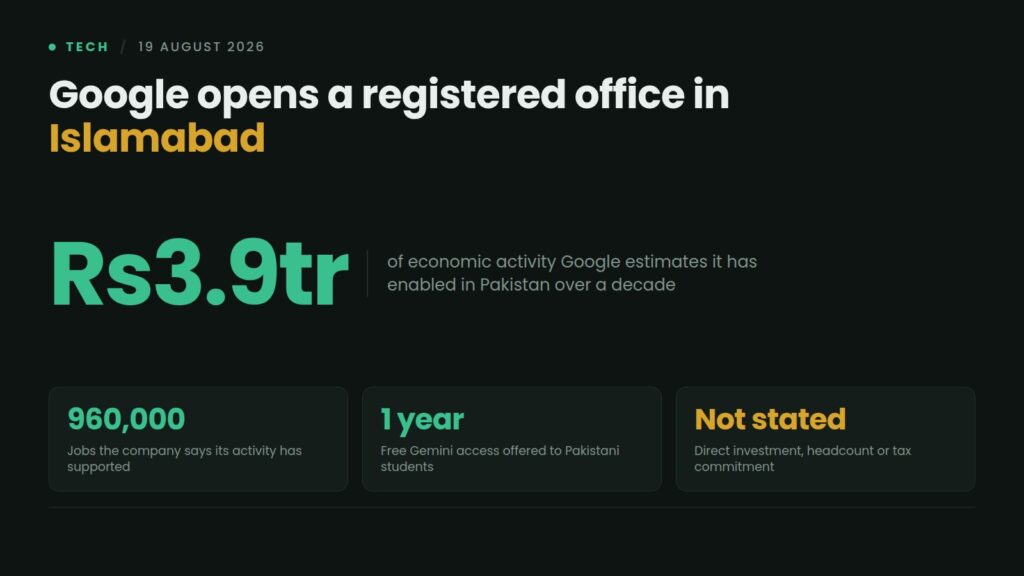
White called it a major milestone after more than a decade of investment and engagement in Pakistan. The company’s own estimate of that decade: over Rs3.9 trillion in economic activity enabled and more than 960,000 jobs supported, with over a million Pakistanis trained.
Google has been commercially active in Pakistan for years without a registered office. What changed on Tuesday is legal presence, and that is a narrower thing than the ceremony suggested — which does not make it unimportant.
What a registered office actually changes
Until now, Pakistani advertisers buying Google ads were transacting with an entity outside Pakistan. Revenue earned from Pakistani businesses was booked elsewhere, and the tax treatment ran through withholding arrangements on cross-border digital services rather than through a domestic corporate return.
A local entity changes that. It gives the company a Pakistani tax registration, a domestic bank relationship, the ability to employ people directly on local contracts, and a legal address at which it can be served. For the FBR, a taxpayer with a physical presence is a fundamentally different proposition from a foreign platform invoicing from abroad.
It matters in the other direction too. A company with staff and assets in a jurisdiction is exposed to that jurisdiction’s regulators in a way a remote entity is not. Content directions, data requests and service suspensions all land differently when there are employees in Islamabad rather than a compliance team in Singapore.
That exposure is precisely why large platforms have historically been cautious about registering in markets with a record of internet restrictions. Google accepting it is the substantive signal in this announcement.
The Rs3.9 trillion figure needs handling
Rs3.9 trillion of economic activity and 960,000 jobs over a decade are large numbers, and they are the company’s own estimates of enabled activity rather than anything it invested or paid.
Economic impact studies of this kind typically count the value generated by everyone using a platform — businesses advertising, developers publishing apps, creators earning on video, freelancers finding clients through search. It is a real category of value. It is also a methodology that attributes to the platform a share of activity that would exist in some form regardless.
The number worth asking for is different and was not given: how much Google will invest directly, how many people it will employ in Pakistan, and what it will pay in Pakistani tax now that it has a registered entity. None of the three appeared in the announcement.
The commitments that were made
Three were stated, and they differ sharply in how concrete they are.
Gemini free to Pakistani students for one year. The most immediately real of the three, and genuinely useful — access to a frontier model is otherwise a dollar subscription in a market where that is a meaningful barrier. It is also a twelve-month promotional term, and the interesting question is the price at the end of it. A cohort that has built a year of coursework habits around a tool is not a neutral customer when the trial expires.
Over a million Pakistanis trained. Stated as an achievement rather than a forward commitment. Training programmes of this kind are usually online certification courses, which are worth something but are not the same as employment.
Support for IT exports through investment in people, hardware manufacturing and local businesses. The vaguest, and the one containing the most interesting word. “Hardware manufacturing” from Google in Pakistan would be a significant departure — but with no figure, no site and no timeline attached, it is an aspiration recorded at a ribbon-cutting.
Why now
The timing sits inside a broader pattern rather than standing alone.
Pakistan’s IT exports have been the fastest-growing category in its export mix. Digital payments infrastructure has changed more in three years than in the previous twenty. The government is midway through a World Bank-funded review of every digital institution it operates. The US Chargé d’Affaires attending a corporate office opening indicates this was read on both sides as more than a commercial formality.
For a market of 250 million people, overwhelmingly young, with internet penetration still climbing, the commercial logic needs no elaborate explanation. The constraint was never the size of the opportunity.
What would make it real
Three markers, over the next year.
Headcount. A sales office is a handful of account managers. An engineering presence is a different order of commitment and the one that would signal Pakistan is being treated as a place to build rather than only to sell.
Tax disclosure. A registered entity files returns. What Google pays in Pakistani corporate tax will be a matter of record, and it is the cleanest measure of what localisation is worth to the exchequer.
Behaviour under pressure. The first content or access dispute after registration is the real test. A company with local staff has more to lose from non-compliance and more to lose from compliance. How it navigates that will tell Pakistani users more about what changed on Tuesday than any impact figure.
Related: Pakistan Is Reviewing Eleven Digital Institutions at Once. One of Them Is the Regulator.