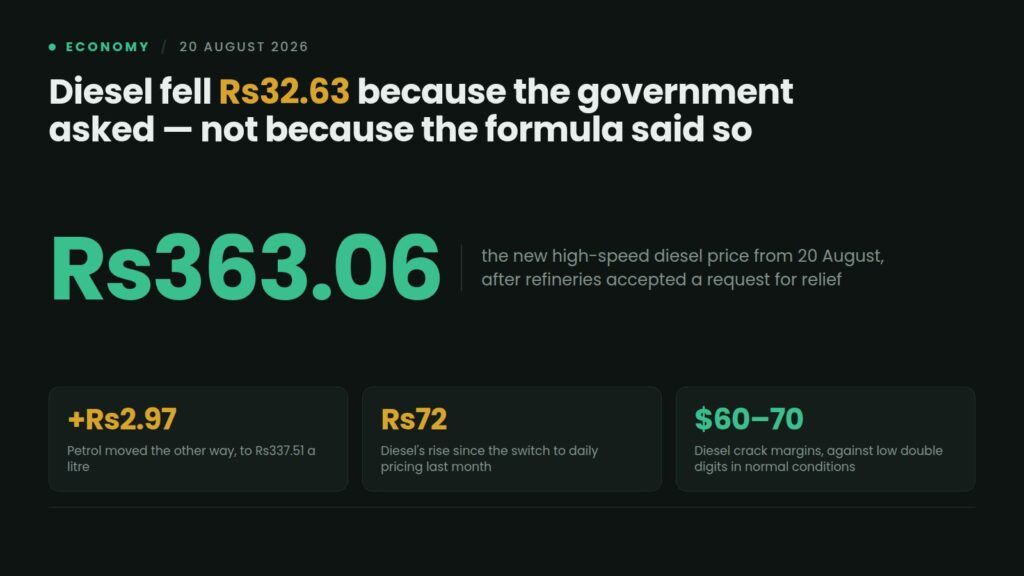
High-speed diesel fell Rs32.63 per litre from 20 August, taking the pump price to Rs363.06. Petrol went the other way, up Rs2.97 to Rs337.51.
The cut did not come from the pricing formula. Petroleum Minister Ali Pervez Malik said refineries had accepted a government request to reduce diesel prices, with Prime Minister Shehbaz Sharif personally directing the negotiations.
That distinction is the whole story. This was not a calculation. It was an ask.
Why diesel had run away
Diesel had risen Rs72 per litre since the government moved from weekly to daily pricing last month.
The cause sits outside Pakistan. The minister pointed to diesel crack margins — the gap between the price of crude and the price of the refined product made from it — reaching $60 to $70. That is an extreme reading. In normal conditions diesel cracks run in the low teens.
A crack margin at that level means the world is short of diesel specifically, not short of oil. Middle East tensions and the US-Iran situation have disrupted refined product flows more than crude supply, and even oil-producing countries have faced constraints on the refined side.
Pakistan imports both crude and finished diesel. When cracks blow out, the imported cost of diesel rises faster than the crude price, and a formula that passes through import parity delivers exactly what it delivered: Rs72 in a matter of weeks.
Who was hurting
The government named the affected groups directly — farmers, transporters and public transit operators — and that list explains the urgency better than the price does.
Diesel is not a consumer fuel in Pakistan. It is an input cost. It runs tube wells, tractors, buses and the entire road freight network on which imports, exports and domestic distribution depend. A Rs72 increase does not land on motorists; it lands on the price of moving everything.
The political arithmetic was also unavoidable. The government spent the past fortnight negotiating with goods transporters who kept thousands of vehicles off the roads for over a week, and settled a fuel dealers’ dispute with a margin increase that takes effect on 1 September. Adding Rs72 of diesel cost on top of an unresolved freight dispute was not a survivable position.
Somebody is paying for this
Here is what has not been explained.
A Rs32.63 reduction that comes from refineries accepting a request rather than from the formula means refineries are absorbing a margin they would otherwise have earned. The scale is substantial: on national diesel consumption, Rs32.63 a litre is a transfer measured in billions of rupees a month.
The timing makes it more pointed. These are the same five refineries that this week committed $4.5 to $5 billion to upgrade projects, with implementation agreements due within 45 days under the amended brownfield policy. Those agreements turn on tariff protection, deemed duty arrangements and pricing guarantees — all of which the government controls.
A request for price relief, made by a government that is simultaneously negotiating the terms on which those refineries commit five billion dollars, is not a request between equals. Whether anything was traded, and what, has not been disclosed.
The petrol increase is the tell
Petrol rose Rs2.97 on the same day. That is the detail worth holding onto.
If the pricing mechanism were being suspended wholesale for political relief, petrol would have been held flat or cut too — it is the fuel most private motorists actually buy. Instead petrol moved as the formula dictated while diesel was overridden.
That is a targeted intervention rather than a general one, and as targeting goes it is defensible. Diesel affects the cost of everything; petrol largely affects the cost of private travel. Choosing to intervene on the input rather than the consumption fuel is the more economically coherent choice, whatever the process.
Daily pricing is now on trial
The move from fortnightly to daily pricing was meant to transmit international prices smoothly rather than in shocks, which is the right principle. Smaller, more frequent adjustments are easier for businesses to absorb than large periodic jumps.
The first serious test produced Rs72 of cumulative increase and then a negotiated Rs32.63 reversal. What that demonstrates is not that daily pricing failed, but that Pakistan will not tolerate the outcome when the mechanism transmits a genuine global shock.
A pricing formula that is overridden by ministerial request the moment its output becomes politically difficult is not really a formula. Refineries pricing their next investment decision will have noticed — and they have 45 days to sign.
Related: Five Refineries, $5 Billion, 45 Days to Sign. The Target Is Zero Furnace Oil.