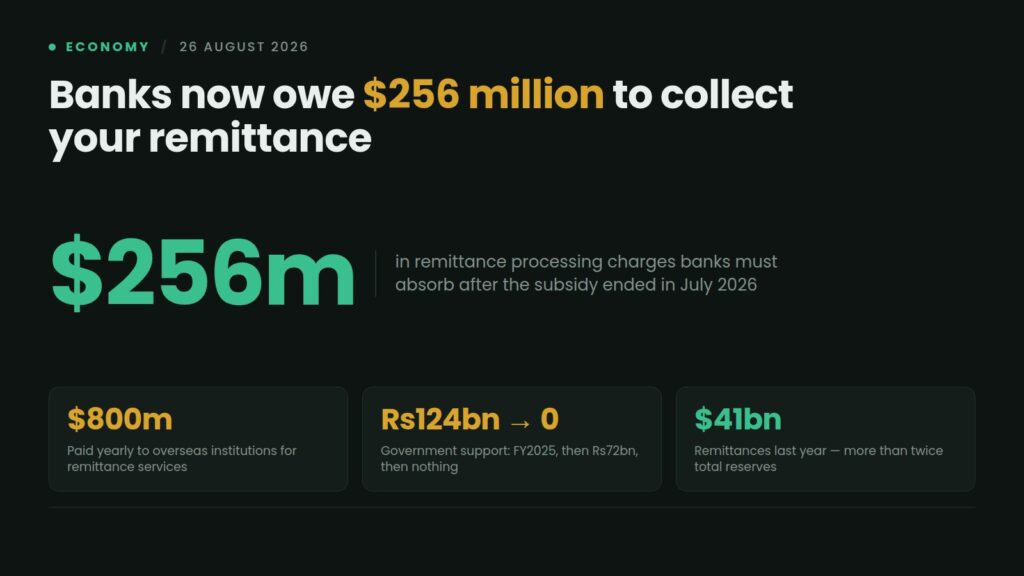
Pakistani banks will absorb roughly $256 million in remittance processing charges this financial year, after the government ended the scheme that used to reimburse them in July 2026.
State Bank Deputy Governor Dr Inayat Hussain put a warning alongside the figure: if banks do not absorb the cost, the charges could eventually be passed on to the people sending money to Pakistan.
That sentence deserves more attention than it has received, because of what sits on the other side of it.
What the money was for
Remittances do not move themselves. A worker in Riyadh or Dubai hands money to an exchange house or a correspondent bank, which routes it through the international banking system to a Pakistani bank, which credits a recipient’s account. Every institution in that chain charges for the service.
Pakistani banks have historically paid around $800 million a year to overseas financial institutions for those services. The government reimbursed a large share of it — Rs124 billion in FY2025 and Rs72 billion the following year.
The logic was straightforward. Subsidising the cost let banks offer free or near-free transfers, which kept remittances flowing through channels the state can see, count and hold as reserves. It was not generosity; it was a payment to keep the formal system competitive.
The falling allocation — Rs124 billion to Rs72 billion to zero — tracks the fiscal consolidation that produced FY26’s 2.6 percent deficit. This is one of the line items that got cut to get there.
What is at stake is not $256 million
Remittances exceeded $41 billion last year and are forecast at $44 billion. Against Pakistan’s foreign exchange reserves of $18.4 billion, overseas Pakistanis send home more than twice the country’s entire external buffer every year.
Set the saving against the flow it protects. The government has removed a subsidy costing a few hundred million dollars from the mechanism that delivers forty billion.
The risk is not that remittances stop. It is that a fraction of them move channel.
The competing channel is always available
Informal transfer networks have operated across this corridor for generations. They are fast, they require no documentation, they often quote a better rate, and they are unaffected by anything the State Bank does to bank charges.
The formal system’s advantage has been price and convenience — built deliberately, over years, through exactly the kind of subsidy that has just been withdrawn. Remove it, let banks recover $256 million from customers, and the calculation facing a worker sending $300 home changes at the margin.
The sums involved per transaction are small. So is the difference that historically moves this behaviour. Pakistan spent a decade and considerable money bringing remittances into formal channels precisely because the informal alternative is so easy to reach.
A shift of even a few percent of a $44 billion flow out of the banking system is a larger number than the subsidy that was saved.
Banks are unlikely to eat it quietly
The deputy governor’s framing puts the choice on the banks, and the honest reading is that it is not much of a choice.
$256 million is a real cost against sector profitability, and Pakistani banks have spent three years in an unusually comfortable position — funding the government at high yields with minimal risk. That trade has been closing as rates fall, which is why consumer and SME lending has grown so fast this year. Absorbing a new nine-figure cost into a normalising margin is not something a listed bank does without pressure.
What is more likely is partial pass-through, applied where it is least visible: worse exchange rates on conversion rather than an explicit fee, or charges concentrated on smaller transfers where the fixed cost per transaction bites hardest.
Smaller transfers are the ones most likely to leave.
The contradiction to resolve
This lands in the same week PVARA and the State Bank confirmed they are studying tokenised sovereign bonds aimed at the diaspora — an instrument whose entire purpose is to deepen the financial relationship between overseas Pakistanis and the formal system.
One arm of policy is building new products to attract diaspora money into regulated channels. Another has just made the existing channel more expensive to use.
Moody’s, upgrading Pakistan to B3 this week, listed heavy dependence on remittances among the structural vulnerabilities that keep the rating seven notches below investment grade. That dependence is a fact of the economy for the foreseeable future. Managing it means protecting the channel, not economising on it.
Related: Moody’s Upgraded Pakistan to B3. That Is Still Seven Notches Below Investment Grade.