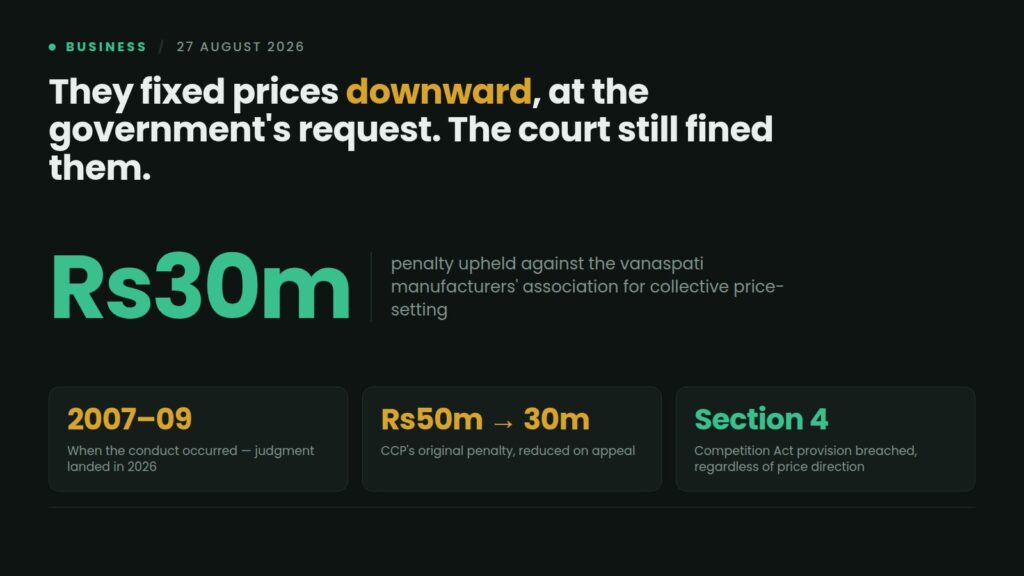
The Supreme Court has upheld a Rs30 million penalty against the Pakistan Vanaspati Manufacturers Association for collectively fixing ghee and cooking oil prices.
The detail that makes this ruling matter: the prices the association negotiated were lower, and the government asked for them.
What actually happened
Between 2007 and 2009, the federal government approached PVMA seeking lower prices for ghee and cooking oil. The association negotiated on behalf of its member companies and communicated the agreed prices back to them.
The Competition Commission of Pakistan found that this breached Section 4 of the Competition Act and imposed Rs50 million. The Competition Appellate Tribunal reduced it to Rs30 million. A Supreme Court bench of Justice Jamal Khan Mandokhail and Justice Salahuddin Panhwar has now upheld that.
PVMA’s defence was that lower prices served the public interest. The court rejected it, holding that competing businesses must independently determine their prices based on their own commercial decisions — and that the violation lay in the collective price-setting itself, regardless of whether the resulting prices were higher or lower than the market would have produced.
Why the direction of the price is irrelevant
This is the part that looks counterintuitive and is actually the point.
Competition law does not protect low prices. It protects the mechanism that produces them. Once an industry association has established that it can convene its members, agree a number and circulate it, the machinery for coordination exists — and machinery built to lower prices in a year of political pressure works exactly as well to raise them in a year when nobody is watching.
The channel is the offence. Permit price coordination when the outcome looks benign and there is no principled place to stop.
The government’s role makes it more uncomfortable rather than less. A trade body has limited ability to refuse a request from the state, and an association told to deliver lower prices will do what PVMA did. The ruling holds that this does not create an exemption — which means the state cannot lawfully ask an industry to cartelise on its behalf, however good the motive.
Seventeen years
The conduct occurred in 2007-09. The final judgment landed in 2026.
Rs30 million on conduct that ended seventeen years ago, against companies operating in a sector whose annual import bill alone runs to roughly $4 billion, is not a deterrent in any commercial sense. Adjust for inflation over that period and the real value of the penalty is a fraction of what the CCP originally set.
A firm calculating whether to coordinate prices weighs the gain against the probability of being caught, the size of the penalty, and how long the money stays in its own hands. On this record, all three point the same way.
The precedent is worth more than the fine. A Supreme Court ruling that the public-interest defence fails is now binding on every trade association in the country, and it applies whether the coordination is initiated by members or requested by a ministry.
Which associations should be reading this
Pakistan’s economy is organised around sectoral associations that negotiate collectively with government as a matter of routine.
This month alone: the petroleum dealers’ association threatened a nationwide shutdown and secured a margin increase to Rs9.98 per litre. Goods transporters halted the movement of freight for over a week to press four demands. The auto parts association has written to the Prime Minister over tariff policy. Refineries collectively accepted a government request to cut diesel prices by Rs32.63 a litre.
Most of that is lawful. Lobbying for policy, negotiating regulated margins and making representations to ministers are all legitimate association functions, and a government-set margin is a price fixed by the state rather than by competitors.
The line this ruling draws is between asking government to set a price and members agreeing one among themselves. The diesel episode sits closer to that line than it looks — a group of competing refineries collectively accepting a common price reduction is the same structure PVMA was penalised for, distinguished mainly by the fact that the state was the counterparty rather than the convener.
What would make the CCP effective
The commission’s problem has never been legal authority. It is speed and consequence.
Penalties calculated as a share of turnover rather than a fixed rupee amount, and appeals resolved in years rather than decades, are what turn competition enforcement from a cost of doing business into a reason not to. Both require resourcing the commission and the tribunal rather than amending the statute.
The court has now said clearly what the law means. Whether that changes behaviour depends on how long the next case takes.
Related: Pakistan Spends $4 Billion on Cooking Oil. Olives Are Meant to Cut That by a Tenth.